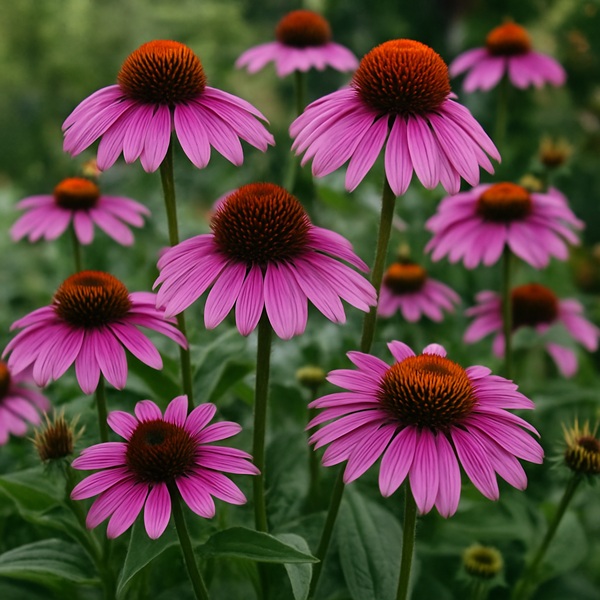
Few plants combine as many beneficial properties as echinacea. Its bright, daisy-like flower heads have long gone beyond purely decorative value: today it is firmly established as one of the medicinal crops that can be grown with ease in an ordinary garden. In Ukraine, purple coneflower (Echinacea purpurea) is especially popular, known for its pronounced immune-stimulating and anti-inflammatory properties. Under Ukrainian conditions, this plant establishes itself very well, especially in the southern and central regions, where the summer is long and sunny.
Its medicinal qualities, however, are not the only reason gardeners value echinacea. A flower bed with echinacea is always full of life: from June until the first frosts, it blooms tirelessly, attracting bees, butterflies, and bumblebees. In addition, thanks to the vertical structure of its flower heads, the plant adds volume to borders and mixed plantings. Varieties with white, pink, red, orange, and even green petals create vivid contrasts in combinations with sage, monarda, ornamental grasses, or catmint.
Echinacea is especially appealing to those who prefer a natural, relaxed style in garden design: prairie plantings, naturalistic gardens, and medicinal herb beds are its ideal setting. It also thrives without constant intervention: drought tolerance, the ability to adapt to poor soils, and resistance to pests make it a true find for the Ukrainian gardener. But for echinacea to reveal its full potential, it is important to approach both planting and дальнейший care correctly.
For echinacea, the two most important conditions are sun and drainage. With too little light, the plant becomes stretched, loses its ornamental appeal, and the flower heads grow smaller. With stagnant moisture, the root system and the base of the stem begin to rot. That is why it is best to choose open sunny sites with good air circulation, but without harsh northern winds. Partial shade is possible only in the hottest regions of Ukraine, and even then with caution.
As for the soil, it should be:
loose and well structured;
neutral or slightly alkaline (pH 6.0–7.5);
neither acidic nor waterlogged;
enriched with organic matter, but without excess nitrogen.
Sandy loam or light loamy soils are ideal. If the soil is heavy, sand and compost should be added. Before planting, it is advisable to dig the site to a depth of 25–30 cm, remove weed rhizomes, and add wood ash, which not only reduces acidity but also supplies potassium. Fresh manure is not recommended, as it stimulates excessive leaf growth at the expense of flowering.
Interestingly, echinacea can serve not only as an ornamental feature in the flower garden but also as a functional element of the landscape: it can stabilize slopes, tolerate drought, and withstand full sun without fading. Because of this, it is often used in rock gardens, borders, near trees, or alongside shrubs. The main thing is not to plant it in low-lying areas where water stands after rain: in such conditions, the root system suffers badly, especially in the humid climate of western Ukraine.
Echinacea propagation can be easily adapted to the gardener’s specific needs and preferences. Want to try growing it from seed? No problem. Need to fill a flower bed quickly? Dividing the clump will work well. In Ukraine, any method can be used, depending on the season, the region, and the purpose.
The three main methods are:
By seed. Sowing in open ground is done in April or October. Spring sowing produces seedlings within 10–14 days. Autumn sowing gives hardened young plants that emerge in spring. For seedlings, seeds are sown in February–March in a light substrate without burying them, under film or glass. Pricking out is done at the stage of 2 true leaves, and transplanting takes place in May.
By dividing the clump. This is best done in spring (March–April) or autumn (September). The clump is carefully dug up, divided into 2–3 parts with roots, and planted in a new place.
By rhizome cuttings. A less common method that requires experience and greenhouse conditions.
The seed method is ideal for large-scale propagation. Dividing the clump is a quick way to get a flowering plant as early as the following year. Cuttings are the choice of experienced growers when preserving a specific variety is important. In all cases, planting into the ground is best done in May, when stable temperatures have set in. In southern Ukraine, it can be done even earlier, depending on the weather.
Once echinacea has established itself well in the garden, it requires little effort to maintain. This is exactly why it is so highly valued: it is not demanding, rarely gets sick, and can grow with minimal intervention. Still, to extend the flowering period and achieve maximum ornamental effect, it is worth following a few basic recommendations.
Watering. Although echinacea is drought-tolerant, it needs regular moisture during very hot days or in the first month after planting. Water at the base, without wetting the leaves or flower heads. The frequency is 1–2 times a week, depending on the weather. The main thing is to avoid overwatering: it is better to water less often but more deeply, so the moisture reaches the lower soil layers.
Loosening and mulching. After rain or watering, it is worth loosening the soil to prevent crusting and ensure air reaches the roots. Mulch such as straw, wood chips, or grass helps retain moisture, suppress weeds, and improve soil structure. In the southern regions of Ukraine, mulching is especially important because it reduces water evaporation in hot weather.
Feeding. Echinacea does not need intensive fertilization. One or two feedings per season are enough. In spring, apply a nitrogen fertilizer to stimulate leaf growth; during budding, use phosphorus and potassium to improve flowering. Organic matter such as humus or compost is best added in autumn during digging.
Pruning should also be mentioned separately. Faded flower heads are best removed — this stimulates the formation of new flower stalks and keeps the plant neat. Tall varieties sometimes need staking, especially in windy or rainy weather.
Echinacea is a true champion among hardy plants. But even it can run into problems, especially in damp conditions or overcrowded plantings. The western regions of Ukraine, such as Lviv and Ivano-Frankivsk, are more at risk of fungal diseases because of rainy summers.
The most common diseases are:
Powdery mildew. A whitish coating on the leaves in late summer. The solution is treatment with fungicides such as Skor or Topaz and thinning the planting.
Gray mold. Appears when moisture stagnates, especially in cool weather. The affected parts should be removed, and the plant treated with copper-based products.
Root rot. A result of overwatering in heavy soils. It is prevented by good drainage and moderate watering.
Pests include:
Aphids. They appear in hot weather, especially in June and July. They can be controlled with a soap solution or products such as Fitoverm or Actellic.
Slugs. They feed on the lower leaves. Groza pellets, ash, or beer traps are effective.
Bugs and leafhoppers. Rare, but possible. Treatment involves systemic insecticides.
The key to a healthy garden is prevention. Regular inspection of plants, proper spacing, cleanliness in the beds, and sensible watering can prevent most problems without the use of chemicals.
Echinacea is a perennial that can grow in one place for 5–6 years. But over time, the clumps spread, become less dense, and lose their attractiveness. To prevent this, they are rejuvenated every 3–4 years.
Clump rejuvenation is carried out:
in spring (March–April) or autumn (September);
the clump is dug up and divided into sections with roots;
the divisions are replanted into new holes enriched with compost or ash.
Preparation for winter depends on the climate. In the southern and central regions, such as Mykolaiv, Kirovohrad, and Dnipro, no additional cover is needed. It is enough to cut back the top growth and mulch the base. In the northern and western regions, such as Sumy, Chernihiv, and Volyn, light protection should be used — spruce branches, dry leaves, or agrofabric.
Echinacea seeds are easy to collect on your own. When the flower heads are fully mature, they are cut, dried, threshed, and stored in paper bags in a dark place. Germination remains good for up to three years. This way, you can expand your plantings every year or share seeds with neighbors.
Echinacea is not just a flower, but a full component of a natural, harmonious garden. It is beautiful, useful, hardy, and capable of decorating your plot for decades if given the right start.