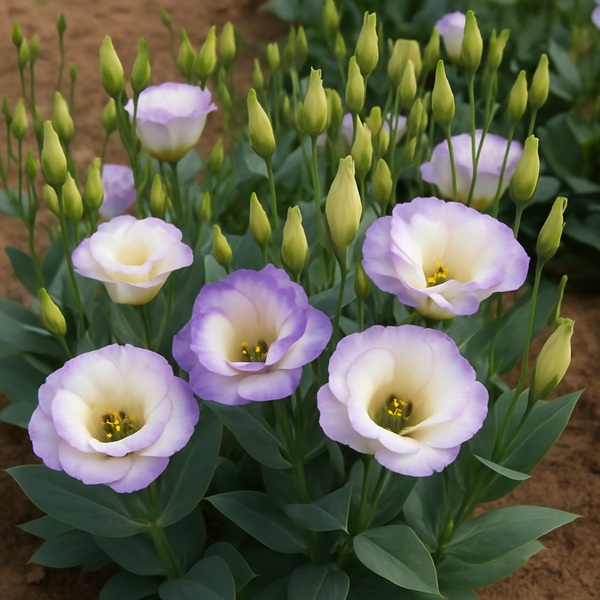
Large-flowered eustoma, also known as lisianthus, is one of the most elegant ornamental plants and is appearing more and more often in Ukrainian flower beds. Its flowers, resembling either a rose or a poppy, amaze with their variety of colors: from classic white and soft pink to deep violet and even greenish tones. Thanks to its versatility and refined appearance, it is used both in landscape design and in premium floristry. At the same time, the plant is fairly demanding, especially when it comes to temperature and humidity, so it requires careful attention, particularly in the temperate climate of Ukraine.
The southern regions of Ukraine — Kherson, Mykolaiv, and Odesa — are the most suitable for growing eustoma outdoors. In central Ukraine, including Poltava, Cherkasy, and Kyiv regions, growers often rely on the seedling method or cultivate the flower in greenhouses. In the north and west of the country, eustoma is usually grown in containers or as a houseplant, especially where summers are short or rainfall is frequent. In pots, it can bloom even in winter if given the proper temperature (+18 to +22 °C) and supplemental lighting.
This crop is ideal both for individual plantings and for mixed borders or grouped arrangements. It works beautifully as an accent flower, retains its ornamental effect for a long time, and in cut form can last up to two weeks. Because of this, eustoma is grown not only by hobbyists, but also by professional flower growers, especially in greenhouse production. Under certain conditions it can be grown as a perennial, but in the open ground of Ukraine it most often behaves as an annual crop because it cannot survive frost.
Successful eustoma growing in the Ukrainian climate begins with properly organized seed sowing. It is most often propagated by seed, which is extremely small and often pelleted for convenience. Because of its long growing season, sowing is done as early as January–February, especially if the plants are intended for outdoor cultivation. The seeds are sown on the surface of a light peat-based substrate with the addition of vermiculite, without covering them, since they need light in order to germinate.
The optimal conditions for germination are a temperature of +20 to +25 °C, high air humidity, and supplemental lighting for up to 14 hours a day. Mini-greenhouses, bottom watering, and additional lamps are used for this purpose. Seedlings may appear only after 14–21 days, so patience is required. At this stage, sudden temperature fluctuations and direct sunlight should be avoided, and young plants must be protected from drafts.
After two or three true leaves have formed, the seedlings are pricked out into individual pots. Transplanting must be done as carefully as possible, because the roots of eustoma are very sensitive to mechanical damage. After pricking out, the young plants continue to grow in a warm, bright room for another 6–8 weeks. Hardening begins two weeks before transplanting into open ground by gradually lowering the surrounding temperature. On average, 3.5–4 months pass from sowing to planting out in the flower bed.
Choosing the right planting location is half the battle in growing eustoma. It loves sun, warmth, and fresh air. Open sunny sites protected from northern winds are best. In shade, eustoma blooms poorly, becomes leggy, and forms buds weakly. It is important that the soil be well drained, since stagnant water is one of the main causes of root rot.
The ideal soil characteristics are:
structure — loose, light, and breathable;
acidity — neutral or slightly alkaline (pH 6.5–7.2);
nutrition — rich in humus, with added sand or perlite;
drainage — essential, especially in heavy soils.
Before planting, the seedlings should be fed with a compound fertilizer high in phosphorus and potassium. The planting scheme depends on the variety: 25–30 cm between taller plants, 15–20 cm between shorter ones. It is recommended to treat the planting holes with a biofungicide, for example one based on Trichoderma. After planting, the soil is moistened, but without excess — the plant does not like water getting on the leaves or into the center of the rosette.
After planting into open ground or a greenhouse, eustoma needs careful and consistent care. The most important aspect is the watering regime. The plant does not tolerate overwatering, but if the soil dries out, growth stops. Watering is done as the top layer dries to a depth of 2–3 cm. It is best to use warm, settled water and water in the morning or evening, without wetting the leaves or buds.
During the first 3–4 weeks after planting in the ground, eustoma actively builds up its green mass. At this stage it should be fed with nitrogen fertilizers or formulations in which nitrogen dominates, such as NPK 20:10:10. Once buds appear, feeding is switched to phosphorus-potassium fertilizers: this improves flowering, strengthens the flower stalks, and prevents brittle stems. Universal products include Kristalon, Master, and Plantafol. Root feeding and foliar feeding should be alternated — spraying on the leaves helps compensate for deficiencies of micronutrients such as boron, zinc, and magnesium.
In greenhouses, it is especially important to control air humidity: if it is too high, the risk of fungal disease increases. The space should be ventilated regularly, plant crowding should be avoided, and damaged leaves should be removed in time. Mulching the soil is also essential — it reduces moisture evaporation, suppresses weeds, and helps maintain a stable microclimate around the root system.
Although eustoma is not extremely vulnerable, in open ground it often suffers from fungal infections, especially in unstable weather. The most common diseases are gray mold, fusarium, root rot, and downy mildew. The main causes are excessive soil moisture and poor air circulation. For prevention, biological products such as Fitosporin and Trichoderma are used, and fungicides such as Switch, Ridomil Gold, and Skor are also applied periodically.
The main pests of eustoma are thrips, aphids, and whiteflies, especially in dry weather. They suck out the plant’s sap, weaken it, and may transmit viruses. The most effective approach is regular inspection and immediate action when a problem appears. Systemic insecticides such as Aktara and Mospilan are used for protection, along with sticky traps in yellow or blue. It is best to alternate products to prevent resistance.
Sanitary care is mandatory: trimming damaged leaves, ventilating the growing area, and reducing watering during cloudy weather. The key thing to remember is that disease is easier to prevent than to treat. That is why preventive treatments are carried out even on healthy plantings — especially in warm, humid weather favorable to pathogens.
Eustoma begins flowering about 100–120 days after sowing. Blooming lasts for several weeks, depending on the variety and weather conditions. If faded buds are removed promptly, a second wave is possible — the plant continues producing new flower stalks until the first frosts. Tall varieties produce the largest number of inflorescences if they have been grown without stress, with correct watering and feeding.
For cutting, stems with partially opened buds are selected. Cut eustoma keeps very well in water — for 10–14 days. The water should be changed daily, and the stem ends should be recut at an angle. To avoid exhausting the plant, some shoots should be left on the bush for further growth. In flower beds, cutting is done selectively to maintain the neat appearance of the planting.
It is difficult to grow eustoma as a perennial outdoors in Ukraine, because it cannot survive temperatures below –5 °C. However, some specimens can be preserved by transplanting them into pots and moving them into a bright, cool room for winter. Watering in winter should be minimal, and in spring, after hardening off, the plant can be returned to the flower bed. Most gardeners still grow eustoma from seed each year — this makes it possible to experiment annually with varieties and colors, adapting the crop to their own conditions.