Dracaena is a popular ornamental plant that is becoming more and more common in homes, offices, and winter gardens across Ukraine every year. In shape and appearance, it resembles a miniature palm, although it has nothing to do with true palms. It belongs to the Asparagus family and includes more than 120 species, though only about twenty are suitable for indoor cultivation. Among the most common are fragrant dracaena, marginata, dragon tree, and Sander’s dracaena. Thanks to its low-maintenance nature and striking appearance, dracaena has become a favorite of both experienced plant growers and beginners.
One of the main reasons for dracaena’s popularity is its ability to purify the air of harmful impurities. Scientific studies confirm that dracaena effectively filters formaldehyde, benzene, and other volatile organic compounds, making it especially valuable for city apartments, particularly in regions with high levels of air pollution. In Ukraine, where air quality in large cities often leaves much to be desired, dracaena becomes more than just a decorative plant — it becomes part of the home ecosystem. It is also believed to have positive energy: it promotes calm, harmony, and a boost in vitality. These qualities are especially appreciated in modern life, when stress and fatigue have become everyday companions.
From an aesthetic point of view, dracaena also has many advantages: some species grow up to the ceiling, forming a “palm-like” structure, while others remain compact, with dense green or variegated foliage. This makes it possible to choose a plant for a specific interior — from clean minimalism to bright eclectic design. In Ukrainian conditions, dracaena is most often grown indoors, but in southern regions such as Odesa or Kherson regions, it can be taken outdoors in summer to create the effect of a tropical garden. The main thing is not to forget that dracaena is sensitive to temperature fluctuations, so it should be brought back inside before nighttime cooling begins. In this way, choosing dracaena is not only about décor, but also an investment in comfort and the health of the household.
Successful dracaena growing begins with proper planting, which lays the foundation for its health and active growth in the years ahead. The best time for planting or repotting dracaena in Ukraine is spring, especially March and April, when vegetative processes become active. When choosing a pot, it is important to use containers with drainage holes to avoid stagnant moisture. The pot size should match the size of the root system: too much volume will lead to root rot, while too little will limit growth. Ideally, the new pot should be 2–3 cm larger in diameter than the old one.
The soil for dracaena should be light, permeable, and nutritious. It is best to use a specialized mix for palms or dracaenas, which is readily available in Ukrainian garden centers. If you prepare the substrate yourself, mix leaf soil, humus, sand, and a little peat in a ratio of 2:1:1:0.5. It is very important to provide quality drainage — expanded clay, fine gravel, or pieces of foam at the bottom of the pot in a layer of at least 2–3 cm. This is especially relevant for regions of Ukraine with higher humidity, such as the western areas. During planting, the roots are placed carefully without bending or breaking, evenly covered with soil, and lightly firmed.
The placement of dracaena after planting also deserves special attention. It is best to keep the plant in a bright room with diffused sunlight. Direct sun, especially in summer, can cause leaf burn. That is why on south-facing windows it is better to provide shade with tulle curtains or blinds. It is worth remembering that dracaena does not like sharp temperature changes or drafts. The optimal temperature for rooting and active growth is +20 to +25 °C, and in winter no lower than +15 °C. These conditions are easy to provide both in apartment buildings and in private houses with autonomous heating. If all these details are observed, dracaena adapts quickly to its new place and within a few weeks will delight you with fresh, dense foliage.
Proper dracaena care means taking its biological needs into account. Light is one of the key growth factors. In Ukrainian conditions, especially in winter when the days are short and cloudy, dracaena should be placed closer to a source of natural light while still avoiding direct sun. East- or west-facing windows are ideal, and if needed, grow lights can be used. A lack of light leads to fading of the leaf color and even leaf drop. Variegated dracaena varieties such as ‘Marginata’ or ‘Compacta’ are especially sensitive to light, and without additional illumination may lose their decorative appeal.
Watering is another important aspect. Dracaena is sensitive both to drying out and to excess moisture. During the warm season, it is watered regularly as soon as the top layer of soil dries out — usually once every 3–5 days. In winter, especially if the indoor temperature drops to +16 to +18 °C, watering is reduced to once every 7–10 days. The water should be soft, settled, and at room temperature. In some regions of Ukraine, where tap water is hard, it is better to use rainwater or filtered water. Excess salts cause a white coating to appear on the soil and on the leaf tips. To increase air humidity, especially during the heating season, it is helpful to spray the leaves regularly.
Feeding is carried out from early spring to mid-autumn — from March to September. Complex fertilizers for decorative foliage plants are used. Dracaena is fed once every 2–3 weeks during active growth, while in winter it is not fed because the plant enters a resting period. Bush shaping is also important: over time, dracaena loses its lower leaves, forming a “bare” trunk. To rejuvenate the plant and create a fuller crown, pruning is done by cutting the top at the desired height and stimulating the remaining trunk to form new shoots. This method is especially effective if the dracaena has become stretched due to lack of light or improper care. The cut should always be treated with crushed activated charcoal to prevent infection.
Despite its hardiness, dracaena is not fully protected from diseases and pests, especially if the basic care rules are broken. The most common pests are spider mites, scale insects, and thrips. They damage the leaves, causing yellowing, deformation, dryness, and leaf drop. Signs of infestation may include sticky residue, fine webbing, or brown or yellow spots on the leaf surface. In neglected cases, dracaena may lose its ornamental value and sometimes even die. In Ukraine, the risk increases during the heating season, as dry air encourages active pest reproduction.
To avoid this, it is important to follow preventive measures:
Regularly inspect the leaves, especially the undersides;
Spray with water and wipe the leaves with a damp cloth or sponge;
Air out the room, while avoiding drafts;
Keep the plant away from radiators, which dry out the surrounding air.
If pests are found, action should be taken immediately. At an early stage, wiping the leaves with a soap solution is effective. If the infestation is severe, insecticides are used: Fitoverm, Actellic, Confidor, or their Ukrainian equivalents. Treatment should be carried out in a well-ventilated room, wearing protective gloves and a mask. Repeat spraying is done after 7–10 days. As for fungal infections, dracaena may suffer from root rot caused by overwatering. In that case, urgent repotting is needed, with the rotten parts of the roots trimmed away and the plant treated with a fungicide such as Topsin-M or Fundazol. In humid regions of Ukraine, such as Volyn or Lviv regions, special attention should be paid to soil condition in order to prevent water stagnation.
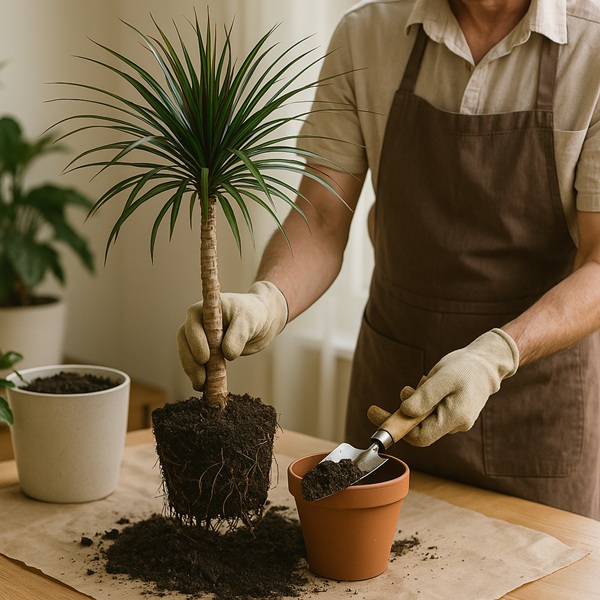
Dracaena, like many indoor plants, eventually needs repotting. The main reasons are the expansion of the root system and soil depletion, as salts accumulate and air permeability decreases. Young plants are repotted every year, mature ones once every 2–3 years. The best period is spring, from March to April. A day before repotting, dracaena is watered to make removal from the pot easier. The roots should be carefully cleaned of old soil, and damaged parts should be cut away with a clean, disinfected knife or pruners.
Then drainage and a little soil are placed in the new pot, the plant is set in place, the roots are gently spread, and the fresh soil mix is added, lightly firming it. The substrate should not be packed too tightly — the roots need air. After planting, dracaena adapts for several weeks, during which watering is reduced to avoid stress. Rejuvenation is carried out mainly for tall or stretched specimens with a bare trunk. The top is cut at the desired height, after which the remaining part produces new shoots. The cut is treated with activated charcoal or cinnamon.
The cut top can also be rooted: it is placed in a glass of water with added charcoal or planted in moist peat. To speed up the process, it is covered with a small film greenhouse. Rooting takes 3–6 weeks. In southern regions of Ukraine, repotting is best done in March, while in northern ones it is better at the end of April, when temperatures become steadily warm. If rotten roots or an unpleasant smell are discovered during repotting, all damaged areas should be removed and treated with a fungicide. In such cases, full replacement of the soil is mandatory. Repotting and rejuvenation ensure not only long life, but also the ornamental beauty of dracaena.
Dracaena propagation is a simple and interesting process that makes it possible to renew old plants or expand your collection. Three main methods are used:
Top cuttings. The most common method: the cut top is rooted in water or in a peat substrate. Successful rooting requires a temperature no lower than +22 °C, regular moisture, and shade.
Stem cuttings. The stem is cut into sections 8–10 cm long, each with at least one node. The cuttings are planted horizontally or vertically in a moist peat-and-sand mix.
Air layering. Used for old, stretched plants: a cut is made on the stem, wrapped with moist sphagnum moss and film. After 1.5–2 months, roots form, after which the top is cut off and planted.
Dracaena is best propagated from March to mid-summer, when Ukraine’s climatic conditions are most favorable for growth. After rooting, young plants need a stable environment without drafts, sharp temperature changes, or bright sun. Watering should be moderate, only after the top layer of soil dries. Feeding is not done during the first 1–2 months, until the plant has formed a root system. If necessary, a mini-greenhouse is created to increase air humidity — this is especially relevant for apartments with central heating or air conditioners.
Successful dracaena propagation makes it possible not only to preserve favorite varieties, but also to experiment with plant form, height, and placement in the home. One mature specimen can produce several new ones, which can become full-fledged decorative elements of the interior. And following care recommendations adapted to Ukrainian conditions will ensure the beauty and health of these exotic “palms” for many years.