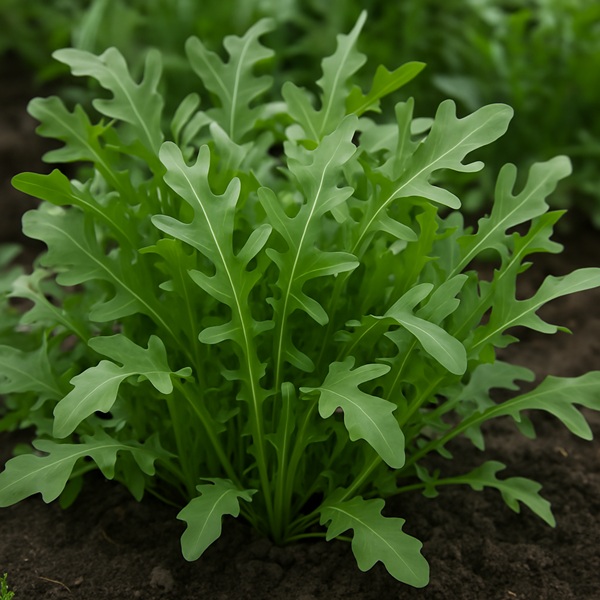
Arugula (Eruca sativa), also known as garden rocket or simply rocket, is a spicy leafy green from the cabbage family (Brassicaceae) that is rapidly gaining popularity among Ukrainian gardeners. Its distinctive piquant taste, with mustard-like and nutty notes, makes arugula a favorite ingredient in Mediterranean cuisine and, in recent years, in the everyday diet of Ukrainians as well. In addition to its appealing flavor, arugula has a valuable nutritional profile: vitamins A, C, K, and B-group vitamins, as well as calcium, potassium, iodine, iron, and organic acids. It strengthens the immune system, improves digestion, helps remove toxins, and has antiseptic properties.
From an agricultural standpoint, arugula is an undemanding and extremely fast-maturing crop. From sowing to the first harvest, only 20–25 days pass, which makes it possible to grow it in several waves throughout the season. Under Ukrainian conditions, taking climate zones into account, up to 5–6 sowings can be made during the growing period. The crop performs especially well in the central and southern regions, where a warm spring and long summer make it possible to harvest greens continuously. Another advantage is its resistance to cold: mature plants tolerate frosts down to –5°C, and the seeds germinate already at +5 to +7°C, which allows sowing even very early in spring or late in autumn.
There are several types of arugula, but in open ground in Ukraine two are grown most often: garden rocket (Eruca sativa) and wild rocket (Diplotaxis tenuifolia). The first is earlier-maturing, with rounded, tender leaves and a milder taste. The second has narrow, deeply cut leaves, a more pronounced mustard flavor, and greater heat resistance, though it grows more slowly. In most regions of Ukraine, garden rocket is chosen more often because of its versatility, high germination, and good productivity. Popular varieties include ‘Poker,’ ‘Rococo,’ ‘Rocket,’ ‘Oliva,’ and ‘Colta’ — some of them are better at resisting bolting and are also less affected by pests.
Despite its low-maintenance nature, arugula is very sensitive to growing conditions. To obtain tender, juicy, and aromatic greens, the location must be chosen correctly. Sunny plots are ideal, but the crop also grows well in partial shade, especially in the southern regions of Ukraine, where direct heat can reduce leaf quality. Under excessive shade, the plants stretch, the leaves become pale and small, and the flavor weakens. At the same time, in July and August, when the heat reaches its peak, partial shade helps produce a milder taste and slows bolting. For that reason, in the summer months arugula is best sown among taller crops or under light cover.
The optimal soil is loam or sandy loam, well-drained, fertile, and with a slightly alkaline or neutral reaction (pH 6.5–7.5). Site preparation begins in advance: the soil is dug to a depth of 20–25 cm, weeds are removed, humus or compost is added at 3–4 kg per square meter, and wood ash, superphosphate, or potassium sulfate may also be incorporated. The use of fresh manure is not recommended, since excess nitrogen causes excessive leafy growth and nitrate accumulation. In addition, overly rich soils often worsen the taste: the leaves become too soft and less aromatic. Soil compaction should also be avoided — loosening before each sowing is essential.
The best preceding crops for arugula are cucumbers, tomatoes, onions, potatoes, and legumes. It should not be sown after radish, daikon, cabbage, or other cruciferous crops, because these plants share diseases and pests. After harvesting arugula, it is advisable to sow green manure crops such as mustard, phacelia, or oats to restore soil structure and fertility. A special feature of arugula is its fairly powerful root system, which does not tolerate excess moisture well, so not only fertilization but also proper aeration is important.
In Ukraine, arugula can be sown from late March or early April, as soon as the soil warms to +5°C. To speed germination, the bed can be covered with film beforehand. Sowing is done directly into open ground, in furrows 1–1.5 cm deep, with 15–20 cm between rows. The seeds are sown not too densely to avoid unnecessary thinning. After sowing, the furrows are covered, the soil is lightly firmed, and watered. Seedlings appear in 5–8 days. To keep a steady supply of greens, repeated sowings every 2–3 weeks through September are recommended.
Watering is one of the main factors in successful open-ground cultivation of arugula. The crop is moisture-loving, but it does not tolerate stagnant water. Watering should be regular and moderate so the soil remains moist but not waterlogged. In hot weather, watering is done daily or every other day, preferably in the morning or evening. When moisture is lacking, arugula becomes bitter and tough and also sends up flower stalks prematurely. It is especially important to maintain moisture during the first weeks after emergence. To preserve moisture, the beds can be mulched with straw or cut grass.
Thinning is done when 2–3 true leaves appear, leaving 8–10 cm between plants. If the sowing came up too thick, the extra plants are removed gradually and used as microgreens. Ten to fourteen days after emergence, feeding may be carried out. Organic infusions are best, for example nettle infusion or biohumus solution. Mineral fertilizers should be used cautiously, especially in hot weather. It is also important to loosen the soil between the rows regularly and control weeds, since they not only take moisture but also attract pests.
Arugula is an extremely fast-growing crop, and this is its main advantage. Harvesting can begin as early as 20–25 days after sowing. The best time to cut it is when the plant has 4–6 true leaves: at this stage the greens are at their juiciest, most tender, and moderately spicy. Arugula is cut 2–3 cm above ground level, preferably without damaging the growing point — this makes it possible to get 2–3 waves of greens from one sowing. If proper conditions are maintained, including watering and feeding, the crop recovers very quickly and produces high yields.
For longer storage, arugula can be preserved in different ways. The best is freezing it fresh: the leaves are washed, dried, chopped or left whole, and frozen in containers, bags, or ice-cube trays with water or oil. This preserves the maximum flavor and works well for sauces, pasta, and omelets. Salting is also possible: the greens are layered with salt in a ratio of 1 part salt to 5 parts arugula, packed into jars, and stored in the refrigerator. Drying is used less often, since much of the aroma is lost during the process, though dried arugula still works for seasoning blends and herbal mixtures.
Fresh arugula keeps in the refrigerator for no more than 3–5 days. To extend its shelf life, the leaves should be wrapped in a damp paper towel or cloth and then placed in a tightly closed container. When arugula is grown for sale, it is important to remember that its marketable appearance is quickly lost without cooling, so the crop should be harvested in the morning and sold or processed as quickly as possible. In Ukraine, arugula is appearing more and more often at farmers’ markets, in retail chains, and in the HoReCa sector — it is a promising niche crop both for personal use and for commercial production.
Arugula can be grown easily not only in open ground but also in containers, boxes, pots, and even plastic bottles. Thanks to the plant’s compact size and short development cycle, it is ideal for balconies, loggias, windowsills, and even kitchens. In autumn and winter, when vegetable gardens are at rest, arugula can become a source of fresh greens for everyday meals. The main requirements for successful cultivation are light and a stable temperature. South- or east-facing windows are best. Under short daylight conditions, grow lights are used, for at least 12 hours of lighting per day. The optimal temperature is +15 to +22°C.
For planting, choose containers at least 10–12 cm deep with drainage holes. A layer of expanded clay or pebbles is placed at the bottom, followed by a loose substrate such as a mixture of peat, biohumus, coconut fiber, or a light greens-growing soil. The seeds are sown into furrows up to 1 cm deep, lightly covered, moistened with a spray bottle, and covered with film. After 3–5 days, once seedlings appear, the film is removed. When 2–3 true leaves develop, the plants are thinned, leaving 6–8 cm between them.
Advantages of container growing:
constant access to fresh greens regardless of the season;
control over growing conditions and product cleanliness;
aesthetic value and convenience in the kitchen or on a balcony;
savings on store-bought greens.
Arugula in a pot is not only food, but also a stylish interior element. The plant forms an attractive green mass, and its yellow flowers look decorative. If the main goal is leaf production, flowering should be prevented: as soon as a flower stalk appears, the tip is cut off or the sowing is renewed. For a continuous harvest, a new batch can be sown every 3–4 weeks — this creates a “green conveyor” even in an apartment.
Although arugula is generally resistant to disease, some problems may still occur. The main enemies of the crop are:
crucifer flea beetles — small insects that chew holes in the leaves, especially active in May and August;
slugs and snails — dangerous in shaded, damp places;
aphids — settle on young shoots in overcrowded plantings;
fungal infections — develop under stagnant moisture, especially in greenhouses.
Prevention and control include:
crop rotation — do not sow after radish, cabbage, or turnip;
thinning and ventilation of plantings;
covering with agrofabric in the first weeks after emergence;
dusting with ash, tobacco dust, or herbal infusions;
watering at the root and avoiding wetting the leaves.
Ukraine’s climate makes it possible to grow arugula almost year-round. Spring and autumn provide ideal conditions: moderate temperatures, plenty of moisture, and the best flavor. In summer, especially in July and August, arugula bolts quickly, and the leaves become tougher and more bitter. During that period, it is better to sow it in partial shade and provide generous watering. In autumn, the crop performs very well again, especially in the southern and central regions.
For winter consumption, winter sowing in greenhouses or indoor growing on a windowsill works well. In October and November, arugula can be sown in cold frames, where it will grow slowly until true frosts begin. With artificial lighting, greens can be available continuously. In this way, arugula is one of the most versatile and accessible crops for both Ukrainian consumers and home gardeners.