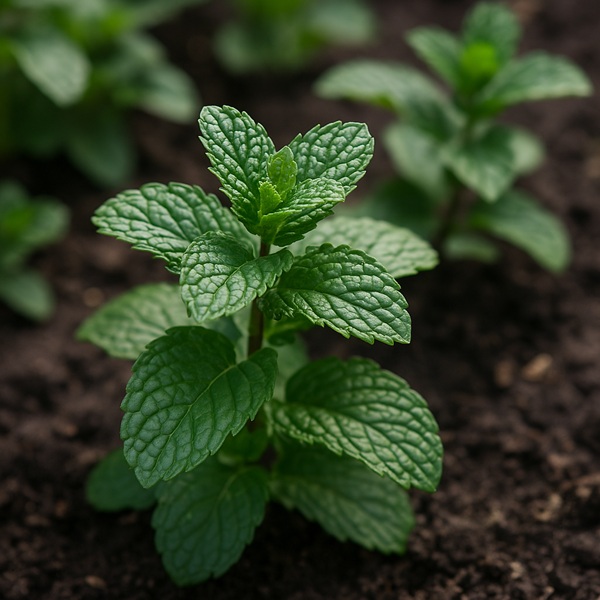
Mint is one of the most popular aromatic herbs and can be grown easily in a home garden, vegetable plot, or even in a container on a balcony. Under Ukrainian conditions, mint performs extremely well thanks to the temperate continental climate: the plant tolerates temperature fluctuations, is resistant to drought, recovers well after cutting, and can produce several harvests in one season. Mint is valued not only for its fresh taste and aroma, but also for its rich composition: essential oils, menthol, tannins, B vitamins, vitamin C, and organic acids. Because of this, the plant is widely used in folk medicine, cooking, and cosmetics.
In nature, mint is represented by dozens of species, but in cultivation the most common are peppermint, curly mint, longleaf mint, apple mint, chocolate mint, and other hybrids. The most popular type in Ukraine is peppermint (Mentha × piperita), a hybrid of water mint and spearmint. It is distinguished by its rich aroma and high menthol content, which makes it especially valued for tea and herbal use. When choosing a variety, it is worth considering the region of cultivation: for the northern and central regions, frost-resistant varieties with a short growing season are better suited, while in southern Ukraine mint can be grown almost year-round if irrigation is available.
Important: mint is a perennial crop, but it should be renewed every 3–4 years because older plants lose their intensity of aroma and become less productive. For successful cultivation, it is also important to remember that mint spreads aggressively, forming dense thickets. Its rhizomes expand rapidly, so it is best to limit its spread from the start — for example, by planting it in containers sunk into the soil or in special raised borders. This prevents it from taking over neighboring beds and makes care much easier.
For mint to produce abundant green mass and a pronounced aroma, it is important to create proper growing conditions. It is most productive with enough sunlight, ideally 6–8 hours a day. In Ukraine, this is fully achievable in almost all regions except heavily shaded yards and narrow balconies. Although mint can also grow in partial shade, its aromatic qualities decline: the concentration of essential oils in the leaves decreases, while the shoots become elongated and brittle. Good lighting is especially important at the beginning of the growing season, because this is when active growth buds are formed.
Mint prefers fertile, loose soils with a neutral or slightly alkaline reaction, pH 6.0–7.5. The best soil type is loam or sandy loam with good drainage. When preparing a site for mint in autumn, it is recommended to add organic matter such as humus or compost at a rate of 3–5 kg per square meter, and in spring to dig the soil over again with the addition of wood ash and a small amount of complex mineral fertilizer. Mint grows poorly in acidic or waterlogged soils, and under such conditions it is more often affected by fungal diseases. It can also grow on sandy and poor soils, but the harvest will be more modest and feeding will need to be more frequent.
Moisture level is one of the key factors affecting plant development. Mint is moisture-loving, especially at the beginning of active growth in May and June. At the same time, stagnant water should be avoided because the root system is very sensitive to excess moisture. Watering should be regular and moderate, on average 2–3 times a week depending on weather conditions. During dry periods, daily watering in the morning or evening may be advisable. To prevent the soil from drying out, it is worth mulching the planting with cut grass, humus, or straw. This also helps suppress weeds and improves soil structure. When mint is grown in containers, especially on sunny balconies, watering may be needed every day or even twice a day in hot weather.
Mint propagation is a simple process with several effective methods. The easiest is rhizome division, especially if you already have a mature plant. In spring or autumn, the clump is divided into several parts with 3–5 shoots and healthy roots, then planted in a new place. This method allows you to quickly obtain a strong plant already adapted to local conditions.
Another popular method is cuttings. With the arrival of warm weather, from the second half of April through May, the top shoots 10–15 cm long are cut, the lower leaves are removed, and the cuttings are placed in water. Roots appear in 5–10 days, after which the young plants can be transferred to open ground or a container. This method is convenient for quickly expanding the planting area or moving mint to a balcony. As an alternative to water, moist sand or a light substrate can also be used, and rooting is just as effective there.
Mint is planted in open ground in spring, from April to early June, or in autumn, from late August to early September. The spacing between bushes should be 30–40 cm, with about 50 cm between rows. Planting depth is up to 5 cm, so that the growth point remains level with the soil surface. It is important not to bury the plants too deeply, because this slows growth and complicates rooting. After planting, mint should always be watered, and for the first 5–7 days it should be shaded from the sun, especially if planting was done on a hot day. In containers, it is necessary to provide a drainage layer and use nutrient-rich soil with the addition of peat and vermiculite.
Mint is a fairly undemanding crop, but it still needs regular care throughout the growing season. In spring, after the first leaves appear, it is recommended to gently loosen the soil around the bushes. This improves air access to the roots and stimulates the formation of new shoots. The next important step is formative pruning: the tops of young stems should be pinched after 4–5 pairs of leaves appear. This procedure encourages the formation of a denser, more compact bush, delays early flowering, and therefore helps preserve a stronger aroma.
Throughout the summer, weeds should be removed regularly, especially in the first weeks after planting or dividing the bushes. Mint does not like competition: weeds take moisture and nutrients and also encourage the appearance of pests. It is equally important to keep the soil loose and to renew mulch as needed. Feeding is carried out 2–3 times per season. Organic solutions based on poultry manure diluted 1:15 or mullein diluted 1:10 work best, as do complex mineral fertilizers for leafy crops with a moderate nitrogen content. Too much nitrogen stimulates excessive leafy growth but reduces the concentration of essential oils.
Pruning should be done not only in spring, but also throughout summer. After each harvest, mint needs renewal: the stems are cut back to a height of 5–7 cm above the ground, which stimulates the formation of new shoots and leaves. Under Ukrainian conditions, 2–3 full cuttings per season are possible, especially in the central and southern regions. In autumn, after the final harvest, the above-ground part is cut back completely, and the site is mulched with peat or compost. This helps protect the root system from frost and improves the soil structure for spring.
Proper harvesting and processing of mint are the key to preserving its taste and medicinal qualities. The highest concentration of essential oils in the leaves is observed a few days before flowering begins, at the budding stage. This is when the greenery is most aromatic and richest in active compounds. Under Ukrainian conditions, this period falls in late May to early June with spring planting, and in July to August in summer cultivation or in established perennial plantings. Cutting is done in the morning, after the dew has dried, in dry weather, which reduces the risk of spoilage during drying.
After harvesting, mint should not be immediately piled into containers. First it should be sorted, removing damaged, yellowed, or dirty leaves. Then the plants are tied into small bundles and hung in the shade in a well-ventilated room. The optimal drying temperature is +25 to +35°C. Another option is drying on racks or trays in a thin layer. Important: do not dry mint in direct sunlight, since this destroys essential oils and causes loss of color.
Finished dried mint is stored in tightly closed glass or ceramic jars, or in paper or cloth bags, in a dry, dark place. The optimal air humidity is no more than 50%, and the temperature should remain below +20°C. Under these conditions, the aroma and beneficial properties are preserved for up to 1.5 years. Other preservation methods include freezing, when the leaves are washed, dried, and frozen in plastic containers or ice trays with water or oil; mint pastes, where chopped leaves are mixed with sugar or oil to create aromatic blends for desserts or drinks; and tinctures, where mint is infused in alcohol or vodka for household, medicinal, or cosmetic use. In this way, even a small amount of mint, properly harvested and dried, can become a versatile base for tea, compresses, fragrant baths, and dishes.
Despite its fairly high resilience, mint in Ukraine can suffer from certain pests and diseases, especially in overcrowded or neglected plantings. The most common problems are mint flea beetles, small insects that chew holes in the leaves and become active in dry heat; spider mites, recognized by fine webbing and yellowing foliage, usually caused by dry air; and aphids, which gather in large colonies on the tops of shoots and suck out the sap, suppressing growth. These can be controlled with wormwood or garlic infusions, soap solution, ash, mechanical removal, or specialized products where needed.
Among diseases, the most common are rust, powdery mildew, and fusarium. All are caused by fungi and most often appear with excessive moisture, poor ventilation, and overly dense planting. The main methods of prevention are keeping proper spacing between bushes, removing old leaves, regular loosening, and spraying with biological preparations or a weak copper sulfate solution.
After 3–4 years, even the best mint bushes naturally lose vigor: the leaves become smaller, the aroma weakens, and yield decreases. In that case, the planting should be renewed by selecting the strongest shoots, dividing the clumps, and transplanting them to a new place. The old plot should be dug over, enriched with humus or compost, and left fallow for one season. This approach helps preserve varietal purity, avoid the buildup of pathogens in the soil, and ensure a stable mint harvest in the coming years.