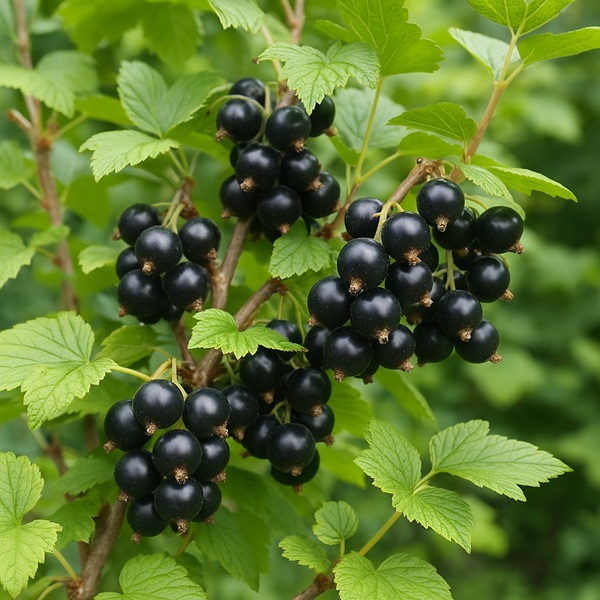
Currants are one of the most widespread and beloved berry crops in Ukraine. They are grown almost everywhere, from the southern steppe to the slopes of the Carpathians. They are valued for their high yields, early fruiting, resistance to climatic stress, and, of course, for the beneficial properties of their berries. Currants are rich in vitamins C, P, B1, and B2, and contain organic acids, pectins, iron, calcium, and potassium. Black currants are especially important, ranking among the top berries for vitamin C content. In Ukraine, three main types are grown: black, red, and white currants, each with its own cultivation features, although their general care is similar.
Black currants prefer moist sites with fertile soils, while red and white currants tolerate drought better and are less demanding in terms of growing conditions. This allows gardeners to choose suitable varieties depending on the region. In the south of Ukraine, such as Odesa, Mykolaiv, and Kherson regions, red and white currants are grown more often, while in the northern and western regions, such as Chernihiv and Lviv regions, black currants predominate. At present, many regionally adapted varieties have been developed in Ukraine, including Yuvileina Kopania, Vernihora, Sofiivska, Dobrynia, Kyivska Velyka, and others. Thanks to varietal diversity and the crop’s high adaptability, currants can serve as the basis for both commercial plantations and small household gardens.
For currants to produce abundant, high-quality harvests, it is important from the very beginning to choose the right planting site and prepare the soil properly. Currants are a light-loving crop, but black currants tolerate light partial shade well, especially in southern regions where direct sun quickly dries out the soil. Red and white currants bear fruit better in full sun. In Ukraine, where the seasons are clearly defined, it is important to take into account the relief, groundwater level, and soil structure.
Optimal planting conditions:
Location: sheltered from strong winds, well ventilated, without stagnant air;
Light: as much sun as possible; partial shade is acceptable for black currants;
Soil: sandy loam or loam, loose, rich in organic matter, pH 6.0–6.5;
Groundwater: no closer than 1.5 m to the surface, otherwise the roots may rot;
Site: level or with a slight slope, preferably southern or southwestern; lowlands should be avoided.
Soil preparation:
The site is cleared of weeds 2–3 weeks before planting.
The soil is dug to a depth of 30–40 cm.
Organic matter is added, such as humus or compost at 8–10 kg/m², along with mineral fertilizers such as superphosphate and potassium salt.
If necessary, acidic soils are limed with 500–600 g/m² of lime.
On sandy soils, clay or peat is added to improve moisture retention.
In regions with high humidity, such as Volyn and Rivne regions, raised beds and drainage should be provided. In the southern regions, protection against drying out is important, including mulching and drip irrigation. Such an integrated approach ensures strong bush health and stable yields for many years.
Proper planting of currants is the foundation of their successful development, early fruiting, and longevity. In the conditions of Ukraine, where spring may be either early or prolonged, it is especially important to follow the proper timing and planting technique. Currants can be planted in both spring and autumn, but autumn planting, from late September to early November, is considered more effective: before frost, the plant has time to root, and in spring it begins to grow immediately. Spring planting is more relevant for northern and colder regions, where winter is long and has little snow.
Planting time and technique:
Autumn: late September to mid-October, depending on the region;
Spring: late March to the first half of April, as soon as it is possible to work in the garden;
Planting scheme: 1.5–2 m between bushes and 2–2.5 m between rows;
Depth: the root collar is buried 5–7 cm to encourage the formation of basal shoots;
Angle: the seedling is planted at a 45° angle, which stimulates shoot development from the root;
Watering: abundant, 10–12 liters per bush, followed by mulching with peat, humus, or cut grass.
Planting sequence:
Dig a hole 40–50 cm deep and wide.
Add humus, 1–2 buckets, one glass of ash, and 100 g of superphosphate.
Partially fill the hole with soil, form a mound, and spread out the seedling roots.
Cover with soil, firm it down, and water generously.
Shorten the shoots, leaving 2–4 buds on each, so the bush remains 10–15 cm above the ground.
In the southern and eastern regions of Ukraine, the soil must be mulched after planting to reduce moisture evaporation. In the western regions, where humidity is often high, special attention is given to drainage. In regions with sandy soils, such as Poltava and Kirovohrad regions, clay or compost is added to the planting hole to improve moisture retention.
After proper planting, currants do not require excessive care, but regular measures throughout the year significantly increase yield and plant vitality. Watering, loosening the soil, feeding, and pruning are especially important, as they directly affect the number of shoots, the formation of flower buds, and resistance to disease.
Watering and loosening:
The most important periods for watering are during ovary formation in May, berry filling in June, and after harvest.
The norm is 3–5 buckets of water per mature bush, 1–2 times a week in hot weather.
Watering is best done in the morning or evening.
After watering, loosening to a depth of 5–7 cm near the base is essential.
In autumn, in September, moisture-charging watering is carried out, up to 10 liters per bush.
In the southern regions, it is advisable to organize drip irrigation.
Feeding:
In early spring: ammonium nitrate, 30–40 g/m², or a 1:10 mullein infusion.
Before flowering: a complex fertilizer or a 1:20 chicken manure infusion.
After berry harvest: superphosphate and potassium sulfate, 30–40 g per bush.
In autumn: wood ash, 1–2 glasses per bush, and humus.
Pruning:
It is carried out in autumn or in spring before sap flow begins.
Old shoots, older than 5 years, as well as diseased and thickening shoots, are removed.
10–15 strong shoots of different ages are left, such as 2–3 annual shoots, 3–4 biennial shoots, and so on.
Black currants require regular rejuvenation because they bear fruit mainly on young shoots.
Red and white currants bear fruit on older branches, so they are pruned more carefully.
Care conditions should be adjusted according to the region: in the west, more attention is paid to thinning the bushes and improving ventilation; in the east, to watering and protection from heat. Regular care is the guarantee of a stable harvest and plant health.
Like any fruit crop, currants can be affected by diseases and pests, especially in conditions of high humidity, thickened bushes, and insufficient care. At the same time, with proper cultivation practices, most problems can be prevented. Different threats dominate in different regions of Ukraine: fungal infections are more common in the west, while insect pests are more common in the south.
Common diseases:
Powdery mildew: a white coating on leaves and shoots, curling, and stunted growth.
✦ Treatment: spraying with fungicides such as Topaz, Skor, or Fundazol, and pruning affected parts.
✦ Prevention: thinning bushes, limiting nitrogen fertilizers, and proper watering.
Anthracnose: brown spots on leaves and premature leaf drop.
✦ Treatment: Bordeaux mixture, Hom, and copper-containing products.
✦ It is important to grow resistant varieties such as Sofiivska or Dobrynia.
Rust: orange spots on the underside of leaves.
✦ Appears when coniferous trees grow nearby.
✦ Remedies: removing leaves and treating with Oxykhom or Abiga-Peak.
Pests:
Bud mite: causes