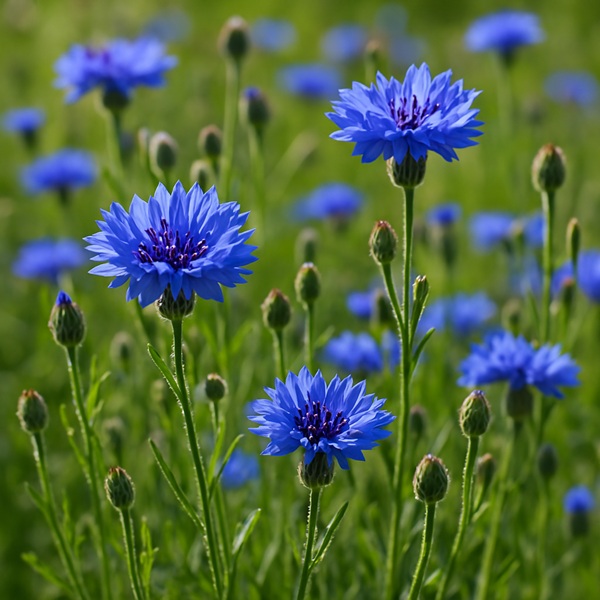
Cornflower (Centaurea) is a genus of herbaceous plants in the aster family (Asteraceae), comprising more than 500 species, most of which are found in Europe and Asia. In Ukraine, cornflowers have long been known as wildflowers that decorate meadows, roadsides, fields, and gardens. The most popular species among gardeners include blue cornflower (Centaurea cyanus), brown knapweed (Centaurea jacea), Fischer’s cornflower (Centaurea fischeri), and giant knapweed (Centaurea macrocephala). Thanks to their hardiness, drought tolerance, and bright, long-lasting flowering, cornflowers are ideal for growing both in private gardens and in urban landscaping.
These plants may be annual, biennial, or perennial, forming clumps from 20 to 120 cm tall, depending on the species and variety. Their leaves may be simple or pinnately divided and often have a silvery coating. The flowers are solitary flower heads borne at the tops of the stems. Their color ranges from classic blue to white, pink, purple, yellow, and even almost black. Flowering usually begins in May–June and continues until August, while some varieties bloom again in September. Cornflowers blend naturally into any garden style, from rustic country gardens to formal geometric layouts. They look excellent in mixed borders, rock gardens, along pathways, in flowerbeds, and in combinations with perennials and ornamental grasses.
In addition to their ornamental qualities, cornflowers also have medicinal value. Blue cornflower is especially prized, as its flowers contain anthocyanins, flavonoids, vitamins, and essential oils. In folk medicine, they are used for eye conditions such as conjunctivitis, fatigue, and inflammation, as well as for kidney and liver disorders and as a mild diuretic. Infusions made from the petals are included in herbal teas and cosmetic products. Cornflowers are also widely used in floristry: cut flowers retain their decorative appeal in bouquets for a long time, while dried flower heads are used in dried arrangements and herbariums. Given Ukraine’s climate, cornflowers can be successfully grown throughout the country, from Zakarpattia to Kharkiv, both in open ground and in containers.
Before sowing or planting cornflowers, it is worth deciding on the purpose: ornamental display, cut flowers, creating a meadow-style flower garden, or harvesting for medicinal use. Depending on this, the species and variety are selected. For mass planting in flowerbeds and borders, blue cornflower is most often used, including both classic and double-flowered forms such as ‘Blue Boy,’ ‘Double Blue,’ and ‘Jubilee Gem.’ For naturalistic plantings, meadow, woolly, and eastern species are well suited. In mixed borders, tall varieties such as Fischer’s cornflower or giant knapweed look especially impressive, with their bright yellow flower heads and dense bush form. Hybrids with unusual colors are also gaining popularity, including ‘Black Ball,’ ‘Red Boy,’ and ‘White Queen.’
The planting site for cornflowers should be sunny, well ventilated, and have light, well-drained soil with a neutral or slightly alkaline reaction (pH 6.0–7.5). Ideal conditions are sandy or light loamy soils rich in organic matter. In heavy, clayey, acidic, or overly wet soils, the plants are suppressed, bloom less profusely, and become more prone to disease. In the rainy climate of western Ukraine, raised beds or drainage are advisable. In the steppe and southern regions, mulching and protection from overheating are essential.
Site preparation 2–3 weeks before planting includes:
digging the soil to a depth of 25–30 cm;
adding humus or compost at 4–6 kg/m²;
adding wood ash at 100 g/m² and, if necessary, dolomite flour to reduce acidity;
breaking up clods and leveling the surface.
If seed sowing is planned, the soil should be thoroughly loosened and lightly firmed for better seed-to-soil contact. When transplanting seedlings, the spacing should be marked in advance: 20–25 cm for low-growing plants and 40–50 cm for tall ones. Cornflowers are not afraid of wind, but they should not be planted in low-lying areas with stagnant water.
The seed method is the most common way to grow annual cornflowers. In Ukrainian conditions, the best times are spring (late March to mid-May) and autumn (the second half of September to October). Spring sowing allows flowers to be obtained as early as June, while autumn sowing produces hardened plants that bloom in May of the following year. The seeds are sown in furrows 1–1.5 cm deep, covered with loose soil, moistened, and lightly firmed. At a temperature of +12 to +18 °C, seedlings appear within 7–10 days. In autumn, in the northern and eastern regions, it is advisable to provide additional cover with agrofabric or spruce branches.
The seedling method is used for rare varieties or to speed up flowering. Seeds are sown in March in boxes, buried 0.5 cm deep, moistened, and placed in a bright location. After 2–3 true leaves appear, the seedlings are pricked out into separate pots. They are transplanted into open ground in April–May after hardening off. Its advantages are high survival rates, control over planting density, and the ability to combine colors. Its disadvantage is greater labor intensity, especially on large areas.
Perennial cornflowers are propagated by dividing the bush in spring or autumn. The bush is dug up, divided with a sharp knife into sections with 2–3 renewal buds, and transplanted into prepared holes. This helps rejuvenate the plant and preserve varietal traits. Rare hybrids are propagated by cuttings or root layers. This approach gives good results in ornamental horticulture and nursery production, especially in western and central Ukraine.
Cornflowers are plants that do not require excessive attention, but to achieve the best ornamental effect, they should be given regular watering, weeding, loosening, mulching, and fertilization. With proper care, cornflowers bloom abundantly and for a long time, remaining attractive until late summer or even autumn, especially in the mild climate of Ukraine.
Watering should be moderate. Cornflowers do not tolerate waterlogging or stagnant moisture, but prolonged drought, especially during bud formation, also negatively affects their growth and flowering. During hot periods, watering is carried out 1–2 times a week, depending on how quickly the top layer of soil dries out. The best time to water is in the morning or evening. To preserve moisture and reduce weeds, mulching the root zone with peat, grass, or humus is recommended.
Feeding ensures long-lasting and abundant flowering. A typical feeding schedule is:
In spring (April–May): nitrogen fertilizers such as nitrate or urea to stimulate vegetative growth.
During budding (May–June): complex mineral fertilizers with micronutrients, such as NPK 10-10-10 or 12-12-17.
After flowering (July–August): phosphorus-potassium fertilizers such as ash or superphosphate to strengthen the root system.
Among organic options, nettle infusions, humus, and ash solutions work well. Excessive nitrogen leads to elongated stems and fewer flowers. Weed control is essential: regular weeding is the key to active growth and an attractive appearance in flowerbeds.
Cornflowers usually begin flowering in late May or early June and continue until the end of July. Some varieties can bloom again in August–September if light pruning is carried out in July. To extend the decorative period and stimulate the formation of new buds, it is recommended to remove faded flowers in time. This encourages the production of additional flower stalks. In the first weeks of vegetation, it is also useful to pinch young shoots, as this promotes branching of the bush.
For tall varieties, it is important to provide supports or neighboring plants that can serve as natural support. In windy conditions, especially in northern and eastern Ukraine, this helps prevent stems from lodging. Proper planting, with taller plants placed toward the back of the flowerbed, also helps preserve the overall appearance.
If you plan to collect seeds, leave several of the strongest flower heads on the plant. Once dry, they are cut, further dried in the shade, threshed, and cleaned. Seeds remain viable for 2–3 years if stored in a dry, cool place. They should only be harvested in dry weather. To avoid cross-pollination between different varieties, the distance between them should be at least 5–10 meters, especially if you want to preserve varietal traits.
Although cornflowers are fairly resistant to most diseases, violations of cultivation practices or unfavorable conditions may lead to powdery mildew, rust, gray mold, or root rot. The main causes are excessive moisture, poor ventilation, and overly dense plantings. Among pests, the most common are aphids, thrips, leafroller caterpillars, and spider mites.
Preventive measures include:
crop rotation and avoiding repeated planting in the same place;
spring treatment with fungicides such as “Fundazol,” Bordeaux mixture, or “Topaz”;
autumn sanitation by pruning and burning plant debris;
maintaining the correct watering regime.
Pests can be controlled with biological products such as “Fitoverm” and “Aktarin,” as well as infusions of onion, garlic, and wood ash. Aphids are especially dangerous, as they multiply quickly and cause leaf curling and flower deformation.
Perennial cornflowers overwinter well in Ukraine, especially in regions with reliable snow cover. However, in the east and north, it is advisable to cut the bushes back to 10–15 cm in autumn and mulch them with peat or humus to protect the roots from freezing. In spring, the mulch is removed, the soil is loosened, and sanitary pruning and feeding are carried out.
So, cornflowers are not only a colorful accent in the garden, but also a practical, low-maintenance crop for cutting, decoration, and medicinal use. They successfully combine ornamental beauty, resilience, and hardiness, which makes them a true украшение of the Ukrainian garden.