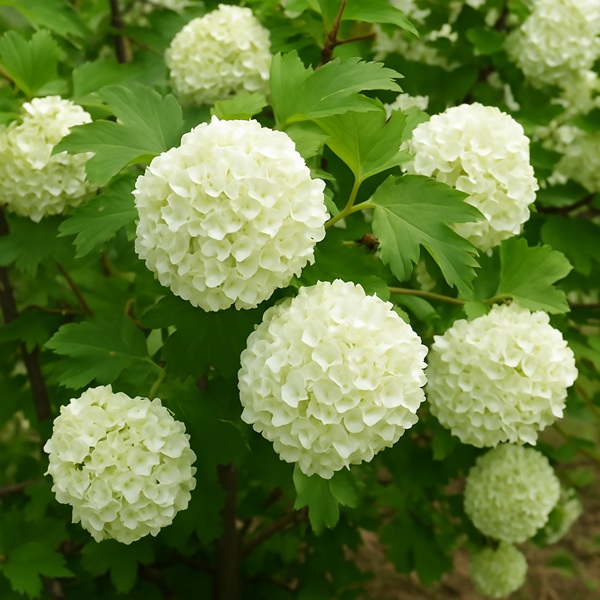
Snowball viburnum is the common name for the ornamental form of guelder rose (Viburnum opulus ‘Roseum’), distinguished by its large spherical clusters of sterile white flowers that resemble snowballs. It is precisely because of this resemblance that the plant received the French name boule de neige — “snowball.” Despite its ornamental purpose, snowball viburnum belongs to the same species as the fruiting guelder rose widespread in Ukraine. However, unlike the fruit-bearing form, this variety does not produce fruit, because its flowers lack stamens and pistils — they are sterile.
The shrub reaches 2–3 meters in height, has a dense spreading crown, quickly builds up green mass, and remains decorative from early spring until late autumn. Flowering begins in May and lasts about a month. The flower clusters are large, dense, and up to 15 cm in diameter, at first greenish, then snow-white, and toward the end may turn creamy or slightly pink. The leaves are three-lobed, bright green in summer, and reddish burgundy in autumn, which adds ornamental appeal even outside the flowering period. The shoots are strong, with grayish-brown bark, and the root system is powerful and shallow.
Snowball viburnum is widely used in landscaping and garden design throughout Ukraine: in parks, squares, home gardens, and summer cottages. It is valued for its unpretentious nature, frost resistance, and ability to form dense hedges. The plant is suitable for both solitary and group plantings, looking especially beautiful as a flowering accent against a lawn or in a composition with other shrubs. It is also ideal for formal areas, alleys, and recreation zones. Thanks to its versatility and striking appearance, snowball viburnum has become one of the most beloved ornamental shrubs in Ukraine.
Choosing the right planting site is the key to successful cultivation. Despite its overall hardiness, the shrub reveals its full ornamental qualities only under favorable conditions. In Ukraine, it grows in almost all climate zones — from the Carpathians to the south — provided the main cultivation rules are followed. Snowball viburnum prefers sunny or lightly shaded locations protected from wind. In deep shade, the plant develops more slowly, the flower clusters become smaller, and the foliage is less насыщене in color.
The best soil for snowball viburnum is loamy, well-drained, moderately moist, with a neutral or slightly acidic reaction (pH 6.0–7.0). On heavy clay or sandy soils, the shrub develops slowly, so the substrate should be improved. To improve heavy soils, add sand, humus, and compost. For soils that are too light, add clay, peat, and organic fertilizers. Good root aeration is essential, because stagnant water around the root collar can lead to rot. If needed, lay drainage from expanded clay or broken brick.
Preparing the planting hole includes:
digging the chosen site to a depth of 30–40 cm;
digging a hole 50×50×50 cm for saplings up to 3 years old, or 60×60×60 cm for older plants;
placing a drainage layer at the bottom;
adding a fertile mixture of garden soil + humus + sand in a 2:1:1 ratio;
if necessary, adding 1 cup of wood ash and 50 g of superphosphate.
The shrub should not be planted in low-lying places or where groundwater is high. It is also undesirable to plant snowball viburnum near trees with aggressive root systems such as poplar, walnut, or willow, which will take away moisture and nutrients.
In Ukraine, snowball viburnum is planted in spring (from mid-April to late May) or in autumn (from late September through October). Spring planting is recommended for regions with harsh winters, since the plant has time to establish well. Autumn planting is convenient because moisture accumulates naturally, and in spring the shrub starts growing faster. If the sapling has a closed root system, it can be planted throughout the growing season.
Step-by-step planting scheme:
Prepare the planting hole as described above.
Place the sapling in the center, carefully spreading the roots.
Fill with soil and firm it gently.
Water abundantly with 10–15 liters of water per shrub.
Mulch the trunk circle with peat, bark, or compost.
When planting, the root collar must not be buried — it should remain at ground level. During the first 4 weeks after planting, regular watering is necessary, 1–2 times a week depending on the weather. In the southern regions, temporary shading is advisable to protect the leaves from scorching.
During the first year, the area around the shrub should be kept clean — remove weeds, loosen the soil, and renew the mulch. No feeding is needed if the planting hole was prepared properly. At the end of summer, you may lightly pinch young shoots to stimulate branching.
Starting from the second year after planting, snowball viburnum requires regular but uncomplicated care. It is an undemanding, resilient crop capable of producing lush and long-lasting flowering every year. The main care elements include watering, feeding, formative pruning, and mulching.
Watering is especially important during hot months, which is typical of southern and central Ukraine. Although the shrub tolerates short periods of drought quite well, a lack of moisture during bud formation negatively affects both the number and quality of flower clusters. Watering is carried out once every 5–7 days, using 20–30 liters of water per shrub. After watering, it is advisable to loosen the soil to prevent crust formation. On heavy clay soils, excess moisture should be monitored carefully, since stagnation is dangerous for the root collar.
Fertilizing is done three times per season:
In spring — nitrogen fertilizers such as urea or ammonium nitrate to stimulate shoot growth;
Before flowering — a complex mineral fertilizer such as NPK 10-10-10 or a mullein infusion;
After flowering (July–August) — phosphorus-potassium fertilizers such as ash or superphosphate to strengthen the plant before winter.
In autumn, 1–2 buckets of compost or humus are applied under the shrub. This improves soil structure and provides nutrients for the following year.
Pruning is carried out in early spring before sap flow begins. The following are removed:
frost-damaged, weak, or diseased shoots;
thickening growth in the center of the shrub;
old branches over 5 years old for rejuvenation.
Flowering occurs on the current year’s shoots, so heavy pruning does not harm the plant — on the contrary, it improves its ornamental value. The shrub can be shaped in any form: spherical, fountain-like, or compact. In the southern regions, it is advisable to keep the shrubs lower to reduce moisture loss and root stress.
Snowball viburnum is highly resistant to diseases, but under unfavorable conditions — excessive moisture, overcrowding, or shade — it may be affected by fungal diseases or pests. The most common issues are powdery mildew, leaf spot, aphids, spider mites, and leafroller caterpillars.
Most common problems:
Powdery mildew — a white coating on the leaves in the second half of summer. The cause is excess nitrogen and overcrowding. Treatment: “Topaz,” “Skor,” or sulfur-based preparations.
Leaf spots — brown or black spots on the leaves that appear during rainy periods. Prevention: spring spraying with Bordeaux mixture and thinning of the crown.
Gray rot — excessive moisture and stagnation in the root zone cause leaf and flower decay. Watering should be reduced and affected parts removed.
Pests:
Aphids — settle on young shoots and cause leaf curling. Remedies: “Actellic,” “Intavir,” soap solution, or garlic infusions.
Spider mite — active in hot, dry weather and forms webbing. Treatment: “Fitoverm,” “Aktara.”
Leafroller caterpillars — eat the leaves and roll them into tubes. Control: manual removal and biological insecticides.
Prevention:
annual sanitary pruning;
thinning overcrowded shrubs;
early spring spraying with Bordeaux mixture;
destroying fallen leaves in autumn.
Regular observation and proper cultivation practices often make it possible to avoid chemicals and keep the shrub highly decorative.
Snowball viburnum can be propagated in several ways, but under Ukrainian conditions layering and cuttings are the most suitable. It is not propagated by seed, since the ornamental form is sterile. Division of an adult shrub is also possible, though difficult because of the well-developed root system.
Main methods:
By layering — in spring, a lower branch is bent to the ground, covered with soil, and fixed in place. Roots form within a year, and the young shrub can then be separated.
By green cuttings — in June, shoots 10–15 cm long are cut and rooted in sand or a peat-sand mixture under film. Roots appear in 2–3 weeks.
By woody cuttings — cut in autumn, stored in moist sand until spring, then planted in a greenhouse.
Young shrubs up to 5 years old tolerate transplanting best. It is done in spring or autumn, together with a clod of soil. After transplanting, abundant watering and temporary shading are required.
In landscape design, snowball viburnum is used:
as a specimen plant on a lawn;
in hedges;
in mixed borders;
in combination with conifers, hydrangeas, spireas, and roses.
It looks especially impressive against dark foliage or in compositions with perennials. Snowball viburnum is not only the beauty of May, but also a valuable ornamental plant for any region of Ukraine, successfully combining unpretentiousness with elegance.