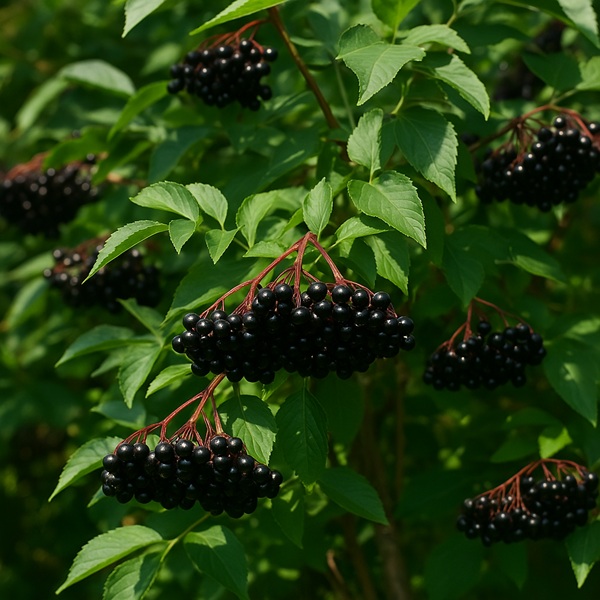
Elderberry (Sambucus) is a genus of shrubs and small trees in the Adoxaceae family, comprising about 25 species. In Ukraine, the most widespread are black elderberry (Sambucus nigra) and red elderberry (Sambucus racemosa), with the former being actively used as an ornamental, medicinal, and fruit-bearing plant. Black elderberry is a tall deciduous shrub that reaches 3–7 meters in height, with a spreading crown, airy foliage, and corymb-shaped inflorescences made up of small creamy-white flowers. It blooms in May–June and bears fruit in August–September. The berries are spherical, black with a purple tint, juicy, and borne in clusters.
In both folk and official medicine, elderberry is known as a powerful remedy for colds, immune support, and ailments of the kidneys and gastrointestinal tract. The flowers are used to prepare teas and infusions, while the berries are used for juices, jams, and liqueurs. The leaves and bark are also used in herbal medicine. Beyond its medicinal properties, elderberry is an excellent ornamental element: it looks attractive in both solitary and group plantings, responds well to shaping, grows quickly, and can be used as a hedge or as a background plant in mixed borders. In addition, elderberry has phytosanitary value — it repels pests and improves soil condition by enriching it with organic matter.
It is worth noting that elderberry is an extremely undemanding plant capable of growing in almost any conditions. It can be found both in the wild — along forest edges, ravines, and rivers — and in old cottage plots, village gardens, and near homesteads. For modern horticulture in Ukraine, not only wild forms are relevant but also ornamental cultivars bred by plant breeders: ‘Black Beauty’ with dark burgundy foliage and pink flowers, ‘Black Lace’ with finely cut dark leaves, ‘Albovariegata’ with variegated cream-and-green coloring, and others. These cultivars combine ornamental appeal, productivity, and resilience, making elderberry a highly versatile garden crop.
When selecting an elderberry variety for growing in Ukraine, both its ornamental qualities and practical use should be taken into account. For berry harvests, it is best to use proven high-yielding black elderberry cultivars such as ‘Haschberg,’ ‘Samdal,’ and ‘Samyl,’ which tolerate the climate of our country well, especially in the Forest-Steppe and Polissia regions. For ornamental plantings, cultivars with unusual leaves and flowers are ideal — they look striking and do not require intensive care.
Choosing a planting site for elderberry is not difficult, but it does affect growth rate and productivity. Elderberry prefers sunny or semi-shaded places protected from strong winds. In full shade, it grows slowly, blooms less abundantly, and bears almost no fruit. Although it is not demanding about soil type, it performs best in moist, well-drained, loamy soils rich in organic matter. Soil acidity should be within pH 5.5–7.5. Stagnant moisture is undesirable, as it can cause root rot.
Soil preparation includes:
digging the site to a depth of 30–40 cm;
removing weeds and plant debris;
incorporating humus or compost (5–10 kg per 1 m²);
if necessary, adding sand or vermiculite to improve soil structure.
If hedge planting is planned, a trench 40–50 cm deep and wide can be dug and filled with a fertile mix. For single planting, a hole measuring 50×50×50 cm is prepared. The spacing between shrubs should be 2.5–3 m for large cultivars and 1.5–2 m for hedges.
The best time for planting elderberry in Ukraine is spring (April–May) or autumn (late September–October). Spring planting is recommended in regions with cold winters, since the plant has time to establish before frosts arrive. In autumn, elderberry experiences less stress and forms its root system faster in a cool, moist environment. If a seedling with a closed root system is used, it can be planted throughout the entire warm season.
The planting technique involves:
Digging a hole or trench.
Adding compost and wood ash to the bottom.
Setting the seedling vertically and carefully spreading the roots.
Filling with fertile soil, firming it, and watering generously (10–15 liters per shrub).
Mulching the surface with peat, straw, or bark.
Seedlings with an open root system should be soaked in a growth stimulant solution (for example, “Kornevin”) for 2–3 hours before planting. The root collar should not be buried — it should remain at soil level. After planting, elderberry is watered regularly for the first month (1–2 times per week), especially in dry weather. At the same time, it is important to avoid both drying out and overwatering, as young roots are very sensitive.
In the southern regions of Ukraine, elderberry is best planted in spring so that it has time to adapt before the heat arrives. In the northern and western regions, where moisture lasts longer, autumn planting is even preferable. During the first two years, the plant is not fed with mineral fertilizers — the organic matter added at planting is sufficient. The main focus is watering, crown formation, and regular loosening.
Caring for elderberry in open ground is simple, which makes it especially attractive for both beginner gardeners and experienced growers. The essentials are regular watering, nutrient application, and pruning. When these conditions are met, elderberry grows steadily, blooms abundantly, and produces a rich harvest.
Watering is especially important in the first year after planting and during dry periods. A mature plant tolerates short-term moisture deficiency, but during budding and berry filling the soil should remain moderately moist. In the Forest-Steppe and Polissia regions, where summer is often accompanied by rainfall, watering is done as needed. In the southern regions of Ukraine, drip irrigation or water furrows are recommended. One mature shrub needs 20–30 liters of water per week during active growth.
Starting from the second year, the following feedings are applied:
in spring — nitrogen fertilizers (nitrate, urea, poultry manure infusion) to build green mass;
during the budding period — complex mineral fertilizers with micronutrients;
after harvest — phosphorus-potassium compounds (superphosphate, potassium sulfate) to prepare for winter.
Organic fertilizers — humus, compost, and ash — are applied in spring or autumn during digging. Excess nitrogen is undesirable, as it causes lush leaf growth at the expense of flowering and berry production.
Pruning is extremely important for harmonious shrub development. It is carried out:
in early spring — sanitary pruning (removing dry, frost-damaged, and overcrowding branches);
after flowering — formative pruning (shortening shoots and stimulating branching);
in autumn — light sanitary thinning.
The shape of the shrub can vary: spherical, fan-shaped, or standard. Thanks to its rapid regrowth, elderberry recovers easily after pruning, making it possible to maintain the desired appearance each year.
Elderberry is distinguished by high resistance to diseases and pests. However, if care is neglected or weather conditions are unfavorable, certain problems may arise — mainly fungal diseases and insect pests. The most affected are dense, overwatered, or excessively shaded plantings.
The most common diseases are:
Powdery mildew — a white coating on leaves and young shoots. It appears in damp weather. Treatment includes “Fundazol,” “Topaz,” or infusions of pine needles and wood ash.
Gray rot — affects berries during ripening, especially in rainy periods. Prevention includes thinning the shrub and reducing watering.
Viral mosaic and leaf spotting — yellow or brown patterns on the leaves. Diseased plants should be removed and burned.
The main pests are:
Aphids — settle on shoot tips and cause leaves to curl. Tobacco infusions, garlic, green soap, and preparations such as “Aktara” or “Intavir” are used.
Spider mite — active in hot weather. Leaves become covered with fine webbing. Control measures include “Fitoverm” and “Actellic.”
Leafrollers and sawflies — feed on leaves and flowers. They are collected by hand or controlled with biological products.
Preventive measures include:
ensuring proper air circulation in plantings;
pruning and cleaning shrubs annually;
treating with 1% Bordeaux mixture in early spring;
removing fallen leaves and affected fruit in autumn.
Systematic care and scheduled rejuvenation of shrubs every 10–12 years help prevent the buildup of infections in plantings.
Elderberry begins bearing fruit in the 3rd–4th year after planting. During active growth, one shrub can produce up to 10–15 kg of berries. Flowering lasts from May to June, and harvesting takes place in August–September. The berries are collected only when fully ripe — they become black, soft, and separate easily from the stalk.
Harvesting is done by hand, in dry weather, preferably in the morning or evening. Fresh berries keep for 2–3 days in the refrigerator. For long-term storage, the following methods are used:
freezing — after washing and drying the berries;
drying — in a dryer at +40...+50 °C until fully dehydrated;
preserving — in the form of jam, juices, syrups, and liqueurs.
Elderberry flowers are also harvested during blooming — the inflorescences are cut and dried in the shade. Leaves, bark, and roots are also used in folk medicine, but with caution, since some substances contain mildly toxic compounds.
Propagation methods include:
by seed — requires 2–3 months of stratification;
by layering — shoots are pinned to the ground in spring and separated the following year;
by green cuttings — rooted in summer in a greenhouse;
by root suckers — easily separated from the mother shrub.
Elderberry is a highly versatile crop. It is combined with lilac, spirea, rowan, and lavender. It is used as:
a medicinal and fruit-bearing plant;
an ornamental plant — in hedges and mixed borders;
a phytosanitary crop — for soil improvement and pest repelling.
In the conditions of Ukraine, elderberry adapts easily to most climate zones, does not require intensive care, and can enhance any garden. It is a true find for those who value natural beauty, usefulness, and simplicity.