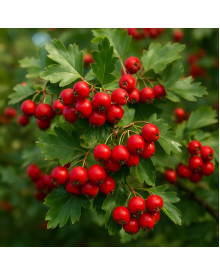
Lingonberry (Vaccinium vitis-idaea) is an evergreen berry shrub valued both for its ornamental qualities and for its medicinal and culinary properties. In Ukraine, it is known primarily as a wild forest berry common in Polissia and the Carpathians, but in recent decades the crop has been actively introduced into household and farm plots. When all cultivation requirements are properly followed, lingonberry shows high yields and good resistance to diseases and pests.
The bush is compact, up to 30 cm tall. The stems are creeping, the leaves are small, leathery, dark green, and remain on the plant through winter. Flowering takes place in May–June, and the fruits — bright red berries 6–8 mm in diameter — ripen from late August. One unique feature is that many garden varieties bear fruit twice per season — in August and again in October. This makes lingonberry especially interesting for commercial and semi-commercial cultivation.
The following varieties are the most widespread in Ukraine:
‘Coral’ — early, with large berries, frost-resistant;
‘Rubin’ — high-yielding, suitable for processing;
‘Ida’ — adapted to the climatic conditions of Central Europe;
‘Mount’ — noted for even fruiting.
All of these varieties establish well in the Forest-Steppe zone, Polissia, and the foothills of the Carpathians. In the southern regions, cultivation is possible provided shading and regular watering are arranged. Even on a small plot of 10 m², it is possible to harvest up to 1.5–2 kg of berries per season, which makes the crop worthwhile even for summer residents.
The key soil requirement is an acidic reaction (pH 3.5–5.5). This is the main limitation for most Ukrainian gardeners, since natural soils such as chernozem and loam are not suitable for lingonberries. However, with proper preparation, optimal conditions can be created.
Step-by-step bed preparation:
Choose a sunny or lightly shaded place protected from the wind.
Remove the top layer of soil to a depth of 30–40 cm and replace it with an acidic substrate.
For the substrate, use a mixture of:
high-moor (reddish) peat — 3 parts;
sand — 1 part;
conifer bark, sawdust, or forest litter — 1 part.
To lower the pH, add:
powdered sulfur (30–50 g/m²);
citric acid in water solution;
or specialized acidifying products.
In Polissia and the Carpathians, it is sometimes possible to do without completely replacing the soil, especially if the plot is peaty. But even in such cases, it is desirable to improve the soil structure with sand and conifer-based organic matter and to mulch the surface with pine needles.
If the soil is heavy (clay) or tends to retain water, it is essential to:
form raised beds 25–30 cm high;
arrange drainage using crushed stone or expanded clay;
use agrofabric to protect against weeds and retain moisture.
Tip: in the southern regions of Ukraine, it is better to grow lingonberries in containers — this allows precise control over soil composition and moisture.
The best time for planting is spring (April–May) or autumn (September–October). In most regions of Ukraine, the spring option is preferred because the plants have more time to adapt before winter.
Container-grown seedlings with a closed root system establish best because:
the roots are not damaged during transplanting;
they can be planted throughout the season;
the survival rate is higher.
Seedlings with an open root system require:
mandatory soaking before planting (3–4 hours);
treatment of the roots with fungicides and growth stimulants.
Planting layout:
between plants — 25–30 cm;
between rows — 35–40 cm;
depth — at the level of the root collar, without burying it.
After planting, the plants should be watered well (about 1 liter per bush) and the surface should be mulched with peat, pine needles, or bark. In the first year, lingonberries develop slowly — the plant focuses on forming its root system. Above-ground growth may be almost unnoticeable. Therefore, the plants should not be fertilized in the first season, especially with mineral fertilizers, since an excess of nutrients may disrupt soil acidity.
To stimulate development:
provide regular but moderate watering;
maintain acidity — acidify the water when necessary, for example with citric acid (1 tsp per 10 liters);
do not allow weeds to appear, especially grasses, since they suppress lingonberries.
The first harvest can be gathered in the 2nd or 3rd year, and the bushes reach maximum productivity in the 4th or 5th year.
Starting from the second year after planting, once lingonberries have formed a stable root system, care becomes regular. Since this is a perennial crop that can grow in one place for up to 20 years, it is important to provide stable conditions for development. The main focus is on watering, acidity control, fertilization, pruning, and mulching.
Watering is especially important in the southern and central regions of Ukraine. Lingonberries are sensitive to drying out, especially during flowering and fruit set. In hot weather, watering is done 2–3 times a week, approximately 5–7 liters per m². It is best to water with acidified water (pH 4.5–5.5), using citric acid (1 tsp per 10 liters of water) or powdered sulfur. Acidity can be checked using litmus paper or an electronic pH meter.
Fertilization begins in the second year according to the following scheme:
In spring — a small dose of nitrogen fertilizer (ammonium nitrate, ammonium sulfate);
During budding — a complex fertilizer for ericaceous crops;
In autumn — a phosphorus-potassium fertilizer to strengthen tissues before wintering.
Among organic fertilizers, conifer litter, sawdust, and bark are the most suitable. Manure, humus, and compost made from food waste are not recommended — they alter the pH and may cause root rot.
Pruning is minimal: only dry, damaged, or old branches over 5 years old are removed. After 7–10 years, partial rejuvenation of the planting is possible — the bushes are cut down to ground level, leaving living parts for regrowth.
Lingonberries bear fruit twice a year. The main harvest is gathered from late August to early October depending on the variety. A second fruiting is possible in October–November if autumn is warm. The berries ripen gradually, so harvesting is done in 2–3 stages. The fruits are easy to pick and do not fall off, which makes harvesting convenient.
Main harvesting methods:
by hand — the gentlest method, which does not damage the bushes;
with special berry combs — on mature plantations;
semi-mechanized — in industrial cultivation.
Yield levels:
from one bush — 150–300 g;
from 1 m² — up to 700 g;
from 100 m² — 40–70 kg with dense planting.
The fruits have a dense skin and natural preservative properties thanks to benzoic acid. At +4 °C in a refrigerator, they keep for up to 3 months; in a cellar, up to 2 months. Dried berries retain their beneficial properties for up to 2 years. It is best to dry them outdoors in the shade or in a dryer at +40...+50 °C.
Processing options:
jams, preserves, fruit leather;
compotes, pickled lingonberries as a traditional storage method;
syrups, juices, fruit drinks;
tinctures, liqueurs, teas, and herbal blends.
Lingonberries are often mixed with blueberries, rose hips, currant leaves, and mint to create functional vitamin teas.
Lingonberries are propagated in several ways:
Vegetatively — the most reliable method:
by dividing the bush in spring or autumn;
by layering — a branch is bent down, covered with soil, and separated after rooting;
by cuttings — green shoots are cut in June, treated with a stimulant, and rooted under film.
By seed — a more difficult method, requiring stratification for 3–4 months at +2...+4 °C. It is used more often in breeding work.
Lingonberries rarely become diseased, but under unfavorable conditions the following are possible:
phytophthora — from excess moisture;
gray mold — in dense plantings;
powdery mildew — during prolonged dampness.
Prevention:
regular thinning;
drainage and raised beds;
removal of diseased parts.
Possible pests:
caterpillars that eat the leaves — treated with “Fitoverm” or “Lepidocide”;
aphids and ants — especially near garden trees;
rodents in winter — controlled with pine-needle mulch and protective mesh.
The prospects for lingonberry cultivation in Ukraine are very high. It is becoming more popular due to the increased demand for organic and medicinal products and for functional berries. A small plantation can provide not only for a household, but also form the basis of a berry microbusiness. In terms of cultivation technology, lingonberries are similar to blueberries, but they are less demanding and adapt more easily to a temperate climate.
So, lingonberry is not just a beautiful and tasty berry, but a perennial crop with great potential for private gardeners and small agricultural projects.