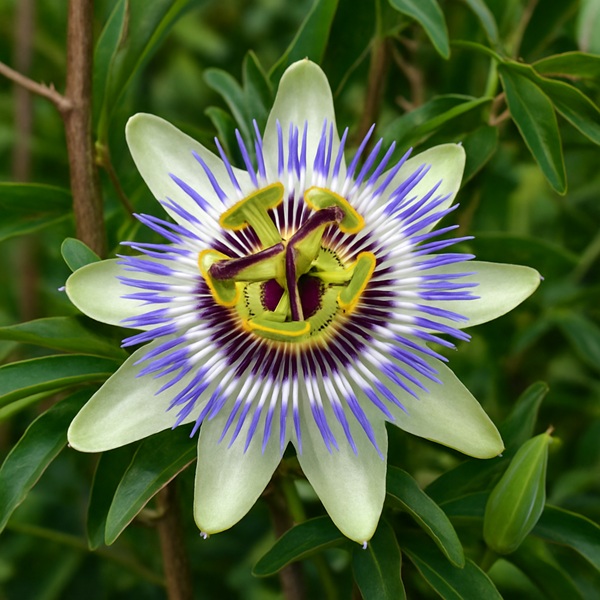
Passionflower, or passiflora (Passiflora), is an ornamental and fruit-bearing vine native to the tropics and subtropics of the Americas. It captivates with its unusual, almost fantastical flowers and is becoming increasingly popular among Ukrainian flower growers. In addition to its aesthetic value, some passionflower species produce delicious, fragrant fruits — passion fruit — which can also be obtained in Ukraine under the right conditions. Despite its southern origin, passionflower adapts well to a temperate climate when grown in containers, greenhouses, or as a houseplant, and it can also be grown seasonally in open ground during the warmest part of the year.
Passionflower is an evergreen or semi-deciduous vine that clings to supports with tendrils. Its shoots can reach 3–6 meters in length, and with good care, even up to 10 meters. The flowers, 5–12 cm in diameter, have a unique symmetry: a central column with stamens and stigma is surrounded by petals and a distinctive “crown” of thread-like rays. Their color ranges from white-blue to violet-red, depending on the variety. Flowering lasts from early summer to autumn, and in indoor cultivation it may continue almost continuously. In Ukraine, the most commonly grown species are Passiflora caerulea, Passiflora edulis, and their hybrids.
Passionflower is well suited to vertical landscaping: it decorates arches, walls, gazebos, and trellises. It is also grown on balconies, in greenhouses, and in winter gardens. It creates a true “living screen” of foliage and flowers. Under Ukrainian conditions, seasonal growing is especially popular: in spring the plant is moved outdoors, in summer it grows and blooms actively, and in autumn it is brought back indoors for wintering. In the southern regions of Ukraine, planting it in open ground is possible, but only with reliable winter protection or in specially equipped warm zones.
For passionflower to grow healthily, bloom abundantly, and bear fruit, it is important to choose the right place and provide the proper microclimate. Although it comes from warmer regions, the plant is not overly demanding. However, it is sensitive to lack of light, temperature fluctuations, and stagnant water. The best conditions can be created on a glazed balcony, in a greenhouse, or near a south-facing window.
Lighting:
Passionflower is a light-loving plant and needs at least 6–8 hours of direct sun per day.
With insufficient light, the shoots become leggy and flowering weakens or disappears completely.
In winter, it is advisable to supplement with grow lights for up to 12 hours a day.
Temperature:
In summer, the ideal temperature is +20 to +28°C. Temperatures above +30°C combined with dry air may cause buds to drop.
In spring and autumn, it is comfortable at +18 to +22°C.
In winter, passionflower should preferably be kept at +8 to +12°C for deciduous types, or at +12 to +15°C for evergreen varieties.
Growing location:
In open ground — only in the southern regions of Ukraine, with winter cover.
On balconies and terraces — on the south or southwest side, with shading during extreme heat.
In greenhouses — ideal from spring to autumn, followed by moving indoors.
Passionflower does not tolerate drafts. Even brief exposure to cold or wind can cause bud drop and stop growth. Outdoors, it should be protected with screens or planted near other plants that reduce wind exposure.
Planting passionflower begins with choosing the right pot, substrate, and support. This plant quickly builds up both root mass and vegetative growth, so enough space should be planned from the start. The best time for planting is spring — March or April — when daylight hours are increasing.
Container size:
For seedlings — pots of 0.5–1 liter.
For mature plants — 5–10 liters, with mandatory drainage holes.
For open-ground growing — a planting hole with drainage and fertile soil.
Substrate:
Ideal mix: turf soil, humus, peat, and sand (2:2:1:1).
An alternative is ready-made soil for citrus or grapevines.
Acidity should be slightly acidic to neutral (pH 6.0–6.5).
Planting technique:
Place drainage at the bottom of the pot — expanded clay or pebbles.
Keep the root collar at soil level.
After planting, water thoroughly and provide shade for a few days.
Be sure to install a support — mesh, wire, or vertical rods.
Young plants are repotted every year, while mature ones are repotted once every 2–3 years by transshipment, without damaging the roots. Passionflower does not tolerate loss of part of its root system well, so repotting should be done very carefully.
Passionflower is a vigorous and active plant that grows quickly, blooms heavily, and responds well to proper care. The main task is to provide regular watering, stable temperatures, moderate air humidity, and regular feeding.
Watering and humidity:
During the growing season, from spring to autumn, it should be watered generously as soon as the top 2–3 cm of soil have dried out.
In autumn, watering is reduced, and in winter the plant is watered rarely, only after the substrate has dried somewhat.
High air humidity is optimal: misting, trays with moist pebbles, and room humidifiers all help.
Feeding:
From March to August — every 10–14 days with fertilizer for flowering or fruiting plants.
Fertilizers with a higher phosphorus and potassium content work especially well.
Nitrogen fertilizers should be used carefully, as too much nitrogen causes vigorous leaf growth at the expense of flowering.
Pruning:
Every spring before growth begins — sanitary and formative pruning: shorten the main shoots by one-third and remove weak or leggy growth.
In summer, light shaping can be done to maintain form and stimulate side branching.
Pruning promotes active flowering and improves the appearance of the vine.
Without pruning, passionflower may lose its ornamental appeal, become leggy, and flower poorly. This is especially important indoors, where limited space requires regular control of the plant’s growth.
Passionflower blooming is a true show. Each flower lives only 1–2 days, but dozens of buds may appear on the plant, ensuring continuous flowering. Under the right conditions, fruiting is also possible — especially in Passiflora edulis varieties or specially bred hybrids.
Conditions for flowering:
Buds form on young shoots of the current year.
To set flowers, the plant needs bright sun, fresh air, and a temperature of +20 to +25°C.
Too much nitrogen or too little light suppresses bud formation.
Fruit set:
Self-pollinating varieties can set fruit on their own.
Indoors, hand pollination with a brush is recommended.
The fruits ripen in 60–90 days, starting green and later turning yellow or taking on a purple tint.
How to improve yield:
Provide 12–14 hours of light.
Feed with phosphorus-potassium fertilizers during flowering and fruit set.
Do not overload a young plant with too many fruits.
Even without fruiting, passionflower remains exceptionally decorative, creating a tropical atmosphere on a balcony, terrace, or in an apartment.
Passionflower does not tolerate frost. In most regions of Ukraine, it cannot overwinter outdoors, so proper indoor wintering must be arranged. Depending on the variety, the plant either keeps its leaves or enters dormancy.
Preparing for winter:
From October, reduce watering and stop feeding.
Remove damaged and excessively long shoots.
Move the pot to a cool, bright room.
Wintering conditions:
Temperature: +8 to +12°C for deciduous species, or +12 to +16°C for evergreen ones.
Light: diffused, or supplemented with grow lights for 6–8 hours.
Watering: moderate, only after the substrate has dried somewhat.
Waking up in spring:
In March, gradually resume watering and feeding.
Prune to shape the plant.
Move it to a warmer, brighter place or into a greenhouse.
After wintering, passionflower quickly resumes growth and begins flowering again as early as May or June. If desired, cuttings can be rooted or seeds can be sown to obtain new plants. Passionflower is a rewarding and resilient crop that, with proper care, will put on a truly spectacular floral show even in Ukrainian conditions.