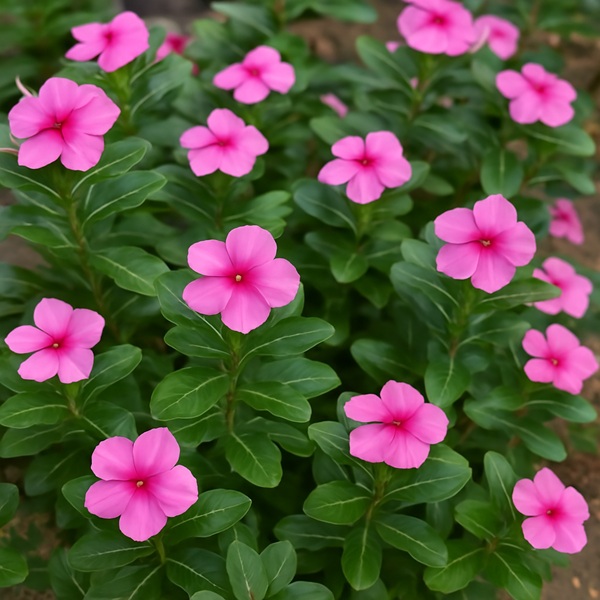
Catharanthus (Catharanthus roseus), also known as Madagascar periwinkle, is a heat-loving evergreen plant native to the tropical regions of Madagascar and India. It is a herbaceous perennial that, in a temperate climate, including in Ukraine, is usually grown as an annual crop or as a perennial houseplant. Catharanthus has become popular in ornamental gardening thanks to its bright, abundant flowers and glossy green foliage. Its flowers resemble phlox or impatiens and come in a wide range of shades — pink, purple, crimson, white, lilac, often with a contrasting eye in the center. This color range makes catharanthus a versatile choice for flower beds, balconies, terraces, and even windowsills.
One of the main features of catharanthus is its ability to bloom continuously from May until the first frosts, provided it receives proper care. Even on cloudy or rainy days, the plant remains decorative and continues forming new buds. In Ukrainian conditions, catharanthus is grown either as an annual in flower beds or as a perennial in containers that are overwintered indoors. Its resistance to heat, drought, and urban dust makes it suitable for city landscaping — it looks excellent in planters, public parks, near stairways, and on terraces. In addition, catharanthus has pharmaceutical value: its leaves contain alkaloids used in medicine, particularly in the treatment of cancer.
What is especially important for Ukrainian gardeners is that catharanthus adapts well to different climatic regions of the country, from the south such as Odesa, Mykolaiv, and Kherson regions to the center including Kyiv, Poltava, and Cherkasy regions, and the west such as Lviv and Ivano-Frankivsk regions. The one essential rule is protection from cold and properly organized watering. The plant is sensitive to excess moisture, especially in heavy clay soils, but it can tolerate drought for a long time while still keeping its flowers even in hot weather. It can be grown both through seedlings and by direct sowing in open ground, but the first option makes it possible to extend the flowering period and speed up the plant’s development.
The most reliable way to obtain richly flowering catharanthus plants in Ukraine is to grow them through seedlings. Sowing is carried out in March to early April, depending on the region. The seeds are small but germinate well if the temperature regime is maintained. The optimal germination temperature is +22 to +26 °C. Before sowing, it is advisable to disinfect the seeds in a weak potassium permanganate solution for 20 minutes and then soak them in a growth stimulant such as Epin or Zircon for 2–4 hours.
The main stages of seedling production are as follows:
The soil mix should be light and breathable — a mixture of peat, coconut fiber, and perlite in a 1:1:1 ratio works well.
The seeds are sown on the surface and lightly sprinkled with vermiculite or a thin layer of peat.
The container is covered with film or glass and placed in a warm, bright location without direct sunlight.
Seedlings appear in 5–10 days. After the first true leaves appear, the cover is removed and the containers are moved to a brighter place. Watering is done carefully — preferably through the tray to avoid overwatering. At the stage of 2–3 true leaves, the seedlings are pricked out into separate cups, and it is advisable to bury them up to the cotyledons. Before planting in open ground, the seedlings are hardened off by taking them outside for a few hours each day.
Catharanthus is planted in open ground at the end of May, once the threat of frost has passed. The plant prefers sunny places, but it also tolerates light partial shade well. The spacing between plants should be 20–30 cm depending on the variety. The soil is dug over in advance, with compost or humus added, along with a little sand for better drainage. At planting, slow-release fertilizers such as nitroammophoska or other complex blends may be used. After planting, watering and mulching with peat are carried out.
Although catharanthus is considered undemanding, the basic care rules should be followed to achieve the maximum ornamental effect. The most important point is regular but moderate watering. The plant does not tolerate either drying out or stagnant water well. Watering is done after the top layer of soil has dried, avoiding water on the leaves and flowers. During hot periods, it is watered 2–3 times a week, and less often in cool weather. This rule is especially important when growing it in containers.
Feeding is carried out once every 10–14 days. Complex fertilizers for flowering plants with a higher content of phosphorus and potassium are used, such as Agricola or Kemira Lux, as well as organic solutions like nettle infusion and ash solution. In open ground, feeding begins 10–14 days after planting, while in containers it begins immediately after rooting. Excess nitrogen should be avoided, since it stimulates leaf growth at the expense of flowering.
Regular removal of faded flowers encourages the formation of new buds. Pinching the shoots in mid-summer stimulates branching and rejuvenates the plant. Catharanthus responds well to pruning, which makes it more compact. In unfavorable weather conditions such as prolonged rains or sharp temperature changes, fungal diseases may appear, including powdery mildew, gray mold, and blackleg. Fundazol, Topaz, and Fitosporin are used for prevention. Among pests, aphids, whiteflies, and spider mites are the most common, and soap solution or insecticides are used against them.
Catharanthus is one of the most versatile plants for growing in pots, containers, and hanging baskets. In Ukraine, where the outdoor season lasts only a few months and winters do not allow heat-loving flowers to remain in flower beds, container growing offers many advantages. Catharanthus grows beautifully in hanging baskets, on balconies, verandas, loggias, and also indoors — in winter gardens or near south-facing windows. With proper lighting and temperature, the plant can bloom all year round.
The main requirements for container growing are:
The pot volume should be at least 2–3 liters per plant.
The soil mix should be light and well-drained, made from peat, vermiculite, and sand or coconut substrate.
Drainage is mandatory — a layer of expanded clay, pebbles, or broken brick.
The location should have bright light, preferably on the south or east side, but with shading during extreme heat.
Catharanthus in pots needs to be watered more often than in open ground, but not excessively. The best method is through the tray or carefully at the root, avoiding waterlogging. Feeding should be done weekly, alternating organic and mineral products. Ventilation is also an important factor — in stuffy conditions, the risk of fungal diseases increases. In September and October, container-grown catharanthus is brought indoors for overwintering. A temperature of +18 to +24 °C and supplemental lighting for 12–14 hours a day allow the plant not only to keep its leaves but also to continue blooming during the off-season.
Catharanthus can be propagated in several ways: by seeds, cuttings, or division of the bush. The seed method is the most common in Ukraine, especially for spring cultivation of annual plants. Seeds remain viable for up to 2–3 years, although varietal traits are best preserved when using purchased seed. Seeds collected by hand can also be sown, but the ornamental quality of the flowers may decline in the next generations.
Cuttings are the best option for indoor or container plants that you want to preserve for the next season. Cuttings are taken from the tops of healthy shoots, 10–12 cm long. The lower leaves are removed, and the upper leaves are shortened. Rooting takes place:
In water with activated charcoal added, where roots appear in 1–2 weeks;
In moist peat with sand under a cover;
In peat tablets, mini-greenhouses, or with bottom heating.
Rooted cuttings quickly form a root system and can bloom in as little as 1.5–2 months. Division of the bush is used rarely, mainly in indoor cultivation when the mother plant becomes too large. The divided parts are replanted into fresh soil and provided with moderate moisture and protection from direct sunlight at first. Catharanthus adapts easily after transplanting and soon resumes growth and flowering.
In modern landscape design, catharanthus holds an important place as a decorative, undemanding, and versatile plant. It is often planted in borders, mixed flower beds, and front-row flower beds, combined with low-growing ornamental grasses, cineraria, ageratum, and hostas. It looks especially impressive when paired with periwinkle, petunia, and marigolds. It can even be planted in dry areas of the garden or in containers placed around the perimeter of a terrace, steps, or a gazebo. Catharanthus is hardy, retains its color for a long time, and does not require daily care.
Indoors, the plant also feels comfortable. It purifies the air well, humidifies it, creates a pleasant microclimate, and brings coziness to any room. For long-lasting flowering indoors, a few conditions should be observed: plenty of light, preferably with supplemental lighting, a temperature not lower than +18 °C, regular but moderate watering, and weekly feeding. In winter, under insufficient lighting, flowering may stop, but it will resume with the arrival of spring.
The advantages of catharanthus include:
Bright and long-lasting flowering until the first frosts;
Ease of cultivation, even for beginners;
Suitability for balconies, flower beds, and windowsills;
Good compatibility with other plants;
Easy propagation.
To sum up, catharanthus is a plant that brings color, mood, and ornamental beauty with minimal effort. In Ukrainian conditions, it does very well both in open ground and in containers. Thanks to its flexibility, versatility, and hardiness, catharanthus can become a true highlight of your garden, balcony, or interior.