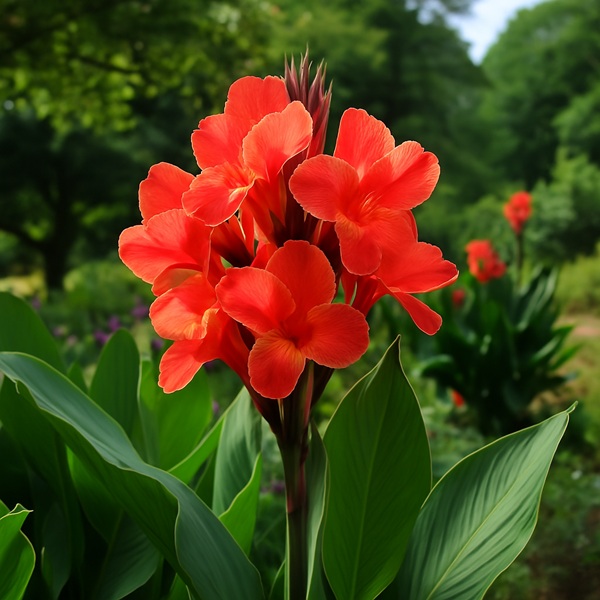
Canna is a striking herbaceous plant with a tropical look and exotic charm. It belongs to the Canna family (Cannaceae) and is represented by numerous varieties and hybrids cultivated all over the world, including in Ukraine. Canna is native to Central and South America, but thanks to the breeding of adapted forms, it has become popular even in temperate climates. It is valued for its large, bright inflorescences, which resemble orchids or gladioli, as well as for its decorative foliage, which may be green, purple, bronze, or variegated. Depending on the variety, canna ranges in height from 50 cm to 2 m, which allows it to be used both in group plantings and as a standalone accent.
Cannas bloom from early summer until the first frosts, which makes them one of the longest-flowering ornamental crops. The flowers are gathered in terminal inflorescences and may be red, yellow, orange, pink, or bicolored. The leaves are broad and oval, shaped somewhat like banana leaves, and often have either a glossy or matte surface. Thanks to their texture and color, the foliage remains attractive even when the canna is not in bloom. That is why the plant is actively used in landscape design: for decorating flower beds, borders, urban flower plantings, terraces, balconies, and also as a container-grown crop.
In Ukraine, canna is grown as a tuberous perennial crop whose tubers must be dug up for the winter. This is due to its sensitivity to frost — temperatures below -5°C are fatal to it. At the same time, under Ukrainian summer conditions, canna grows and develops very well, forming massive clumps and abundant flowering even in regions with short summers. In addition to its ornamental role, canna also has other uses: in some countries it is grown as a fodder or industrial crop, and its starch-rich rhizomes are used in the food industry. In Ukraine, however, canna remains primarily an ornamental plant widely used both in urban landscaping and on private plots.
Planting canna in Ukraine requires preparation, since the plant is sensitive to cold and wakes up slowly after winter. In autumn, canna tubers are dug up and stored in a cool room until spring. The best time for planting in open ground is the second half of May, when the threat of return frosts has passed and the soil has warmed to +12 to +15°C. To speed up vegetation and obtain earlier flowering, it is recommended to pre-sprout the tubers indoors from late March or early April.
Tubers are pre-sprouted in several stages:
Cleaning the tubers of old roots and disinfecting them in a weak potassium permanganate solution for 20–30 minutes.
Planting them in containers with a loose mixture of peat, sand, and humus in a 1:1:1 ratio.
Keeping the containers in a warm, bright place at +22 to +25°C with regular moisture.
For outdoor planting, a sunny site protected from wind is chosen. Canna prefers fertile, well-drained soil with a neutral or slightly acidic reaction, pH 6.0–6.8. It is advisable to add compost, humus, and a complex mineral fertilizer with a higher content of potassium and phosphorus to the planting hole. Planting depth is 5–10 cm, and spacing between plants is 30–60 cm. After planting, abundant watering is carried out, especially in dry weather. During the first weeks, it is important to maintain steady moisture to stimulate growth.
Canna is most often propagated by dividing the tubers, which makes it possible to preserve varietal traits and rejuvenate the plant. Division is carried out in spring before pre-sprouting. It is important that each section has at least one active growth bud. Seed propagation is also possible, but it is used rarely because of the difficulty of germination and the unpredictability of the result. This method is most appropriate for breeding purposes or for obtaining new varieties.
Caring for canna is not difficult, but it does require consistency. The main tasks are watering, feeding, weeding, loosening the soil, and removing faded flower stalks. Canna is very moisture-loving, especially during hot periods. In drought, it should be watered at least 2–3 times a week, and on sandy soils almost daily. At the same time, it is important to avoid standing water, especially in cool weather, since this may cause the rhizomes to rot. Mulching with humus, cut grass, or peat helps preserve optimal moisture.
Feeding is carried out every 2–3 weeks. At the beginning of the growing season, nitrogen fertilizers are used to build green mass, and from the budding stage onward the plant is switched to phosphorus-potassium complexes. Organic infusions also work well: mullein diluted 1:10, fermented herbal infusion, and ash solution. It is important not to overload canna with nitrogen, otherwise the leaves will grow at the expense of the flowers. Weeding and loosening are done carefully so as not to damage the root system, especially after planting.
Sanitary care is just as important. Faded inflorescences are removed regularly so the plant does not waste energy on seed production. Damaged leaves are also removed, especially in damp weather, to avoid fungal diseases. Canna is generally resilient, but when overwatered it may suffer from gray mold, leaf spot, or rust. For prevention, copper-based fungicides or biological products are used. Among pests, slugs and aphids pose a threat, and these are controlled either mechanically or with insecticides.
Since canna is a heat-loving plant that cannot survive Ukrainian winters in open ground, its tubers must be dug up every year and stored until spring. Autumn care begins with gradually reducing watering and stopping feeding in September. This helps the plant enter dormancy. When the canna finishes flowering and the lower leaves begin to yellow, usually from late October to early November, digging can begin. It is not advisable to delay, because the first frosts may damage the above-ground part and affect tuber quality.
The digging process is as follows:
First, the above-ground part is cut back to a height of 10–15 cm.
Then, the tuber is carefully dug up together with a clod of soil so the roots are not damaged.
For 2–3 days, the tubers are dried in a ventilated room and cleaned of soil residues.
Cannas are stored at +5 to +8°C in a dark, dry place with ventilation. Ideally, they are kept in boxes filled with dry sawdust, sand, or peat. Some gardeners wrap the tubers in paper or fabric to protect them from drying out. During winter, the material should be checked regularly: rotting parts should be removed, the tubers should be aired out, and if necessary, slightly moistened or the filler replaced. If the room is too dry, the tubers wrinkle, while excessive humidity causes rot. It is also important to watch for mold, especially in cellars or storage rooms with unstable temperatures.
Canna is one of the few plants that looks attractive both in group and in individual plantings. Thanks to its exotic appearance and large decorative form, it often becomes the central element of a flower bed or ornamental corner. In Ukrainian landscape design, it is used as an accent plant in borders, mixed beds, along alleys, and near ponds. Large-scale canna plantings look especially impressive in city parks, flower beds, and public squares.
Common ways to use canna include:
Specimen planting — single clumps on lawns, in flowerpots, or planters.
Group design — row or cluster plantings in flower beds.
Tropical-style beds — combined with castor bean, amaranth, hostas, and ornamental grasses.
Container growing — for balconies, verandas, and terraces, especially in movable landscaping.
Canna combines well with plants that have contrasting leaves or inflorescences, such as delphiniums, gladioli, dahlias, and coleus. Thanks to the wide color range of its varieties, it is possible to create either bright contrasting or harmonious compositions. Yellow, orange, and red varieties pair especially well with white, purple, or blue flowers. Planting several canna varieties in one mass is also practiced to create gradients and color transitions.
Decorative shrubs such as barberry and boxwood, conifers such as arborvitae and junipers, or vertical supports can serve as a background for canna. The contrast between canna’s large leaves and small-leaved plants creates a balanced composition. It is worth remembering the height of the variety: tall forms are placed in the center or at the back of a flower bed, while low-growing ones are placed in the foreground or in containers.
Although canna is considered undemanding, certain difficulties may arise when growing it in Ukraine. The most common problem is overwatering or stagnant moisture, especially during cool periods, which provokes rhizome rot. In rainy weather and with overly dense plantings, fungal diseases such as alternaria, leaf spots, and rust may occur. Their symptoms include darkening leaves, the appearance of brown spots, and slowed growth.
What to do if problems appear:
If fungal disease appears, treat the plant with fungicides such as Bordeaux mixture or copper sulfate.
Ensure drainage and reduce watering.
Remove affected leaves and treat the cut areas with an antiseptic.
For prevention, dress the tubers before planting and follow crop rotation rules.
Sometimes canna does not bloom. The reasons may include insufficient light, late planting, poor soil, or excess nitrogen. Poor flowering may also result from the plant not having enough time to build mass after wintering. In this case, early pre-sprouting, timely division, and balanced complex feeding are recommended. Among pests, aphids, thrips, and slugs are the most dangerous. Soap solution, wood ash, or specialized products are used against them.
To sum up, canna is a bright, expressive, and relatively easy-care plant that can decorate any plot. By following the basic rules of cultivation, from pre-sprouting to winter storage, it will generously reward you with abundant flowering throughout the summer.