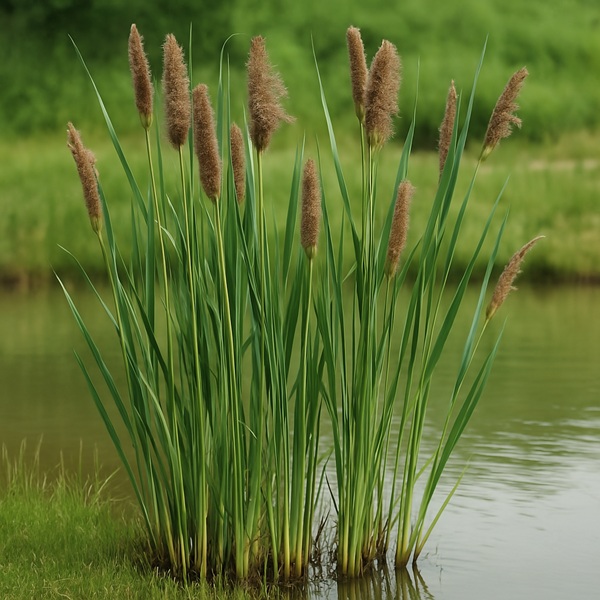
Reed (Scirpus or Schoenoplectus in different classifications) is a perennial herbaceous plant that grows near bodies of water and in marshy areas. In folk tradition, the term “reed” is often used to refer to various marsh grasses, including cattail (Typha) and even, in part, sedge (Carex). However, from a botanical point of view, it most often refers to members of the sedge family (Cyperaceae), primarily Schoenoplectus lacustris. Reed is highly resistant to excess moisture, can reach up to 2.5 meters in height, and has a thick, hollow stem that is actively used in everyday life and decorative design. Its root system is powerful and branched, capable of strengthening shorelines and acting as a natural filter that removes excess phosphates and nitrates from water. In Ukraine, reed is widespread everywhere — from the Carpathians to the coast of the Sea of Azov — along rivers, lakes, marshes, and ponds.
Reed plays an important role in natural ecosystems: it provides shelter and habitat for many animals, including waterfowl, amphibians, and insects. Its dense stands create natural barriers against erosion, soften wave action, and also participate in the circulation of water and nutrients in coastal zones. Beyond its ecological value, reed is widely used by people — it is made into mats, floor coverings, eco-style roofing materials, baskets, and is also used in landscape design for zoning ponds or creating “wild” aquatic vegetation. In addition, the plant is highly valued in bioengineering projects for wetland restoration, including within environmental initiatives in Ukraine.
Planting reed in decorative or natural settings requires an understanding of its biological characteristics and environmental requirements. Unlike most garden crops, reed does not require fertile soil or regular care — on the contrary, it grows well on waterlogged, acidic, and poorly aerated substrates. In Ukraine’s natural conditions, the best sites are lowland areas, river floodplains, and the banks of ponds and lakes with a high groundwater level. In ornamental gardening, reed is planted in artificial ponds, ditches, marshy corners, or even in containers submerged in water. The main requirement is constant access to moisture: if the soil dries out, the plant loses its decorative value and stops growing.
Key conditions for choosing a planting site:
Water depth — ideally from 10 to 50 cm; at greater depths, growth may slow down.
Light — it prefers sunny areas but also tolerates partial shade well.
Soil type — heavy clay or silty substrates with an acidic reaction (pH 5.5–6.5).
An interesting solution is to create an artificial “bog” — a waterproofed container filled with a mixture of clay, peat, and sand. A layer of river silt or humus is placed at the bottom, then the reed rhizome is buried 5–10 cm deep, and everything is filled with water. This option is excellent for phyto-purification ponds, decorative compositions, or natural-style corners on a property.
Reed can be propagated vegetatively or by seed. The most effective method in Ukraine’s temperate climate is vegetative propagation by rhizomes. The plant forms a dense system of underground shoots that can easily be divided in spring or autumn. For planting, sections with at least two active growth nodes are selected and buried in moist substrate to a depth of 5–7 cm. After planting, regular watering is essential; otherwise rooting will be slow or may not occur at all.
The seed method is more often used in conservation or bioengineering projects. The seeds are soaked in water for 3–5 days, after which they are sown in containers with peat, clay, or a silty mixture. Shoots appear in 2–4 weeks but require careful handling. Transplanting is possible only after the root system has become stronger. The main advantage of this method is the ability to grow a large number of plants with high genetic diversity.
Interestingly, if your goal is to green the shoreline of a pond, the best approach is to combine both methods: plant rhizomes in key areas and sow the remaining territory with seeds. This approach ensures even coverage and effective plant adaptation to local conditions.
Although reed is traditionally associated with the wild, in recent years it has increasingly been used in ornamental gardening and in the design of private plots in an eco style. Its clear vertical form, soft movement in the wind, dense growth, and attractive texture create a special atmosphere of “wild harmony.” Reed looks especially impressive when combined with other aquatic or shoreline plants — cattail, sedge, arrowhead, irises, and marsh marigold. This naturalistic style of landscaping is becoming more and more popular in Ukraine among owners of country properties who create decorative ponds, phyto-purification cascades, or corners of wildlife with minimal intervention.
There are several ways to include reed in landscape design:
Creating a natural pond — reed is planted in groups along the southern or eastern side to form a living screen.
Forming visual accents — planting reed in the background of a composition adds height and contrast.
Zoning space — reed thickets serve as a natural boundary between wet and dry areas.
Water purification — the plants absorb nitrates, phosphates, pesticide residues, and other impurities.
An important point: reed spreads very quickly. For decorative use, it is therefore recommended to restrict it with containers or waterproof “pockets” to prevent unwanted spreading throughout the entire pond or garden. This approach is especially useful on small plots. Dried stems can be left through winter — they keep their shape, add texture to the site, and attract birds.
Because reed grows quickly, adapts well to different conditions, and does not require fertilizers, it is increasingly being considered an accessible raw material for practical use, both in traditional and modern technologies. In Ukraine, especially in the southern and central regions, reed is used in construction, for example for roofing and insulation, in crafts such as weaving, and in projects aimed at restoring wetland ecosystems. Its stems are used to make mats, insulation materials, decorative panels, and partitions.
Main areas of reed use in Ukraine:
Construction and finishing: reed is used to make insulation boards and roofing materials for eco-houses and tourist complexes.
Energy: the plant is used as raw material for biogas or pellets, and its energy value is comparable to straw.
Phyto-purification of water: in wastewater treatment projects, especially agricultural ones, reed is planted in special channels as a natural biofilter.
Traditional crafts: in some regions of Ukraine, the tradition of weaving reed into seat pads, baskets, and decorative panels continues.
Given its ease of cultivation and multifunctional nature, reed attracts farmers and entrepreneurs interested in creating closed-loop, nature-oriented production systems. It can be planted around the perimeter of ponds to strengthen banks or used as an additional raw material for insulation and decoration. The investment is minimal, while the benefits are wide-ranging.
Growing reed under controlled conditions is a relatively new practice in Ukraine, but it has real potential. Ease of care, high productivity, and versatility make this crop attractive for farmers working within organic or sustainable agriculture. Reed fits easily into the concept of a closed biological cycle on a farm. It can serve as a natural biofilter, a source of construction material, a decorative element, or even part of the feed base within an ecosystem-based approach.
How reed can be used on a farm:
Buffer zones around ponds that reduce erosion and fertilizer runoff.
Farm bioponds for fish, ducks, or irrigation, where reed stabilizes the water regime.
Biomass for feed or mulch — in moderate quantities within a feeding system.
Raw material for insulating temporary buildings, greenhouses, and sheds.
Its cultivation requires taking the seasonal cycle into account: active growth begins in April and lasts until the end of September. The best time for harvesting is August–September, when the stems reach maximum strength. Drying should be done under cover and in the shade, since overheating causes brittleness. When reed is intended for construction use, it is important to preserve the flexibility and length of the stems.
Thus, reed is not only a wild plant, but also a valuable agronomic resource with minimal costs. It can easily be integrated into environmentally friendly, self-sufficient agricultural systems, as well as into landscape or conservation projects in Ukraine.