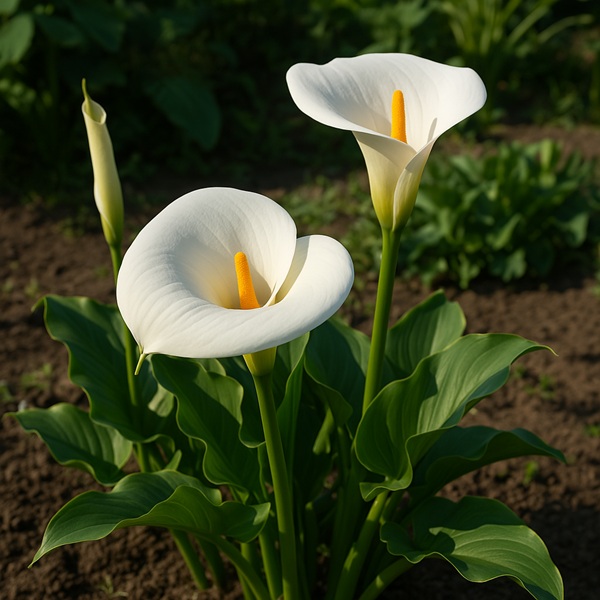
Calla lilies (Zantedeschia) are elegant plants with large tubular flowers and decorative foliage, native to the humid tropics of South Africa. Despite their exotic origin, with proper care they adapt well to Ukraine’s climate, especially in the southern and central regions. These plants are valued not only for their beauty but also for their relative ease of cultivation. Still, for callas to produce lush and long-lasting blooms, several factors must be taken into account, from site selection to the specifics of cultivation techniques.
Callas are divided into two main types: tuberous forms, which are the most common in ornamental gardening, and rhizomatous forms, such as Zantedeschia aethiopica, which differ in planting methods, vegetation periods, and growing requirements. In Ukraine, tuberous varieties are by far the most widespread because they are easier to adapt to seasonal outdoor cultivation. However, in the southern regions, rhizomatous species can also be grown successfully in semi-greenhouse conditions or protected ground.
Special attention should be paid to frost resistance. Calla lilies do not tolerate frost, so when grown outdoors they require annual lifting of the tubers and proper winter storage. In regions with mild winters, such as Odesa, Mykolaiv, and Kherson regions, some gardeners experiment with mulching and covering the plants, but this still carries a serious risk of freezing. In western Ukraine or Polissia, callas are grown only as annuals or container plants that must be brought indoors for the winter. Because of this, before planting you should clearly decide how you plan to grow them — in open ground, in pots, or in a combined way.
Before planting calla lilies, it is important to prepare the planting material correctly. Tubers should be purchased only from reliable suppliers, since plants bought at informal markets or secondhand are often infected with fungus or rot. Such tubers may not only fail to bloom, but may also infect the soil. A healthy calla tuber should be firm, dense, and free from mold, dark spots, or mechanical damage. The optimal diameter is from 4 cm, with clearly visible buds.
Preparation of the tubers includes pre-plant disinfection. A weak potassium permanganate solution or a fungicide such as Fundazol or Previcur is usually used, with the tubers soaked for about 30 minutes. After that, the planting material is dried on a napkin and left at room temperature for 1–2 days. In southern Ukraine, planting can begin as early as late April, once the risk of frost has passed, while in cooler regions it is better done in early May. It is advisable to pre-sprout the tubers in pots with a loose substrate. This stimulates root development and speeds up flowering after transplanting into open ground.
The soil for callas should be light, airy, and well-drained. The optimal acidity is slightly acidic to neutral, with a pH of 5.5–7.0. Clay-heavy or waterlogged sites are completely unsuitable, since they provoke tuber rot. An ideal soil mix consists of 2 parts sod soil, 1 part humus, and 1 part sand. A little perlite or vermiculite can also be added for better looseness. Before planting, it is advisable to enrich the soil with a balanced fertilizer containing micronutrients, while avoiding excess nitrogen, since that encourages leaf growth at the expense of flowering.
A useful note: callas are very sensitive to standing water. When planting in open ground, always place drainage at the bottom of the hole, such as crushed stone, expanded clay, or coarse sand, especially if the site tends to stay wet. For container-grown plants, drainage holes in the pot are absolutely essential.
The correct planting layout directly affects both plant health and ornamental quality. Calla lilies do not like crowding, so there should be at least 30–40 cm between tubers. Planting depth depends on tuber size, but is usually 5–10 cm. After planting, the soil should not be drenched immediately. Callas prefer gradual moistening as they awaken. Too much water can cause rot, especially if air temperatures are still unstable.
During active growth, callas need stable but moderate watering. The soil should remain moist, but never swampy. Watering frequency depends on the temperature: in hot weather it may be daily, while in cool weather once every 2–3 days is enough. Callas respond well to leaf misting, especially in dry or windy conditions. This not only increases air humidity but also helps prevent spider mite infestations.
Fertilizing is done once every 10–14 days. At the beginning of growth, nitrogen-based fertilizers such as urea or mullein infusion are preferred, and once buds begin to form, phosphorus-potassium feeding becomes more important. Organo-mineral blends such as AVA, Biohumus, Buton, and Agricola have proven effective. However, excessive feeding can lead to “fattening,” when the plant produces strong foliage but no flowers. Fertilizers should therefore be alternated and used according to the recommended dosage.
During flowering, it is important to keep the plant clean and well maintained: remove faded inflorescences, avoid overcrowding, and monitor for pests. Aphids, thrips, and spider mites are especially dangerous for callas because they multiply quickly and can significantly weaken the plant. Preparations such as Aktara, Fitoverm, and Inta-Vir are effective. At the first signs of disease, such as leaf spotting, curling, or slowed growth, action should be taken immediately, since callas do not cope well with long-lasting infections.
In most regions of Ukraine, overwintering calla lilies outdoors is impossible, since the tubers cannot survive even short frosts. For that reason, after the vegetation period ends, the plants must be lifted correctly and prepared for storage. The signal to begin is the yellowing and drying of the leaves, which usually starts in late September to early October. It is not worth delaying, because autumn rains and night chills may cause the tubers to rot.
Digging should be done in dry weather. The tubers are carefully lifted from the soil together with the remaining leaves and roots. The green parts should not be removed immediately, since for several more days they continue feeding the tuber and help it mature. After being cleaned of soil, the tubers are laid out to dry in a dry, well-ventilated room, such as an attic, veranda, or under a shelter, for 10–14 days. During this time, the skin becomes firmer, small injuries heal, and excess moisture evaporates. After drying, the remaining leaves and roots are removed, and the tubers are sorted by size.
Storage of callas requires several conditions:
Temperature: from +5 to +10 °C. Refrigerators, basements, and unheated storage rooms are suitable.
Humidity: moderate, without condensation. Air that is too dry causes shriveling, while excessive moisture causes rot.
Packaging: paper bags or boxes with peat, moss, or sawdust. Polyethylene should not be used, since it does not allow airflow.
Every 3–4 weeks, the tubers should be inspected and any damaged or rotting specimens removed. Sometimes by spring the tubers wrinkle or dry slightly, but this is not critical. One or two weeks before planting, they are taken out and warmed at room temperature and, if needed, soaked in growth stimulants such as Epin, Zircon, or potassium humate.
For people living in apartments who want to enjoy calla blooms on a balcony, terrace, or windowsill, container growing is an excellent option. This method is especially relevant for residents of northern and western Ukraine, where open ground does not always provide a long enough growing season. Potted callas make it possible to avoid annual lifting and allow much better control over moisture, feeding, and lighting.
Containers should be wide and deep, preferably with ceramic walls for better air exchange. The volume should be 3–7 liters per tuber. A drainage layer must always be placed at the bottom. The soil mix may be ready-made, for example a substrate for bulbous plants, or homemade: 2 parts leaf soil, 1 part humus, 1 part sand, and 0.5 part perlite. It is also recommended to dust the bottom with a thin layer of wood ash or dolomite flour, which helps prevent root rot.
The advantages of growing callas in containers include:
Mobility. Plants can be moved depending on weather or light conditions.
A longer flowering period. With proper care, callas may bloom for 3–4 months.
Better care control. Watering and feeding are easier to regulate.
Winter rest without digging. After dormancy begins, the pot with the tuber is simply moved to a cool place.
Container-grown callas combine beautifully with other ornamental plants such as pelargoniums, alyssum, and lobelia. Still, it is important to make sure neighboring plants do not shade the calla, because it needs bright, diffused light for at least 6 hours a day. In autumn, after flowering ends, watering is gradually reduced, the plant is brought into dormancy, the leaves are cut back, and the pot is moved to a cool place until the next season.
Growing calla lilies in Ukraine does not require excessive effort, but it does involve a number of details that beginners often overlook. The most common mistake is overwatering, especially at the beginning of the growing season. Callas are extremely sensitive to excess moisture: even slight tuber rot may stop development completely. Another mistake is planting too early into cold soil. The soil temperature should be no lower than +12 °C, otherwise the tuber will not start growing.
A frequent question is why callas do not bloom. The reasons may vary:
the tuber is too small, since the diameter should be at least 5 cm;
there is too much nitrogen fertilizer;
there is not enough light;
the plant did not have a proper dormant period;
the planting is overcrowded and there is competition for resources.
Gardeners also often take lush foliage as a sign of health. In reality, an overly abundant green mass without flowers points to a nutrient imbalance and the need to adjust care. Another common misconception is that callas can overwinter in the ground like tulips or daffodils. This is false and usually leads to the loss of planting material through freezing.
And finally, calla lilies are excellent cut flowers. In water, they keep for 10–14 days, wilt slowly, and hold their shape well. Flower stems should be cut early in the morning, and the water should be changed every 2–3 days. In this way, callas are not only a flower bed decoration, but also a versatile plant for indoor and outdoor décor, suitable for both beginners and experienced flower growers.