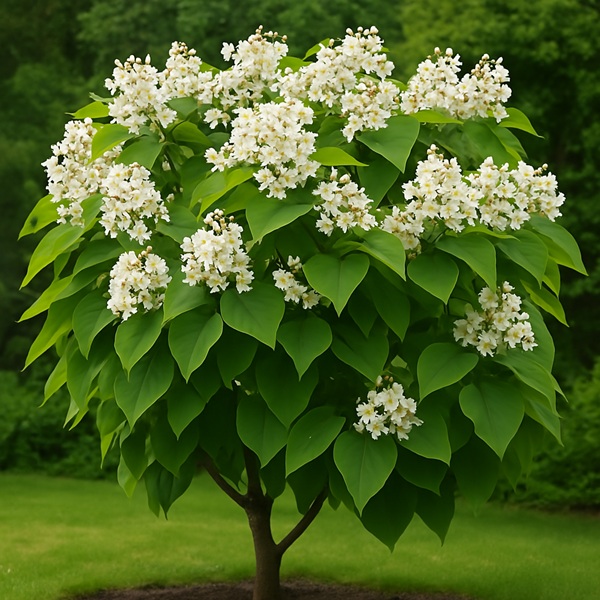
Catalpa is one of the most distinctive ornamental trees that grows very well in a temperate climate, including in Ukraine. It is a deciduous tree native to North America as well as the southern regions of China and India, and it has gained popularity because of its exotic appearance, large leaves, and attractive flowering. It belongs to the Bignoniaceae family. In natural conditions, catalpa reaches a height of 15–20 meters, but in ornamental landscaping in Ukraine, cultivated forms 5–12 meters tall are most common. The crown can reach 6–8 meters in diameter, which makes the tree an excellent choice for creating shade, alleys, or specimen plantings.
The main decoration of catalpa is its large, heart-shaped leaves up to 30 cm long. They have a rich green color, remain ornamental from spring to late autumn, and are rarely affected by diseases or pests. Flowering begins in June and lasts up to four weeks. The flowers are gathered in large panicle-like inflorescences 20–30 cm long, usually white or cream with purple or yellow speckles. They have a pleasant fragrance and make the tree a real centerpiece of the garden during the flowering period. After flowering ends, long narrow pods resembling beans are formed; they remain on the tree until spring and add extra ornamental value.
Several species of catalpa are suitable for cultivation in Ukraine: northern catalpa (Catalpa speciosa), Bunge catalpa (Catalpa bungei), southern catalpa (Catalpa bignonioides), and its popular globe-crowned cultivars. In landscaping, southern catalpa and its cultivar Nana are used most often — a compact tree with a dense rounded crown that does not flower but is excellent for urban conditions. Thanks to frost resistance down to –25 °C in maturity, catalpa is well adapted to the climate of most regions of Ukraine, especially the central, southern, and western parts. Young trees require protection, but after 2–3 years they become sufficiently hardy.
One of the key factors in successful catalpa cultivation is choosing the right site. The plant prefers sunny, open areas protected from strong winds. With insufficient light, the crown becomes loose and flowering is weak or absent altogether. It is best to plant catalpa at some distance from buildings, since its powerful root system needs space. For planting, fertile, loose soils with a neutral or slightly alkaline reaction are chosen, with a pH of 6.5–7.5. Areas with standing water should be avoided, as excessive moisture causes root rot.
Step-by-step preparation of the planting hole:
Size: at least 70×70×70 cm.
Drainage: a 10–15 cm layer of crushed stone, expanded clay, or broken brick is placed at the bottom.
Soil mix: turf soil, humus, and sand in a 2:1:1 ratio.
Additions: wood ash and a complex mineral fertilizer such as nitroammophoska may also be added.
Catalpa is planted in spring, from late April to early May, when the soil has warmed up and the danger of frost has passed. In the southern regions, autumn planting is also possible, though it is riskier for young saplings. During planting, the root collar should remain at soil level. After placing the sapling, the hole is filled, compacted, and watered generously with 20–30 liters of water per tree. A watering rim is formed around the trunk to retain moisture. Staking the tree is mandatory, especially if it is a large sapling. During the first weeks, the soil should be moistened regularly and kept from drying out.
Special attention should be paid to the choice of planting material. Saplings with a closed root system, in containers and about 1.5 meters tall or more, establish best. Such plants adapt more easily after transplanting and develop faster. Before purchase, it is worth inspecting the roots and trunk for damage or signs of disease. If the roots are bare, they should обязательно be soaked in a root stimulator such as Kornevin or Humate before planting.
Catalpa does not require overly complicated care, but to achieve maximum ornamental value, it is worth following proper agricultural practices. Basic care consists of watering, loosening the soil, applying fertilizers, and carrying out sanitary and formative pruning. During dry periods, especially in the first years after planting, watering is essential — 1–2 times a week with 30–40 liters of water per tree. Mature plants are more resilient, but they also respond well to regular watering on hot days. Mulching the root zone with peat, bark, or compost helps preserve moisture and maintain soil structure.
Fertilizing is done 2–3 times a year:
In spring — nitrogen fertilizers such as nitrate or mullein to stimulate leaf growth.
During budding and flowering — phosphorus-potassium complexes.
In autumn — wood ash or superphosphate to prepare for winter.
The soil is loosened after rain or watering to ensure air reaches the roots. While loosening, care should be taken not to damage the shallow root system. Sanitary pruning is carried out in early spring, removing dry, frost-damaged, or diseased branches. Formative pruning is used to correct the crown, especially in varieties with a globe-shaped form. Catalpa tolerates trimming well, so its shape can be maintained even several times during the season.
Possible diseases and pests should also be taken into account. With excess moisture or poor ventilation, powdery mildew or anthracnose may appear. For prevention, treatments with copper-containing products are carried out in spring. Among pests, aphids, caterpillars, and spider mites may occur. Biological preparations or systemic insecticides are used against them. Regular inspection of the crown helps detect problems in time.
Despite its fairly good frost resistance, catalpa requires special care in winter, especially in the first years after planting. Young saplings are sensitive to drops in temperature and may suffer from severe frosts typical of the northern and eastern regions of Ukraine. That is why choosing a site with a mild microclimate is extremely important. In exposed areas or lowlands where cold air accumulates, the risk of freezing is much higher. Mature trees are much more resistant, but they still need proper preparation starting in autumn to overwinter successfully.
Main stages of preparing catalpa for winter:
From October onward, nitrogen fertilization is stopped and watering is gradually reduced.
The trunks of young trees are wrapped with burlap, agrofabric, or another breathable material.
The root zone is mulched with an 8–10 cm layer of peat, humus, or leaves.
To protect from snow load, the branches can be gathered into a “bundle” and tied with rope.
If prolonged frosts below –20 °C are forecast, it is also recommended to additionally cover the root zone with spruce branches or place a light ventilated box over it. In spring, the cover is removed gradually once daytime temperatures remain steadily above 0 °C. Even if some branches freeze back, there is no need to panic — with proper care, the tree recovers quickly. Damaged parts are simply pruned back to living wood, after which growth is stimulated with fertilizers and watering.
The experience of Ukrainian gardeners confirms that, with the right technique, catalpa can grow without problems even in regions with relatively harsh winters, such as Kyiv, Chernihiv, and Sumy regions. The main thing is to provide the sapling with proper conditions in its first years of life: regular watering, protection from wind, loose fertile soil, and winter covering. After adaptation, the plant becomes much hardier and no longer requires excessive attention.
Catalpa is a versatile ornamental plant actively used in various landscaping projects, from city alleys and parks to private gardens and public spaces. Thanks to its striking appearance, large leaves, and long flowering period, it can transform any site. Catalpa looks especially beautiful in a single planting as a specimen tree. In this role, it immediately draws attention and can serve as the main accent of the composition. Its foliage creates shade, and its inflorescences provide a bright focal point.
Main ways to use catalpa in design:
Avenue plantings — along paths, driveways, and boulevards.
A specimen on a lawn — a single tree set against a background of coniferous or deciduous plantings.
Group compositions — together with ornamental shrubs such as barberry and spirea, and perennials such as hosta and echinacea.
Mixed borders — combined plantings with ornamental grasses such as feather grass and miscanthus.
Catalpa combines beautifully with other plants that have smaller leaves or contrasting shapes, such as arborvitae, junipers, boxwood, and herbaceous perennials. Thanks to its large leaves, it adds volume and a bold texture to a composition. The form Catalpa bignonioides Nana is especially popular — a slow-growing tree with a dense rounded crown. This catalpa is ideal for small plots, inner courtyards, or terraces, since it does not need shaping and has a compact appearance.
In recent years, catalpa has been appearing more and more often in urban spaces in Ukraine: in new residential complexes, near office centers, and in public squares. Its popularity is driven not only by its ornamental qualities but also by its ability to clean the air, tolerate pollution, and avoid requiring excessive care. It combines harmoniously with modern architecture and fits organically into the concept of sustainable landscaping.
Catalpa is not just a beautiful tree, but a multifunctional plant with a whole range of advantages. First, its ornamental appeal: large leaves, unusual flowers, and long pods make it decorative throughout the year. Second, catalpa is undemanding in care: once properly rooted, it grows quickly, does not fear drought, and tolerates urban conditions. Third, the tree is safe for people and animals — its parts do not contain toxic substances, and its pollen does not cause allergies.
Advantages of catalpa for Ukrainian gardening:
High ornamental value throughout the season.
Tolerance to heat, drought, and polluted air.
Fast growth — up to 5–6 m in 5–7 years.
Relative resistance to diseases and pests.
Suitable for landscaping in all regions of Ukraine.
Catalpa is an ideal choice for those who want a tree with an exotic look on their property, one that does not require too much care, grows quickly, and lives a long time. It is often used not only in private gardens but also in public spaces, near administrative buildings, in parks, and on boulevards. In Ukrainian conditions, catalpa has long proven its reliability and adaptability to the climate.
To sum up, catalpa is an example of a plant that combines ornamental beauty, practicality, and ease of care. It will become a real highlight of any landscape project, beautify the area, and create shade for rest. Growing it means investing in beauty, ecology, and comfort for many years.