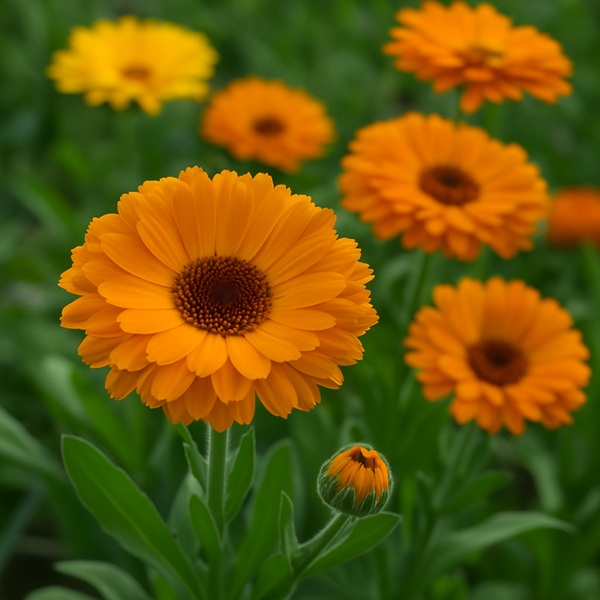
Calendula, better known in everyday Ukrainian usage as marigold, is one of the most popular annual flowers in Ukraine. It is valued not only for its bright appearance and long flowering period, but also for its medicinal properties, its low demands in cultivation, and its ability to act as a natural phytosanitary plant. The crop thrives in open ground throughout the country — from Zakarpattia to Luhansk region. Depending on the region, sowing can begin in mid-March in the south or in April in the central and northern parts of the country, and sometimes even in autumn before winter for earlier flowering in spring.
Calendula belongs to the Aster family. Its homeland is Southern Europe and the Mediterranean, but it has adapted extremely well to Ukraine’s temperate climate. The bushes are compact and branching, reaching from 30 to 60 cm in height depending on the variety. The flowers may be single or double, in shades ranging from bright yellow to deep orange, with a diameter of 4 to 10 cm. Flowering lasts from late May until the first frosts, provided faded buds are removed regularly. Calendula varieties are diverse, and the most common in Ukraine include ‘Radio,’ ‘Promenad,’ ‘Orange King,’ ‘Kabluna,’ ‘Geisha,’ and ‘Golden Ball.’ Some are grown strictly as ornamentals, while others are cultivated as medicinal or multipurpose varieties.
A special feature of calendula is its high adaptability and rapid development: the plant easily tolerates temperature fluctuations, does not require frequent feeding, and germinates well even when sown shallowly. Thanks to its root system, it grows successfully in most soils, tolerates spring frosts down to -5 to -6°C, and withstands short dry spells. Calendula is also used actively in organic farming: it is sown along the edges of beds and between vegetable crops because it repels pests, improves soil structure, and helps increase the yield of neighboring plants. This makes marigold not just a flower bed decoration, but a full part of the agroecosystem.
Despite its unpretentious nature, calendula shows its best ornamental and medicinal qualities only when the site is chosen correctly and the soil is properly prepared. In Ukrainian conditions, it is best planted in well-lit areas, preferably on the southern or southwestern side. It will also grow in partial shade, but flowering will be less abundant and the blooms themselves will be smaller. It is important to avoid places where moisture stagnates, especially in spring when snow melts, because calendula does not tolerate waterlogging well and may suffer from fungal diseases.
Almost any soil can be used for calendula, but the plant performs best on:
loose, fertile loams;
neutral or slightly alkaline soils with a pH of 6.0–7.5;
sites with good drainage and without shallow groundwater.
Before sowing, about 2–3 weeks in advance, the plot is dug over to the depth of a spade bayonet, humus or compost is added at 5–7 kg per square meter, and, if needed, wood ash and a little superphosphate are also incorporated. If the soil is poor or heavy, sand or peat is added. Acidic soils must be limed in autumn, otherwise the plant will lag in growth and become more prone to disease. After digging and leveling, the soil should be allowed to settle, because calendula does not like freshly turned ground.
Calendula is equally suitable for single and group plantings. It looks harmonious in mixed borders, along garden paths, near fences, and in flower beds with other annuals and biennials such as lobelia, cosmos, zinnia, and nasturtium. It can even be sown among vegetables, in the row spaces of tomatoes, cabbage, and eggplants. Calendula is especially effective as a trap plant: it attracts thrips, aphids, and whiteflies to itself, drawing them away from the main crops. It is also worth sowing in orchards near fruit trees and shrubs. This kind of neighborhood helps naturally improve soil health and maintain biological balance on the plot.
Calendula is most often grown by direct sowing into open ground. Thanks to its resilience and high germination rate, it does not require pre-sprouting, although soaking the seeds in a stimulant such as potassium humate or an Epin solution speeds germination and ensures more uniform seedlings. Sowing is carried out depending on weather conditions: in southern Ukraine from mid-March, in central regions from early April, and in the north from late April to early May. The optimal soil temperature for germination is at least +8 to +10°C. Winter sowing is also possible in November, once stable cold weather has set in but before the ground has frozen.
The seeds are sown into furrows 1.5–2 cm deep, with 20–25 cm between plants and 30–40 cm between rows. For denser plantings, strips of 2–3 rows can be formed with 50 cm between strips. After sowing, the seeds are covered with loose soil or compost, lightly firmed, and watered. The first seedlings appear in 6–10 days depending on temperature and moisture. After 2–3 true leaves appear, thinning is carried out, leaving the strongest plants. If necessary, seedlings can be transplanted elsewhere, since calendula tolerates transplanting well even at the 3–4 leaf stage.
Calendula can also be grown through seedlings, especially when earlier flowering is needed or there is a risk of spring frosts. In that case, the seeds are sown in containers in late February to early March using a loose, nutritious substrate. The seedlings are pricked out at the stage of 2 true leaves and planted into open ground in late April to early May. This method makes it possible to obtain flowering as early as May and forms stronger bushes. Still, under Ukrainian conditions, direct sowing is generally used, since it is simpler and fully justified.
After seedlings emerge or transplants are placed into open ground, the main attention should be given to proper and timely care. Although calendula is undemanding, with good care it provides not only abundant flowering but also a high concentration of biologically active compounds in the flowers, which is especially important for those growing it as a medicinal crop. The main care directions are watering, loosening, weeding, removing faded inflorescences, and periodically applying fertilizers.
Watering should be moderate: calendula tolerates short droughts easily, but during hot periods or extended dry weather the soil should be kept slightly moist. The optimal schedule is watering once or twice a week with 5–8 liters per square meter, depending on the climate and the stage of development. It is especially important to provide enough moisture during budding and at the beginning of flowering, because this is when the main mass of flowers is formed. At the same time, excess moisture is undesirable, since it can cause root rot and fungal diseases. After watering, the soil around the plants should be loosened and mulched with cut grass, peat, or straw.
Feeding is needed only on poor soils or when the crop is grown for a long time in the same place. At the beginning of the growing season, complex fertilizers containing nitrogen, phosphorus, and potassium are applied, for example nitroammophoska at 30 g per square meter, and before flowering phosphorus-potassium mixtures such as superphosphate and potassium sulfate are used. Among organic fertilizers, infusions of humus or green fertilizer made from fermented grass can be used. Starting from late June, it is advisable to cut off faded flowers regularly, since this stimulates the appearance of new buds and prolongs the flowering period. If the goal is to collect seed, some flower heads are left on the plants until they fully mature. If needed, the bushes can also be cut back by one third, which encourages rejuvenation and repeat flowering after 2–3 weeks.
Calendula is highly resistant to most pests and diseases, especially when the basic rules of cultivation are followed. However, in some seasons, especially under conditions of high humidity, overcrowding, or excess nitrogen in the soil, the plants may be affected by fungal diseases and a few insect pests. It is important to recognize the problem in time and choose environmentally safe control methods.
The most common diseases are:
Powdery mildew — a whitish coating on the leaves that later darkens. It often appears under excessive moisture and sharp temperature swings. Control methods include spraying with garlic infusion, whey, or the product “Topaz.”
Black spot — dark spots on the lower leaves, which then dry out. Causes include lack of light, excess nitrogen, and stagnant moisture. The solution is thinning and spraying with copper-containing products.
Fusarium wilt — yellowing and limp plants, especially in the southern and central regions during hot summers. Diseased plants should be removed and the soil disinfected.
Pests that sometimes damage calendula include:
Aphids — they settle on young leaves and buds, causing curling and weakening of the plant. Treatment includes soap solution, onion-skin infusion, or products such as Fitoverm and Biotlin.
Spider mites — active in hot weather, they produce webbing and cause mottling and curling of leaves. Control methods include frequent moistening of the foliage and acaricides.
Whiteflies and thrips — they damage leaves, especially in warmer regions. Sticky traps, tobacco infusions, and biological insecticides are helpful.
Prevention is the main form of protection. It includes moderate feeding, correct spacing between plants, avoiding overwatering, timely pruning, and sowing calendula in sunny, well-ventilated places. All plant residues should also be removed at the end of the season, because pathogens and pest larvae may overwinter in them. If medicinal calendula is being grown, it is preferable to avoid chemicals during flowering and harvesting.
Calendula is one of the few crops that combines ornamental qualities with medicinal and agronomic benefits. The flowers are harvested at the stage when the buds are fully open, preferably in the morning after the dew has dried. Only bright, fresh flowers without signs of wilting or damage should be collected. Repeated harvesting is carried out every 3–5 days, since regular picking stimulates further flowering. In the southern and central regions of Ukraine, up to 5–6 full harvest waves can be obtained in one season. The flower heads should be dried in the shade, in a well-ventilated place, spread out in a thin layer.
Dried calendula flowers are used:
in folk and official medicine — for infusions, decoctions, and alcohol tinctures;
in cosmetology — in creams, lotions, and masks;
in detergents, bath additives, and shampoos;
as an antiseptic in veterinary care and horticulture;
in cooking — as a seasoning for salads, soups, and even baked goods.
In the vegetable garden, calendula remains useful even after the flowers are harvested. Its decoctions are used for spraying vegetables against pests, while the dry residues serve as mulch or compost. The roots release phytoncides that suppress the development of nematodes and pathogenic microorganisms in the soil. Calendula infusions are also used as a biological fertilizer or as a seed-soaking solution. So in Ukraine, calendula is not just a flower, but a truly versatile helper worth having on every plot, from the flower bed to the farm field.