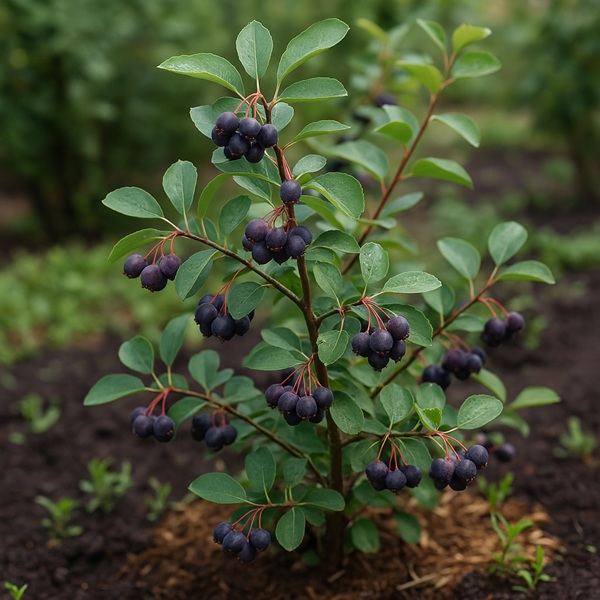
Serviceberry (Amelanchier), also known as juneberry, shadbush, or amelanchier, is a versatile perennial plant that can be used as a fruit crop, an ornamental, or a hedge. In Ukrainian conditions, it shows high adaptability and bears fruit reliably even with minimal care. Bushes can reach 2–5 meters in height depending on the species and growing conditions. One of the main advantages of serviceberry is its high frost resistance: many varieties withstand temperatures down to –35°C, which makes the crop ideal for the northern and eastern regions of the country.
Among the species commonly grown in Ukraine, the most notable are:
Saskatoon serviceberry (A. alnifolia) — distinguished by large fruits, tolerates drought well, and is popular in the southern regions.
Canadian serviceberry (A. canadensis) — more ornamental, with an elegant crown shape, high frost resistance, and strong productivity.
Round-leaved serviceberry (A. rotundifolia) — less common, but valued for its resistance to polluted urban environments.
Hybrid varieties — bred with an emphasis on improved berry flavor and bush compactness.
Serviceberry varieties differ not only in decorative value but also in fruit flavor: from sweet with slight tartness to richly honeyed. The berries are eaten fresh, dried, or used for jams, juices, and wine. Fruiting begins in the second or third year after planting and continues for up to 50–60 years. That is why it is important to choose the right variety for specific climate conditions. In regions with hot summers and limited rainfall, drought-tolerant varieties establish better, while in the western and northern regions frost resistance and resistance to spring frosts are more important. For small plots, dwarf hybrids are a good choice because they are easier to shape and harvest. Special attention should be paid to zoned varieties bred in Ukraine or adapted to local conditions — they cope better with stress factors and are less likely to get sick.
The planting site for serviceberry plays a key role in establishing a productive and healthy planting. The plant loves light, although it also feels quite comfortable in partial shade — under those conditions, the bush develops more slowly but becomes more spreading. The crop shows maximum yield only with sufficient sunlight: in such conditions, the berries become sweeter, juicier, and larger. That is why it is best to choose the southern or southwestern side of the plot, protected from strong winds. Serviceberry is well suited for hedges, can serve as a buffer between crops, or act as a single ornamental element in landscape design.
Serviceberry is undemanding when it comes to soil, but it grows best on:
light loams;
sandy loam soils with good drainage;
neutral or slightly alkaline soils with a pH of 6.5–7.5.
On acidic soils, it develops more slowly, fruits less well, and is more often affected by fungal diseases. In that case, liming the soil in autumn before spring planting is advisable. Serviceberry should not be planted in lowlands with stagnant moisture or where groundwater is high, because the roots may rot. A good solution is planting on raised beds or mounds. The soil for planting is prepared in advance: it is dug over to the depth of a spade, cleared of weeds, and enriched with humus, compost, and ash. Fresh manure should not be applied, as it may burn the root system.
The spacing between bushes depends on the planting purpose:
for a hedge — 0.7–1 m between plants;
for single bushes — 1.5–2 m between holes;
for row planting — at least 2 m between rows and from 1.5 m between plants in the row.
These distances provide good ventilation, access to light, and easier maintenance. If serviceberry is planted as an ornamental, it can be combined with dogwood, spirea, rosehip, or dwarf thuja varieties — it looks attractive in mixed borders.
The best time to plant serviceberry in Ukraine is autumn, from late September to mid-November, when the plant enters dormancy. In the southern regions, where warm weather lasts longer, planting can continue until the end of November. Spring planting is also possible, but only before active sap flow begins, from March to early April, so that the plant does not start growing before it has rooted. The autumn option is more desirable because the root system has time to establish, and in spring the plant develops actively.
Step-by-step planting instructions:
Dig a hole about 60×60×50 cm.
Mix the removed soil with humus in a 1:1 ratio, add 30–40 g of superphosphate and 200 g of ash.
Form a mound at the bottom of the hole and spread the seedling’s roots over it.
Fill the hole, lightly compacting the soil in layers.
Water with 1–2 buckets of water and mulch the tree circle.
The root collar should not be buried more than 2–3 cm, as this may lead to rotting. After planting, the sapling is pruned, leaving 4–5 strong buds — this stimulates branching. If the sapling has a closed root system, it can be planted at any time during the season, provided watering remains moderate.
Depending on the region, planting dates may shift slightly. For example, in Zakarpattia or in the coastal areas of the Black Sea, work may begin earlier, while in Sumy, Chernihiv, or the Carpathians, a bit later. A good guideline is soil temperature: not lower than +8 to +10°C for successful rooting.
Although serviceberry is considered one of the most undemanding crops, proper care allows for a much more abundant and higher-quality harvest, while also preserving the decorative appearance of the bush. During the first year after planting, it is especially important to monitor soil moisture. Young saplings need regular watering once or twice a week, especially in dry weather. From the third year onward, serviceberry can usually manage without frequent watering under normal conditions, but during prolonged drought and during fruit formation, generous irrigation is recommended — 2–3 buckets of water per bush once or twice a month.
Feeding plays an important role, especially if the plant is used not only as an ornamental but also as a fruit crop. In spring, as soon as the snow melts, it is useful to apply nitrogen fertilizers such as urea or ammonium nitrate, 30–40 g per bush, to stimulate shoot growth. At the beginning of summer, potassium-phosphorus fertilizers are applied, such as a solution of superphosphate and potassium sulfate, and in autumn ash or complex mineral blends without nitrogen are used. Organic matter such as compost or well-rotted manure is added during autumn digging once every 2–3 years.
Mulching the tree circle with humus, cut grass, bark, or straw reduces moisture evaporation, prevents weed growth, and protects the roots from overheating in summer and freezing in winter. Annual pruning begins in the third year of the bush’s life. In spring, the following are removed:
dry, broken, or frost-damaged branches;
weak shoots and those growing inward into the crown;
old branches, older than 6–7 years, which have already produced their maximum yield.
It is optimal to leave 10–15 skeletal shoots of different ages. This rejuvenation scheme allows the bushes to remain productive for up to 50 years. Serviceberry can also be trained in a standard form for ornamental purposes or to make berry harvesting easier. In autumn, sanitary pruning is carried out as needed, removing damaged parts after the growing season.
Serviceberry is rightly considered a crop with high resistance to diseases and pests. However, in Ukrainian conditions, especially in the southern and central regions with warm, damp springs, outbreaks of infection or pest appearance may sometimes occur, particularly when plantings are overcrowded and pruning is neglected. Among the most common diseases are:
Powdery mildew — a white coating on leaves and young shoots that causes curling and dieback. It more often affects bushes growing in shade or under excessive moisture. Prevention: spraying with fungicides such as Topaz or Skor in spring and early summer.
Leaf spots (ascochyta, cercospora) — brown or gray spots on the leaves that lead to premature leaf drop. They appear with excess nitrogen and overcrowding. Treatment: remove affected leaves and spray with copper-based products.
Bacterial blight — a rare but dangerous disease accompanied by blackening shoot tips and drying flowers. It requires immediate pruning of affected parts and treatment with copper-containing agents.
Among pests, the main ones are:
Codling moth and sawfly — they lay eggs in the ovaries and damage the fruits. Protection: treatment with biological products such as Lepidocide or chemical products before flowering and after it.
Aphids — settle on young leaves and shoots, sucking sap and deforming the plant. Garlic infusions, laundry soap solutions, and insecticides such as Aktara and Biotlin are effective.
Birds — although not pests in the direct sense, during ripening they may destroy up to 50% of the crop. Solutions include nets, scare devices, and sound repellents.
Prevention is the best method of protection. It includes annual pruning, removal of fallen leaves and fruits, digging the tree circle, applying balanced fertilizers, and regular plant inspection. Spatial isolation is also important — planting serviceberry away from other members of the rose family such as pear and apple, which may serve as infection sources.
In Ukrainian conditions, serviceberry berries begin ripening from mid-June and continue until late July, depending on the variety and region. The berries do not ripen all at once, so harvest is carried out in several stages, every 3–5 days. It is worth bearing in mind that ripe fruits fall off easily, especially in hot, dry weather. To minimize losses, harvesting is done early in the morning or in the evening, when the berries are still firm. The yield from one mature bush can reach 10–15 kg.
Serviceberry berries are very delicate and spoil quickly, especially if the skin is damaged. That is why they are collected in small baskets or shallow boxes, trying not to crush them. Fresh, they keep in the refrigerator for up to 5 days. For long-term storage, the following methods are used:
freezing — whole berries or puree;
drying and dehydrating — especially popular in southern Ukraine;
processing into jam, juices, compotes, jelly, preserves, and syrups;
making wine and liqueurs — thanks to natural yeasts, the berries ferment well.
Serviceberry has high nutritional and medicinal value. The berries contain up to 12% sugars, vitamins A, C, and group B, pectins, anthocyanins, iron, and copper. They strengthen blood vessels, help normalize blood pressure, improve digestion, and act as a mild calming remedy. Regular consumption of the berries or decoctions made from the leaves and bark is recommended for hypertension, vitamin deficiency, and weakened immunity.
Serviceberry is also valued for its ornamental qualities: in spring for its abundant white bloom, in summer for its rich greenery, and in autumn for its bright foliage ranging from yellow to deep red. That is why it is used not only in gardens but also in urban landscaping, as part of hedges, or in landscape compositions.