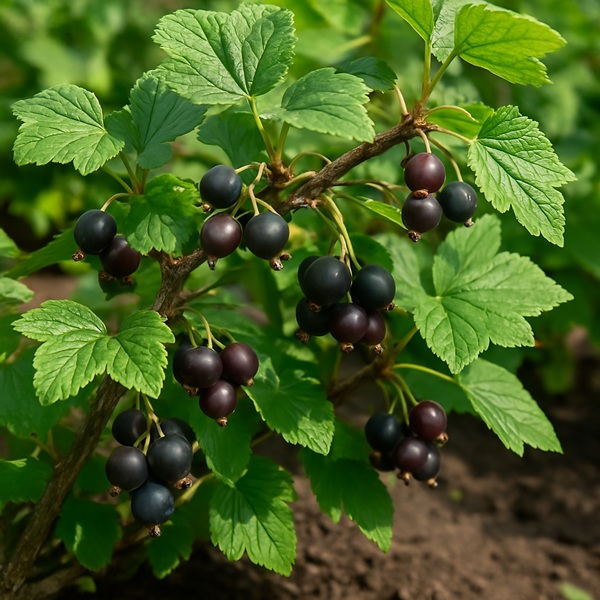
Jostaberry (Ribes × nidigrolaria) is a relatively young hybrid plant created by crossing gooseberry and blackcurrant. The goal of breeding was to combine the advantages of both crops: large, tasty berries, disease resistance, the absence of thorns, and high productivity. In Ukraine, interest in jostaberry has grown significantly over the past decades, especially among gardeners looking for a versatile, low-maintenance, and long-lived crop. Jostaberry fits well into both private gardens and commercial plantings, since it not only produces a good harvest but also serves a decorative role thanks to its vigorous foliage and striking berries.
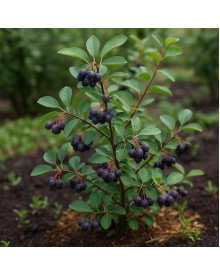
Visually, jostaberry resembles a spreading currant bush, but with larger leaves that are closer to gooseberry foliage in appearance. It has no thorns, is resistant to powdery mildew and anthracnose, and tolerates drought as well as frosts down to –30 to –35°C. The average yield of a mature bush is up to 7–10 kg, and with proper care it may reach 12 kg. The berries are dark purple, almost black, weighing up to 5 g, with a sweet-and-sour taste and a pronounced aroma. They contain vitamins C, P, and E, as well as pectins and organic acids. Thanks to its strong root system, jostaberry copes very well with drought and can also be used as a hedge, especially in rural areas.
Under Ukrainian conditions, jostaberry can be grown in most regions, from Zakarpattia to Kharkiv region. It tolerates both dry summers and rainy springs well. For the central and northern regions, this plant is especially relevant because of its resistance to late spring frosts, which often damage traditional varieties of currants or gooseberries. Breeders recommend planting zoned varieties adapted to Ukrainian conditions, such as ‘Yoshta 72210,’ ‘Ksanta,’ ‘Riksa,’ and ‘Yokhini.’ These hybrids have been tested and have shown good establishment on soils of different compositions, from chernozem to light sandy loams. The main thing to remember is that the crop needs space and does not like overcrowding.
Before planting jostaberry, it is worth paying special attention to choosing a suitable location on the plot. This crop needs a well-lit, open, but not overly windy area. In Ukrainian conditions, southern or southwestern slopes are ideal, as are level sites with a slight incline. Jostaberry will also grow in partial shade, but yield decreases and development slows down. In addition, dense shade can promote fungal diseases, especially in wet years. It is important that the soil is not waterlogged or too heavy — in such places jostaberry develops poorly, gets sick more often, and its root system rots quickly.
The most suitable soils are:
light and medium loams;
sandy loam soils with a neutral or slightly alkaline reaction (pH 6.5–7.2);
fertile chernozems, especially in central and southern Ukraine.
It is undesirable to plant the crop on acidic or depleted soils without prior treatment. In such cases, lime is applied 1–2 months before planting — dolomite flour or limestone, up to 500 g per m², depending on the acidity level. A month before planting, the site is dug over and enriched with 5–6 kg of humus or compost, 150 g of wood ash, and 50 g of superphosphate per 1 m². This provides a nutrient reserve for the first 2–3 years of growth, when the plant is forming a strong root system.
For single plantings, planting pits measuring 50 × 50 × 50 cm are dug. If several bushes are planted in a row, 1.5–2 meters are left between them, and 2–2.5 meters between rows. This is important for air circulation and access to light. A drainage layer such as crushed stone or broken brick may be placed at the bottom of the pit, followed by a nutrient mix: 1 part topsoil, 1 part humus, 1 cup of ash, and 2–3 tablespoons of superphosphate. After planting, the bush is watered with 2–3 buckets of water and mulched with humus, straw, or cut grass. The root collar should be at ground level or slightly lower, up to 2 cm.
The best time to plant jostaberry in Ukraine is autumn, from late September to mid-November. During this period, the plant enters dormancy, while the soil is still warm and moist, which helps rooting. Spring planting is also possible, from late March to mid-April, but only before active sap flow begins. In autumn, the root system has time to adapt, and in spring the bush starts growing vigorously. With spring planting, watering must be monitored especially carefully, since spring in Ukraine is often unstable, with sharp temperature changes and dry winds.
Step-by-step planting scheme:
Dig a pit of the required size.
Prepare the nutrient mixture and fill the pit halfway.
Place the sapling vertically and carefully spread the roots.
Fill the pit, lightly firming the soil in layers.
Water abundantly and mulch the surface.
If a sapling with a closed root system is planted, planting may even be done in summer, but only in cloudy weather or in the evening, with shading during the first week. After planting, it is recommended to shorten the shoots, leaving 3–4 buds on each — this stimulates the formation of a strong bush. In the first year, care comes down to regular watering once every 7–10 days, loosening after rains, removing weeds, and monitoring for pests. Jostaberry grows quite quickly and begins full fruiting in 2–3 years. Bush overcrowding should be avoided: an excess of shoots reduces ventilation and increases the risk of disease. Formative pruning begins in the second year — 5–7 of the strongest shoots are left, and the rest are cut out.
Starting from the second year after planting, jostaberry needs regular, though not complicated, care. The main goal is to provide the plant with proper conditions for stable fruiting, access to moisture, nutrients, and light. In spring, as soon as the snow melts, the trunk circle is loosened, old mulch is removed, and nitrogen fertilizers are applied — 30–40 g of urea or ammonium nitrate per 1 m². This stimulates intensive green growth. During the budding and flowering phase, it is advisable to use compound fertilizers with an emphasis on phosphorus and potassium. Jostaberry also responds well to ash feeding — 150–200 g under the bush followed by loosening and watering.
Watering is especially important in the southern regions of Ukraine, such as Odesa, Mykolaiv, and Kherson regions, where summer can be extremely hot. In dry weather, jostaberry is watered 1–2 times per week with 2–3 buckets of water per bush. At the same time, stagnant moisture must be avoided, because the plant does not tolerate waterlogging. After watering, the mulch layer of humus, straw, or cut grass should always be renewed — this reduces evaporation, suppresses weed growth, and improves the microclimate in the root zone. During the season, the soil under the bushes is loosened 3–4 times, especially after rain.
Formative and rejuvenating pruning is an essential part of jostaberry care. By the fifth or sixth year of life, the bush tends to become overly dense. Each year, old, weak, and damaged shoots should be removed, leaving 10–12 strong branches of different ages. The ideal scheme is to keep 3–4 new shoots each year while gradually cutting out the oldest ones. This keeps the plant productive for up to 15 years. It is also possible to train the bush in a standard form, with one main trunk and a compact crown, which makes care and harvesting easier. In summer, the tips of young shoots may be pinched to improve branching.
Jostaberry is considered one of the most resistant berry crops to diseases and pests. However, if cultivation practices are violated or weather conditions are unfavorable, especially during wet seasons in the central and western regions of Ukraine, the plant may still suffer. The most common fungal diseases are:
Powdery mildew — appears as a white coating on the leaves, which later turns brown and causes tissues to dry out. It usually develops when ventilation is poor and humidity is excessive. Control measures include spraying with sulfur-based products or systemic fungicides such as Topaz and Skor.
Anthracnose — brown spots on the leaves that gradually enlarge and cause leaf drop. It is especially dangerous in rainy weather. Prevention includes spraying with Bordeaux mixture at the beginning of the season.
Septoria and rust — leaf spotting of various colors and deformation of leaf blades. These often appear when nitrogen is overapplied and plantings are overcrowded.
Among pests, the following may sometimes appear on jostaberry:
Aphids — suck sap from young leaves and shoots, causing curling. Control measures include soap solution, garlic infusions, or products such as Biotlin and Aktara.
Spider mites — become active in hot, dry weather and cause mottling and spotting on leaves. Effective acaricides include Fitoverm and Kleschevit.
Sawflies and moths — lay larvae in buds and ovaries, damaging the fruits. Preventive treatments are carried out before flowering and after harvest.
The key principle of protection is prevention. Annual sanitary pruning, removal and disposal of fallen leaves, digging of the trunk zone, moderate feeding, and sufficient spacing between bushes significantly reduce the risk of infection. In spring, before bud break, the plant may be sprayed with 1% Bordeaux mixture or copper sulfate. At the first signs of disease, the affected parts should be removed immediately and burned.
Jostaberry begins active fruiting already in the third year after planting, and reaches peak yield in the fifth or sixth year. The berries ripen gradually over 2–3 weeks, from late June to mid-July. This is convenient because it allows the crop to be harvested in stages as it ripens. With good care, 7–12 kg of berries can be collected from one bush. Unlike many other crops, jostaberry berries stay on the bush for quite a long time and do not fall off, which is especially convenient for summer residents.
The fruits are round, dark purple or almost black, weighing up to 5 g. The taste is sweet-and-sour, with an aroma that combines the traits of currant and gooseberry. The berries contain a lot of vitamin C, up to 100 mg per 100 g, as well as anthocyanins, pectins, and organic acids. Because of this, the fruits are not only tasty but also very healthy. They are used:
fresh — with sugar, in salads and desserts;
for preserving — jams, preserves, juices, and fruit drinks;
for freezing — the berries hold their shape and taste well;
in baking — as a filling for pies and cakes;
in homemade winemaking — because of the presence of natural yeasts.
The berries are harvested in dry weather, in the morning or evening. In the refrigerator, they keep for up to 5–6 days, and in frozen form for up to a year. For transportation, shallow boxes or baskets lined with paper are used to avoid damage. Beyond fruit production, jostaberry is also often grown as an ornamental plant: its dense foliage, symmetrical bush shape, and tolerance to pruning make it an excellent element of landscape design or a living hedge.