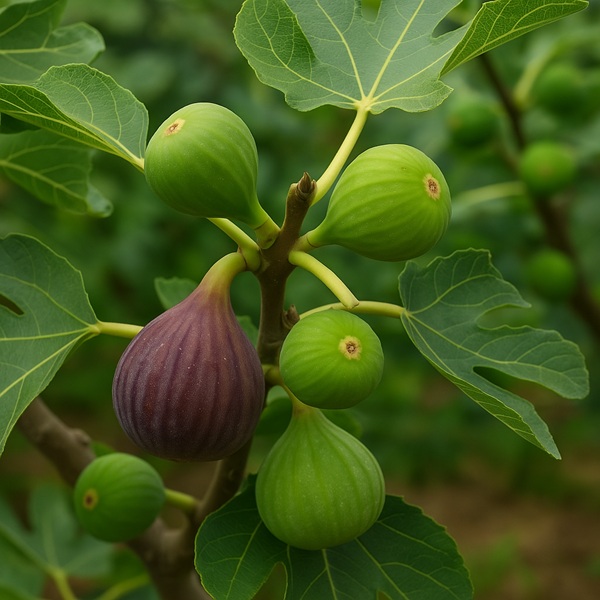
Just twenty years ago, few people believed that figs could be grown in Ukraine. The crop was considered too heat-loving for our latitudes. But today the reality has changed. Figs grow. They bloom. They bear fruit. And not just once per season. So what happened?
The climate has changed, with winters becoming milder. On top of that, adapted varieties have appeared that are able to overwinter in the ground under light protection. Gardeners began shaping the bushes so they could be bent down to the ground. Some grow figs in containers, moving them in autumn to a basement or a glazed veranda. And the crop turned out to be surprisingly flexible, hardy, and reliable.
Today, figs are no longer exotic. From Izmail to Kremenchuk, from Bila Tserkva to Melitopol, it is becoming more and more common to see broad, lobed leaves with green or purple fruits hiding beneath them. They are unlike the usual apples or pears. They have their own aroma, their own feel in the hand, and, most importantly, their own powerful health benefits.
Taste is the first thing people mention. Sweet, rich, with honey notes, sometimes with hints of caramel or mint. They can be eaten straight from the tree, dried, made into jam, added to pastries, or paired with meat. But figs are much more than just a gastronomic pleasure.
The fruits contain:
– iron and potassium, which support the cardiovascular system;
– fiber, which benefits the intestines and microflora;
– folic acid, important for blood formation and immunity;
– tannins and antioxidants, which help cleanse the body.
And the question is: how many crops in Ukraine can offer such a set of useful nutrients while also being undemanding, drought-resistant, and decorative at the same time?
Figs are a natural alternative to pharmacy vitamins. And if you follow a healthy diet, are fasting, or want to reduce your sugar intake, the fruits can become an excellent substitute for sweets. Even for people with diabetes, dried figs are allowed in limited amounts. And for children? A real find. Soft, sweet, seedless in the usual sense, and free from dangerous allergens.
Figs can be planted in Ukraine, but it is important to approach this thoughtfully. First comes the analysis of the site: light, wind protection, the possibility of covering the plant, and the slope. Figs need plenty of light and warmth. Ideally, they should be planted on the south side, protected from the north, near a wall, a greenhouse, or in a sheltered corner of the yard. But in low spots where cold air collects, figs become sickly, grow poorly, and may freeze out.
Figs are not especially demanding about soil. But drainage is important. The ideal soil is loam or sandy loam with a neutral or slightly alkaline reaction, pH 6.5–7.5. If the soil is heavy or acidic, compost, sand, and ash should be added. The planting hole is prepared to a depth of about 60 cm, with drainage laid at the bottom: expanded clay, crushed stone, or broken brick. Then comes a layer of fertile mix: humus, compost, and phosphorus fertilizers. The sapling is placed so that the root collar sits slightly below ground level.
Figs are planted in spring, from late April, when warm weather becomes stable. In southern regions, autumn planting is also possible, but only with protection. The distance between plants should be at least 2–3 meters. Believe it: in a few years, the bush will become broad, with dozens of shoots. So it is better to give it room to develop from the start.
In the Mediterranean, figs grow as trees — tall, vigorous, and spreading. But in Ukraine, especially in the center and north, they need a different approach. Here they are usually grown in bush form or trained as a low fan close to the ground so the shoots can be bent down easily and protected from frost. Because the worst thing for figs is not the temperature itself, but sudden temperature swings and freezing of the root collar.
It is best to begin shaping the bush in the first year. The most convenient form is fan-shaped: 3–5 strong shoots are left, radiating outward from the base. The rest are cut away. This not only makes care easier but also allows the plant to be covered effectively for winter. In autumn, before frosts begin, the shoots are bent to the ground, mulch is placed underneath, and the plant is covered on top with agrofabric, straw, or other nonwoven material. In regions with severe winters, an arched shelter with film or spunbond can be built.
In spring, the covering is removed gradually to avoid sunscald. At the same time, sanitary pruning should be carried out: frozen, weak, or damaged branches are removed. Figs recover quickly and actively produce new shoots. Regular pruning stimulates fruiting, because fruits are formed mainly on the young shoots of the current year. So the better you shape the bush, the heavier the harvest will be.
One of the main advantages of figs is how undemanding they are during the warm season. The plant hardly gets sick, pests are rare, and it tolerates drought surprisingly well. It is a real gift for a busy gardener. The main thing is to organize basic care correctly and not interfere with the plant more than necessary.
What is worth doing:
– Watering once every 7–10 days, and more often in heat. Young saplings are watered more heavily, mature plants moderately. Excessive moisture is undesirable.
– Loosening after rains and watering to avoid soil compaction.
– Mulching to preserve moisture, reduce weed growth, and stabilize temperature. Ideal materials are straw, cut grass, and sawdust.
– Feeding with nitrogen fertilizer in spring, ash and potassium in summer, and humus or compost in autumn.
Pay attention to the leaves: if they turn yellow, check the moisture level; if they wilt, the plant may need micronutrients. In August, it is advisable to apply potassium feeding to prepare the plant for winter. And if you want to get a second crop, it is important to prune the shoots that have already fruited after harvest and support the bush with fertilizers.
By the way, about the second crop. In the southern regions of Ukraine, figs can bear fruit twice a year. The first fruits appear in June–July on older branches, the second in September on the current year’s shoots. This is possible with a warm autumn and correct cultivation practices. So with a little experience, you can stretch out the enjoyment of the fruit for almost half the summer.
Harvesting is the climax of the season. Fig fruits ripen gradually, and they should be picked by hand when they are soft and slightly drooping on the branch. It is not worth delaying the harvest, because overripe fruits crack and spoil. On average, one bush can yield 5–12 kg of fruit. With good care and favorable conditions, it can reach up to 20 kg.
What can you do with figs? Fresh fruits are a true delicacy, unlike the mostly underripe imported ones sold in supermarkets. Figs can be dried in a dehydrator or oven at 50–60 °C, stored in the freezer, or made into jams, fruit leather, and sauces. Dried figs are nutritious, keep for a long time, and retain up to 80% of their vitamins and trace elements. Freezing is also possible, and the fruits keep both their shape and taste well.
And what about the prospects? They are considerable. In Ukraine, farms are already appearing that specialize in growing figs. Stable demand from restaurants, cafés, nutrition specialists, and even export potential all turn figs into an attractive niche crop. It does not require complicated machinery, fits easily into organic farming systems, and can generate profit even from a small area.
So if you are looking for a crop that is beautiful, tasty, healthy, and rewarding, the fig can become a true jewel of your garden. And most importantly, it does not require perfect conditions — only understanding, care, and a little patience.