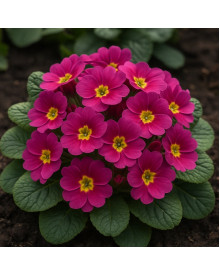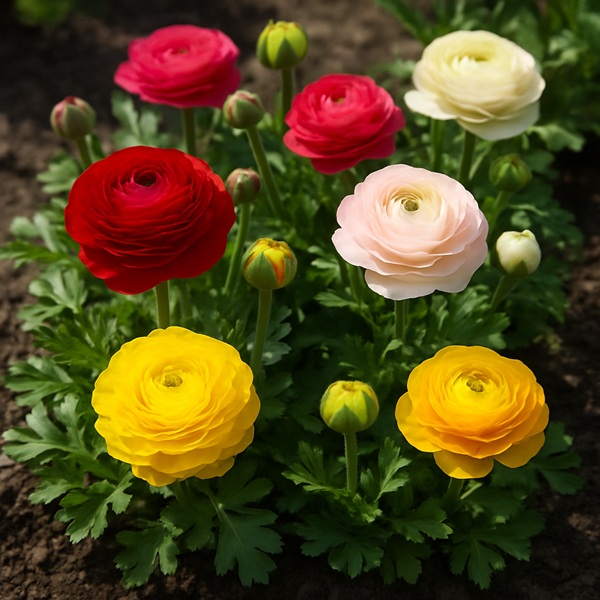
The Persian buttercup (Ranunculus asiaticus) is a herbaceous perennial from the buttercup family that stands out for its lush, vivid bloom. Thanks to its dense, multi-layered petals and broad color range — from white to deep purple — buttercups are often called “Persian roses.” Their buds may be single, semi-double, or fully double, with a diameter of 4 to 10 cm. As cut flowers, they stay fresh for up to 10–12 days, which makes them a favorite among florists.
Buttercups are well suited to growing in Ukraine, especially in the southern, central, and western regions, where the growing season is long enough. At the same time, it is important to remember that this plant is not frost-hardy — the tubers do not overwinter in open ground, so they must be dug up every year. When basic growing practices are followed, buttercups bloom abundantly from late May to mid-July, forming dense, bright “caps” of flowers.
One of the advantages of buttercups is their compact size and versatility: they are grown in flower beds, borders, containers, and rock gardens. They pair harmoniously with pansies, forget-me-nots, violets, and ornamental grasses. Buttercups are often used as a bright accent in spring mixborders. However, to achieve vigorous flowering, it is necessary to choose the tubers correctly, find a suitable planting site, and provide stable growing conditions.
Growing buttercups begins with choosing high-quality planting material. In Ukraine, tubers usually appear on sale at the end of winter. Healthy tubers are dense, firm, and free from signs of mold, rot, or drying out. In shape, they resemble tiny octopuses with several “tentacles.” Before planting, the tubers need to be awakened — soak them for 4–6 hours in warm water with a growth stimulant added, such as Epin, Zircon, or Kornevin, or in a weak potassium permanganate solution.
The optimal time for planting in open ground is from late March to mid-April, after the severe frosts have ended. In the southern regions, planting can begin earlier — from late March; in the central and northern regions, closer to mid-April. In containers, planting begins as early as February–March if supplemental lighting is available. Planting depth is 4–6 cm, and the spacing between tubers is 10–15 cm. The tuber is placed with the “tentacles” facing downward, and the upper part is lightly covered with loose soil.
For good development, buttercups need properly prepared soil. The best option is a loose, nutritious, well-drained substrate with neutral acidity. The optimal mix is garden soil, peat, humus, and sand in a 2:1:1:1 ratio. A little wood ash can be added to the planting hole. Heavy clay soils are improved with sand or vermiculite. The site should be sunny, sheltered from the wind, and with minimal risk of waterlogging. Shade or boggy conditions are unacceptable — they lead to tuber rot.
Caring for buttercups is not difficult, but it does require consistency. Right after planting, watering should be done very carefully — until the tubers root, excess moisture may cause rotting. Once shoots appear, watering is gradually increased, keeping the soil moderately moist. Water in the first half of the day so the surface has time to dry slightly by evening. During active growth and bud formation, watering becomes more frequent, but drainage must still be monitored carefully.
Feeding begins when the first leaves appear. The first application is a nitrogen fertilizer, such as ammonium nitrate or a mullein infusion, which stimulates green growth. During budding and flowering, switch to potassium-phosphorus fertilizers such as monopotassium phosphate, Kemira Lux, or Agricola for Flowers. Feeding is done every 10–14 days, alternating root feeding with foliar feeding. Organic infusions can also be used — compost water, humus, or an ash solution.
To prolong flowering, it is recommended to remove faded buds regularly — this stimulates the formation of new ones. When growing in containers, the pot should be turned from time to time so the plant develops evenly. Excess side shoots can be partially removed so the flowers become larger and brighter. It is especially important to protect plantings from spring frosts in May — if a cold spell is forecast, the plants should be covered with agrofabric or film.
Buttercups do not overwinter in open ground under Ukrainian conditions, so for repeat flowering the tubers must be dug up every year and stored until the following spring. The plants are dug up after flowering has finished, around July, when the leaves turn yellow and begin to die back. This should be done carefully, because over the season each tuber forms a “nest” of several daughter parts that can easily be damaged.
After digging, the tubers are cleaned of soil and roots, washed in a weak potassium permanganate solution, and then dried for 2–3 days in the shade in a well-ventilated place. For storage, cardboard boxes, paper bags, or crates filled with sawdust are used. Optimal conditions are a temperature of +10 to +15 °C and humidity no higher than 60%. It is important to prevent excessive dampness or high temperature — this may lead to mold development or drying out. In winter, it is advisable to inspect the tubers: any soft or damaged ones should be discarded.
Buttercups can be propagated in several ways:
By dividing the tubers. In spring or autumn, the tuber nest is divided into several parts with separate growth points.
By seed. This method is more difficult: the seeds quickly lose viability, require stratification, and need special germination conditions. Plants bloom only in the second or third year.
Microclonal propagation. This is used in specialized nurseries.
For home gardeners, the most reliable method remains seasonal storage and division of the tubers.
Although buttercups are considered a fairly resilient crop, diseases and pest attacks are possible if they are overwatered or planted too densely. The most dangerous diseases are:
Gray mold, fusarium, and root rot. These appear when there is excessive moisture. Signs include browning leaves, wilting, and rotting stem bases. The solution is to remove affected parts and treat with fungicides such as Bordeaux mixture, Fundazol, or HOM.
Powdery mildew. A white coating on the leaves, especially in damp weather. Sulfur-based preparations are effective.
Viral infections. These show up as mosaic patterns and flower deformities. Infected plants are destroyed.
Among pests, the most common are:
Spider mites. Active in hot weather, they cause wrinkling and discoloration of the leaves. Acaricides and increased air humidity help.
Aphids. They settle on buds and young leaves and cause curling. Soap solution, Fitoverm, and Actellic are effective.
Slugs and snails. Active at night, they feed on leaves and buds. Traps, ash, and granular biological products are used against them.
Preventive measures are the best protection: ventilation, proper spacing between plants, moderate watering, and treatment with Fitosporin or garlic infusion. Regular inspection helps detect problems quickly at an early stage.
One of the advantages of buttercups is that they can be grown in containers and flowerpots. This is an ideal solution for city residents, owners of terraces and balconies, or anyone who wants to control growing conditions more closely. For containers, choose pots with a volume of at least 2 liters for 1–2 tubers, with mandatory drainage holes. The substrate should be light and breathable, made up of garden soil, peat, humus, and sand.
Containers are placed in sunny or partially shaded spots. Watering is easy to regulate, but at the early stage it is especially important to avoid excess moisture. After shoots appear, the standard watering and feeding schedule is used. Flowering in containers usually begins earlier — already by late April. After the growing season ends, the tubers can be left in the same container until autumn and then dug up for storage.
Buttercups are also widely used as cut flowers. In water, they last up to 10–12 days, gradually opening their buds. The flowers are cut with pruning shears at the half-open stage. It is best to use cool water in the vase, with sugar, aspirin, or special flower solutions added. Thanks to these qualities, buttercups are often grown for wedding and festive bouquets, as well as for interior decoration.