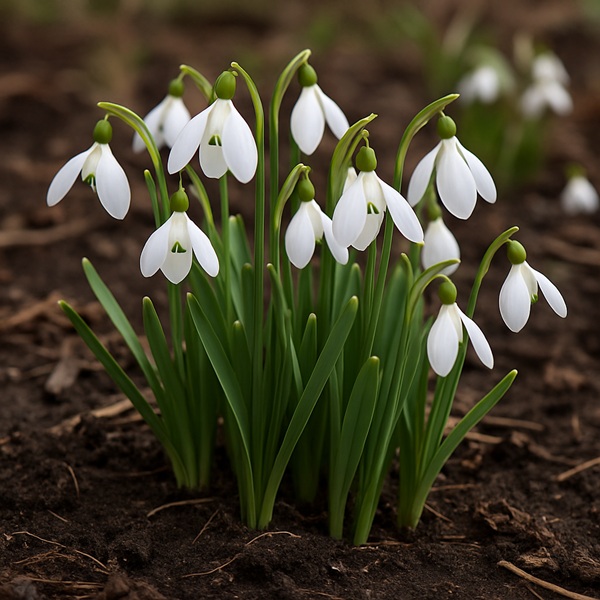
Snowdrops, or Galanthus, are among the first spring flowers and a symbol of nature awakening. In Ukraine, they are especially valued for their early blooming: their snow-white buds appear even before the snow has fully melted. These plants stand out not only for their delicacy, but also for their remarkable hardiness. In their natural habitat, snowdrops grow in the forests of the Carpathians, on the slopes of Zakarpattia, in shaded ravines, and near springs. More and more often, however, they can also be found in ornamental gardens — in group plantings, rockeries, lawns, and under trees.
Ukraine’s climate, with its moderately cool winter and moist spring, is ideal for cultivating snowdrops. Most species and varieties do not require winter cover and are able to bloom every year without transplanting for 5–7 years. It is worth remembering that snowdrops are ephemeroids — plants with a short growing season. They sprout, bloom, and die back within a few weeks, after which the above-ground part disappears until the next season. That is why, when designing flower beds, it is important to consider combinations with other plants: after the snowdrops die back, their place can be taken by later spring crops such as tulips, daffodils, and hostas.
Another important aspect is the legal one. Some species of Galanthus, including those growing in Ukraine, are listed in the Red Book. That is why digging up snowdrops in the forest is strictly prohibited. All bulbs intended for ornamental cultivation should come exclusively from legal sources — certified nurseries or trusted suppliers. Modern breeding offers numerous varieties with different flower shapes, shades of white, and double petals, opening up plenty of possibilities for unique spring garden designs.
Successful snowdrop cultivation in Ukrainian conditions begins with choosing the right site. These plants prefer partial shade, well-drained soil, and fertile ground. The best places are under deciduous trees, where there is plenty of light in spring and light shade in summer. Areas with standing water or heavy clay soils should be avoided, as excess moisture causes bulb rot. Light loams with a neutral or slightly alkaline reaction are ideal. Before planting, it is advisable to dig over the soil, add humus or compost, and, if needed, sand to improve drainage.
Bed preparation steps:
Dig the soil to a depth of 25–30 cm.
Remove weed roots and large clods.
Add organic matter such as well-rotted compost or leaf mold.
If the soil is too acidic, add lime or wood ash.
Snowdrops are planted in late summer or early autumn, roughly from late August to mid-October. The bulbs are planted 5–7 cm deep, with a spacing of 7–10 cm between them. This ensures good nutrition and protection from freezing. After planting, the area can be mulched with fallen leaves — this provides extra insulation and creates conditions closer to their natural habitat. Snowdrops do not like frequent transplanting, so they should not be disturbed unnecessarily.
If you want to create a dense spring carpet of snowdrops, it is best to plant them in groups of 15–20 bulbs. It is also a good idea to mark the planting spot each year so they are not accidentally damaged during spring garden work. By the second or third year after planting, the plants form dense clumps that become a true decoration even before the garden has fully awakened.
Despite their fragile appearance, snowdrops do not require complicated care. The main thing is to provide suitable conditions and carry out a few basic maintenance measures. In spring, once the shoots appear, the soil around the plants can be gently loosened to improve airflow to the root system. Watering is usually unnecessary, as the soil contains enough moisture during this period. The exception is the southern regions of Ukraine, where a warm winter with little snow may create a need for moderate watering.
Attention! Snowdrops do not tolerate standing water or excessive moisture. Watering should be done only when necessary, based on the actual soil moisture level.
During active growth, it is advisable to apply one feeding of a balanced mineral fertilizer with a higher potassium and phosphorus content. This helps strengthen the bulbs and set flower buds for the following year. Nitrogen fertilizers are best avoided, as they encourage excessive leaf growth and shorten the flowering period.
It is best to remove faded flower stalks, especially if seed collection is not planned. At the same time, the leaves should be left until they die back completely — this is when nutrients are stored in the bulb. Cutting the leaves too early weakens the plant and may reduce the number of flowers in the following season.
Snowdrops reproduce well both vegetatively and by seed, but in practice, under Ukrainian conditions, the vegetative method is used more often. Once every 5–7 years, it is recommended to divide overgrown clumps — this not only rejuvenates the plant but also expands the planting area. The best time for division is late spring, right after the above-ground part has completely died back.
Steps:
Carefully dig up the clump, trying not to damage the bulbs.
Divide the nest into individual bulbs or small groups.
Inspect each one for signs of rot or damage — unhealthy bulbs should be discarded immediately.
If planting is delayed, store the bulbs in a dry, well-ventilated place at a temperature of +18 to +20°C.
Seed propagation requires patience: it may take 4–5 years from sowing to the first bloom. The seeds are collected as soon as they ripen, in early summer, and sown in containers or directly into open ground before winter. However, it should be taken into account that not all varieties produce viable seed, and hybrids may not retain their varietal traits.
When propagating snowdrops, it is important to follow crop rotation principles: do not replant them in the same place continuously for more than 7–8 years. This reduces the risk of disease buildup in the soil and encourages more abundant flowering.
Snowdrops are generally not very prone to disease, but under unfavorable conditions — excess moisture, poor ventilation, or overcrowding — they may suffer from fungal infections. The most dangerous is gray mold (Botrytis), which appears as a gray coating on leaves, stems, and bulbs. If symptoms appear, the affected parts of the plant should be removed immediately, watering should be reduced, and the plants should be treated with a fungicide such as Bordeaux mixture or another copper-based preparation.
Main pests:
Bulb fly. Its larvae enter the bulbs and cause them to rot.
Slugs. Active during rainy springs, they feed on young leaves and buds.
Field mice. Especially dangerous in neglected areas, as they damage or eat the bulbs.
Preventive measures:
Regular inspection of the plantings.
Removal of plant debris after the end of the growing season.
Autumn treatment of the soil with ash or superphosphate.
The use of natural repellents such as juniper and aromatic herbs, or protective mesh during planting.
Chemical treatments should be used only in the case of a serious threat and strictly according to instructions, so as not to harm other plants or beneficial microorganisms.
Although snowdrops are usually grown in open ground, they can also be cultivated successfully in containers. This is convenient for urban settings, balconies, terraces, or winter gardens. For planting, choose wide but shallow pots with good drainage. The soil mix should consist of equal parts garden soil, sand, and humus. The bulbs are planted in autumn, and the containers are kept in a cool place — on a glazed balcony or in a basement — at around +5°C.
With the arrival of spring, the pots are moved to a warmer place or taken outside. The flowers begin to sprout and bloom. After the growing season ends, the containers are left in the shade until the following season. It is important to remember that even in indoor culture, snowdrops require a dormant period, cool conditions, and moderate moisture.
Forcing snowdrops for holidays, for example by March 8, is also popular. For this:
The bulbs are planted in a container in September or October.
They are kept for 10–12 weeks at +5°C, in a refrigerator or basement.
They are then moved to a warm, bright place at +15 to +18°C and watered moderately.
Flower stalks appear in 2–3 weeks. After flowering, weakened bulbs are best discarded, while strong ones can be planted in the garden. This method is especially appreciated by collectors and enthusiasts who want a touch of spring even in winter.