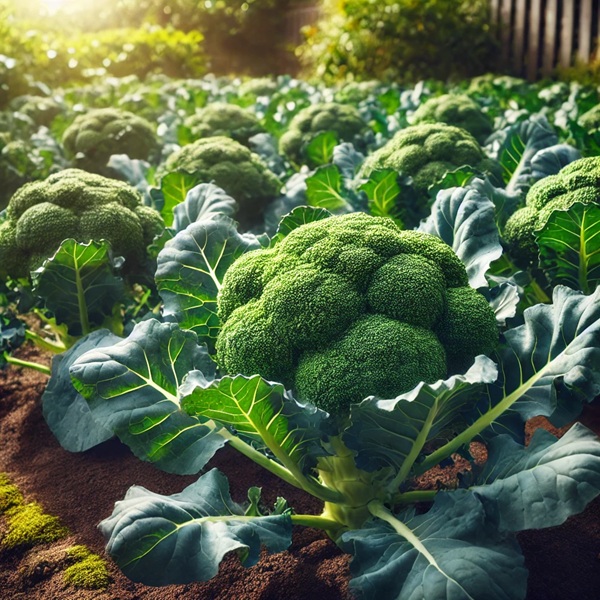
Broccoli is one of the healthiest vegetable crops and belongs to the cabbage family. This plant is a close relative of cauliflower, but it differs in its structure and in its high content of vitamins and minerals. Broccoli contains vitamins A, C, K, and B-group vitamins, as well as plenty of fiber, calcium, iron, and antioxidants, which makes it a valuable part of a healthy diet.
Broccoli is believed to have originated in the Mediterranean, where it was cultivated as far back as ancient times. Today, this crop is popular worldwide thanks to its hardiness and high productivity. Under Ukrainian conditions, broccoli adapts well and can be grown in open ground, in greenhouses, or even at home on a windowsill.
Broccoli prefers a moderate climate and grows well at temperatures between +15 and +25°C. It is less demanding in terms of growing conditions than cauliflower and can produce a harvest even in regions with cool summers. This crop is biennial, but it is grown as an annual because the heads are harvested in the first year after planting.
The broccoli stem can reach 60–90 cm in height, and the main head forms in the center of the plant. If the plant is left in the soil after harvesting, new, smaller heads appear on the side shoots, which allows the harvest period to be extended.
Among broccoli’s main advantages are its high resistance to low temperatures and pests. It can tolerate temperatures dropping to -5°C, which makes it possible to plant it early in spring or even grow it in autumn.
Broccoli can be planted either by starting seedlings or by sowing seeds directly into open ground. In Ukraine, the seedling method is considered the most effective, since it allows for an earlier harvest and provides plants with optimal growing conditions.
Broccoli seeds are sown for seedlings 30–40 days before the planned transplanting into open ground. This is usually done in March–April, while transplanting to a permanent location takes place in the second half of April to early May, when temperatures remain steadily above +10°C.
For sowing, a light fertile substrate is used, made from a mixture of humus, turf soil, and sand. The seeds are planted at a depth of 1–1.5 cm and kept indoors at a temperature of +18 to +22°C. Seedlings appear in 5–7 days, after which the temperature can be lowered slightly to prevent them from becoming leggy.
Before planting in open ground, the plants are hardened off by gradually taking them outdoors. Transplanting is done when the seedlings have 4–5 true leaves. The optimal planting pattern is 30–40 cm between plants and 50–60 cm between rows.
Broccoli prefers loose, fertile soil with neutral acidity (pH 6.0–6.8). It grows best in loamy or chernozem soils rich in organic matter. Before planting, humus or compost is added to the soil, along with wood ash or dolomite flour to normalize acidity.
Broccoli is a moisture-loving crop, so regular watering is an important condition for successful cultivation. It should be watered 2–3 times a week, especially during dry periods. It is important to make sure the soil stays moist but not waterlogged, in order to avoid root rot.
Feeding is carried out several times during the season. The first feeding is done 2 weeks after transplanting the seedlings into open ground, using a diluted manure solution (1:10) or mineral nitrogen fertilizers. The second feeding is done during head formation, when phosphorus-potassium fertilizers are recommended. The third feeding is carried out after harvesting the main head to stimulate the growth of side shoots.
The soil is loosened regularly, especially after rain or watering. This helps prevent crust formation on the soil surface and ensures oxygen access to the root system.
Since broccoli can spread quite vigorously, it is advisable to weed regularly, removing weeds that may compete with the plant for nutrients.
The main broccoli head reaches maturity 60–90 days after planting, depending on the variety. The optimal time for harvest is when the florets are dense and have not yet started to open. If harvesting is delayed, the head will begin to flower and its taste quality will deteriorate significantly.
The head is cut together with a 10–15 cm stem, which improves the taste and makes the vegetable more tender. After cutting, new florets may appear on the side shoots, so the plant is not removed immediately.
Broccoli is stored in the refrigerator at a temperature of +1 to +3°C, wrapped in plastic film or placed in a perforated bag. In this form, it keeps for up to 7–10 days. For long-term storage, broccoli is frozen after first being divided into florets and blanched in boiling water for 2–3 minutes.
Broccoli may be attacked by pests such as cabbage white butterflies, crucifer flea beetles, and aphids. To control them, tobacco or garlic infusions, or insecticides such as Fitoverm and Aktara, are used.
Among the most common diseases are blackleg, powdery mildew, and downy mildew. For prevention, it is important to follow crop rotation, avoid overcrowded planting, and regularly treat plants with biofungicides.
By following all the care guidelines, it is possible to obtain a generous broccoli harvest even under the climatic conditions of Ukraine.