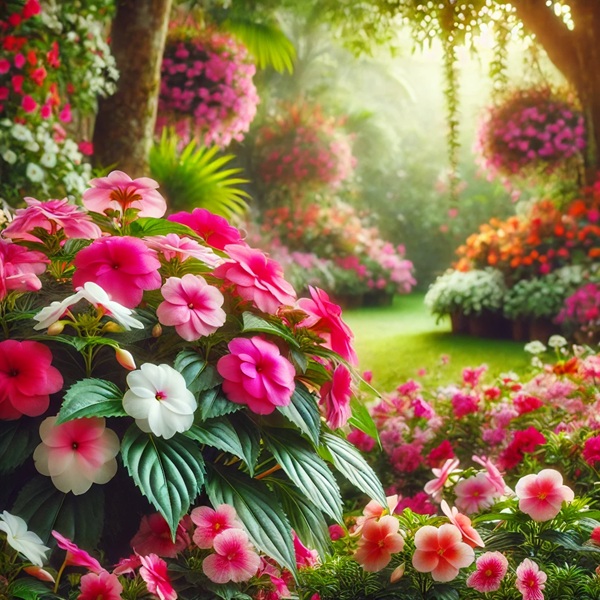
Balsam is an ornamental herbaceous plant belonging to the Balsaminaceae family. Thanks to its bright flowers and unpretentious growing requirements, it has become popular among gardeners in Ukraine. In everyday speech, the plant is often called “Vanka wet” because of its ability to release droplets of moisture along the edges of its leaves, or “touch-me-not” because its ripe fruits burst at the slightest touch, scattering the seeds.
Balsam is represented by both annual and perennial species. Its height may vary from 20 to 70 cm, and sometimes even more, depending on the variety. The stems are succulent and brittle, while the leaves are lance-shaped or oval with serrated edges. Their color may range from light green to dark burgundy. The flowers may be single or double, with a wide palette of shades: white, pink, red, orange, and lilac.
In Ukraine, balsam is grown as both a houseplant and a garden plant. It prefers a warm, moderately humid climate and grows well in open ground, in containers, hanging pots, or flowerpots. It is planted outdoors in spring, once stable warm weather has set in, while indoors it can bloom throughout the year.
A special feature of balsam is its ability to bloom abundantly and for a long time. With proper care, the plant can delight with flowers from May until the first autumn frosts. Indoors, however, the flowering period can be extended by providing appropriate care and lighting.
Planting balsam depends on the growing method — in open ground or in pots. In Ukraine, the best time for planting outdoors is late May or early June, when the threat of night frosts has passed.
For planting, choose a well-lit or partially shaded place. Direct sunlight may cause leaf burn, so the best location is under trees or near shrubs that create light shade. If the plant is grown in pots or flower containers, they can be moved depending on weather conditions.
Balsam likes loose, fertile, well-drained soil. Before planting, it is recommended to prepare the soil by mixing garden soil with peat, humus, and sand in equal proportions. If the soil is heavy, more sand should be added for better drainage.
Seeds are sown in winter or early spring so that by the time of transplanting into open ground, the plants are already strong enough. The seeds are spread over the surface of a moist substrate and lightly sprinkled with soil. The optimal temperature for germination is +20 to +22°C. Seedlings appear in 10–14 days. As soon as they grow to 1.5–2 cm and develop 2–3 true leaves, they are pricked out into separate containers.
Seedlings are planted at a distance of 25–30 cm from each other. The root system of balsam is sensitive, so transplanting should be done carefully, using the transshipment method and preserving the root ball.
Caring for balsam is simple, but for lush flowering several rules should be followed.
Watering should be regular but moderate. Balsam does not tolerate the soil drying out, but excess water can also cause root rot. In hot periods, the plant should be watered daily; in rainy periods, the amount of moisture should be reduced. Indoor plants are watered after the top layer of soil has dried.
The plant responds well to feeding. During the period of active growth and flowering, from May to September, it is recommended to use complex fertilizers for flowering plants every two weeks. In autumn and winter, feeding is reduced or stopped.
Loosening the soil helps provide oxygen to the root system, while mulching preserves moisture and prevents weed growth.
The bush is shaped by pinching the tops of young shoots, which stimulates branching and makes the plant fuller. It is also necessary to remove faded flowers in time, as this prolongs the flowering period.
Balsam can be propagated by seeds or cuttings. Cuttings are the fastest way to obtain new plants. For this, apical cuttings 5–7 cm long are cut from an adult plant and placed in water or planted directly into moist soil. After 10–14 days, roots appear, after which the plant is transplanted to a permanent place.
Seed propagation makes it possible to obtain many new plants, but they may differ slightly from the mother plant in flower color and shape.
Despite balsam’s hardiness, it may be attacked by pests such as spider mites, aphids, and whiteflies. At the first signs of damage, the plants are treated with a soap solution or insecticides.
Root rot most often occurs because of excessive watering or poor drainage. In such cases, watering should be reduced and good water drainage should be ensured.
Powdery mildew and gray mold are fungal diseases that may affect the plant under conditions of excessive moisture and poor air circulation. For prevention, overwatering should be avoided and the plants should be inspected regularly.
With proper care, balsam will delight you with abundant flowering and become a wonderful decoration for a garden or a home.