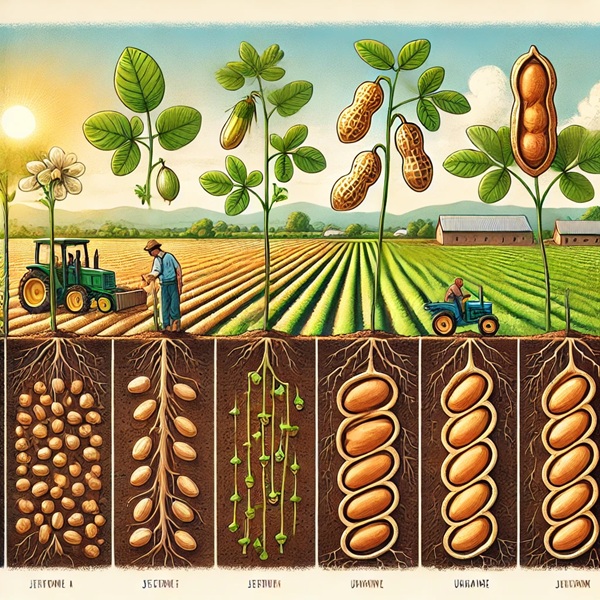
Peanuts, or groundnuts, are becoming an increasingly popular crop among Ukrainian farmers and gardeners. The varieties best suited to growing conditions in Ukraine are Virginia, Krasnodarets, and Ukrainian Valencia. These varieties are characterized by high yields and are adapted to local climatic conditions.
Before planting, it is important to prepare the seeds properly. It is recommended to use only shelled seeds or pods that have not been heat-treated. Before sowing, the seeds should be soaked in warm water for 12–24 hours to speed up germination. A weak potassium permanganate solution can also be used for disinfection, or growth stimulants such as Epin or Zircon.
After soaking, it is worth testing germination: place the seeds on a damp cloth and leave them in a warm place. After a few days, the first sprouts will appear, indicating that the seeds are ready for planting. If germination is low, the seed selection should be reconsidered or the seeds treated again with stimulants.
Peanuts are a heat-loving plant, and suitable conditions are necessary for successful growth. In Ukraine, the southern regions, such as Kherson and Odesa, are the most suitable for peanut cultivation because their climate is the most favorable for this crop. However, by creating the right conditions, such as using greenhouses or hotbeds, peanuts can also be successfully grown in other regions of the country.
The optimal temperature for peanut growth is +20 to +30°C. At temperatures below +15°C, plant development slows down, and at +10°C it stops completely. The soil should be light, loose, and rich in organic matter. Sandy loam and loam soils with neutral acidity (pH 6.0–7.0) are best. Before planting, deep digging is recommended, along with adding humus or compost and wood ash to reduce acidity.
Peanuts are a light-loving crop, and their growth slows when light is insufficient. It is important to choose sunny sites protected from drafts and strong winds. If grown in a greenhouse, additional ventilation should be provided to avoid excessive humidity and the appearance of fungal diseases.
Peanuts should be planted in warm, moist soil. The soil temperature at the time of planting should be no lower than +12 to +14°C. The best planting time is the same period when melons and gourds are planted in your region.
Either the hill method or the row method can be used. With the hill method, holes 5–7 cm deep are made, and 2–3 sprouted seeds are placed in each. The spacing between holes should be 20–25 cm, and between rows 50–60 cm. The row method involves planting the seeds in furrows while maintaining similar spacing.
After planting, the soil is gently firmed and watered with warm water. During the first weeks after planting, it is recommended to cover the beds with agrofabric to protect the plants from night-time cold. Before flowering, the soil can also be fertilized with humus, peat, or manure to provide the plants with the nutrients they need.
To obtain a good harvest, peanuts must be cared for properly. The main cultivation practices include regular watering, soil loosening, hilling, and pest control.
Watering is done as needed, without allowing the soil to dry out. Peanuts are a moisture-loving plant, and their yield depends on watering, so the soil should be kept loose and moist. The best solution is drip irrigation, which is stopped about a month before harvest.
The soil is loosened after every watering or rain. This improves oxygen access to the root system, prevents the formation of a hard crust on the surface, and promotes better fruit development.
Hilling is an important stage in peanut cultivation. Since the fruits form in the soil, the plants need to be hilled several times during the season, similar to potatoes. The first hilling is done to a height of 5–7 cm, 10 days after flowering. It is then repeated 2–3 more times at 10-day intervals.
Among the pests that threaten peanuts, aphids are especially notable. To control them, contact or intestinal insecticides are used. It is best to spray the plants before flowering, following the instructions.
Peanuts ripen 120–150 days after planting. A sign of maturity is the yellowing and drying of the leaves. To check whether the crop is ready, a few bushes can be dug up: if the shell of the nuts is firm and easy to clean, the harvest can begin.
Harvesting is carried out in dry weather. The bushes are carefully dug up with a fork or shovel, then gently pulled from the ground and left for several days to dry. After that, the pods are separated from the tops and dried further in a well-ventilated room.
For storage, peanuts can be kept either in the pods or shelled. The main thing is to ensure low air humidity and good ventilation to prevent mold. The optimal storage temperature is +8 to +12°C. Under such conditions, peanuts can be stored for several months without losing their taste or nutritional value.
Growing peanuts in Ukraine is a profitable and promising process. With the right approach and proper adherence to all cultivation practices, it is possible to obtain a high yield even in a temperate climate.