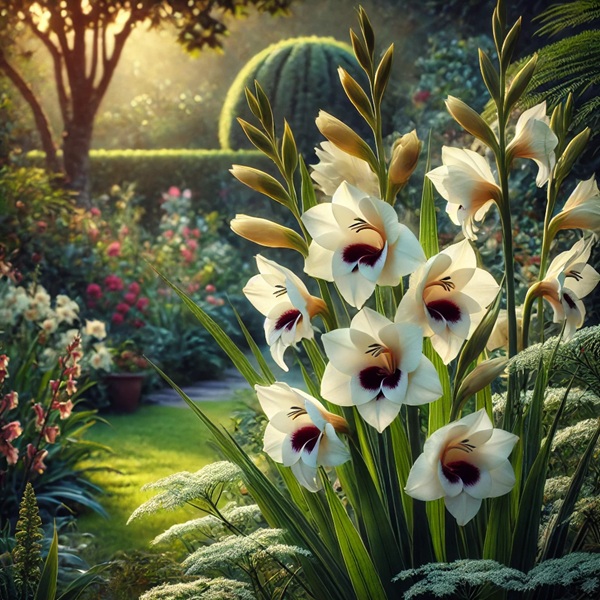
Acidanthera is an elegant perennial plant from the iris family, often popularly called the “fragrant gladiolus.” It is native to the tropics of Africa, but thanks to its decorative appearance and pleasant scent, this flower has become popular in various regions, including Ukraine. Despite its outward resemblance to gladiolus, acidanthera is distinguished by a more graceful flower shape and a pronounced fragrance that is especially noticeable in the evening.
This plant reaches a height of 60 to 120 cm, forming slender stems with narrow green leaves. The flowers are star-shaped and may be white, pink, or cream, often with a contrasting dark spot in the center. Acidanthera blooms in August–September, which makes it an excellent choice for late-summer and autumn flower beds.
In the conditions of Ukraine, acidanthera is more often grown as an annual, since its corms are sensitive to frost. However, with proper care and timely lifting for winter, it can be grown as a perennial. The plant prefers sunny, well-lit places protected from wind, as well as fertile, well-drained soils.
Despite its exotic origin, acidanthera can be successfully cultivated in open ground, in containers, and even in greenhouses. For its full development, it is important to take several key factors into account: proper planting, regular watering, fertilization, protection from pests, and timely preparation for wintering.
Planting acidanthera in Ukraine requires a careful approach, taking into account the climatic features of the region. The corms are planted in open ground in spring, once the threat of return frosts has passed, usually in late April to early May. The optimal soil temperature for planting should be no lower than +10°C.
Before planting, it is recommended to treat the corms with fungicides to prevent fungal diseases. They can also be soaked in a weak solution of potassium permanganate for 1–2 hours. If the planting material was stored at a low temperature, it is advisable to pre-sprout it in containers with a peat-based substrate 3–4 weeks before planting in the ground.
Choosing the right location plays an important role in the successful cultivation of acidanthera. Sunny areas with light, loose soil that drains well are best for planting. Heavy clay soils should be improved by adding sand, humus, or peat.
The corms are planted at a depth of 6–10 cm, depending on their size. The distance between plants should be about 10–15 cm, since acidanthera needs space for full growth and flowering. After planting, the beds are watered abundantly with warm water, and then mulched with a layer of humus or dry peat to retain moisture.
Acidanthera is fairly undemanding, but for lush flowering it is necessary to follow several basic care rules.
Watering plays an important role in the plant’s development, especially during active growth and bud formation. Acidanthera needs regular but moderate moisture — the soil should remain moist, but without standing water. During dry periods, watering is increased, but it is important to avoid excessive moisture so the corms do not rot.
Loosening the soil and removing weeds is another important stage of care. After each watering, it is recommended to carefully loosen the top layer of soil to improve aeration of the root system. This also helps prevent the development of weeds, which may suppress the growth of acidanthera.
Feeding is carried out several times during the season. The first fertilizer is applied 2–3 weeks after planting, using nitrogen fertilizers that stimulate the growth of green mass. During budding and flowering, acidanthera is fed with phosphorus-potassium fertilizers, which promote abundant flowering and strengthen the corms.
Periodic removal of faded buds prolongs the plant’s decorative appearance and allows it to direct its energy toward forming new flowers.
Since acidanthera cannot be left in the ground over winter in Ukrainian conditions, after flowering is finished its corms must be lifted and prepared for storage. This is done in late September to early October, before the first frosts begin.
The stems are cut back, leaving a small stub about 5 cm long. Then the corms are carefully dug up, cleaned of soil, and dried in a well-ventilated room at a temperature of +20…+25°C for 2–3 weeks. After drying, the remains of stems and roots are removed, and the planting material is treated with a fungicide to prevent fungal infection.
The corms should be stored in a dry, dark place at a temperature of +5…+10°C, for example in paper bags or fabric pouches. It is important to monitor humidity levels — excessive moisture may cause rotting, while too much dryness may cause the planting material to dry out.
Two to three weeks before planting, the corms can be taken out of storage, warmed up, and sprouted in a warm room, which will speed up their development after planting in the ground.
Although acidanthera is considered a relatively resilient plant, it may suffer from a number of problems related to unfavorable conditions or pests.
The most common problem is corm rot. This usually occurs because of excessive watering or planting in poorly drained soil. To avoid this, it is necessary to control moisture levels and choose loose, well-drained soils.
Among the pests that may attack acidanthera are thrips, aphids, and spider mites. At the first signs of damage, the leaves and stems should be treated with insecticides such as Actellic or Fitoverm.
With proper care, acidanthera will become a true decoration of the garden, delighting you with its flowering and fragrance until late autumn.