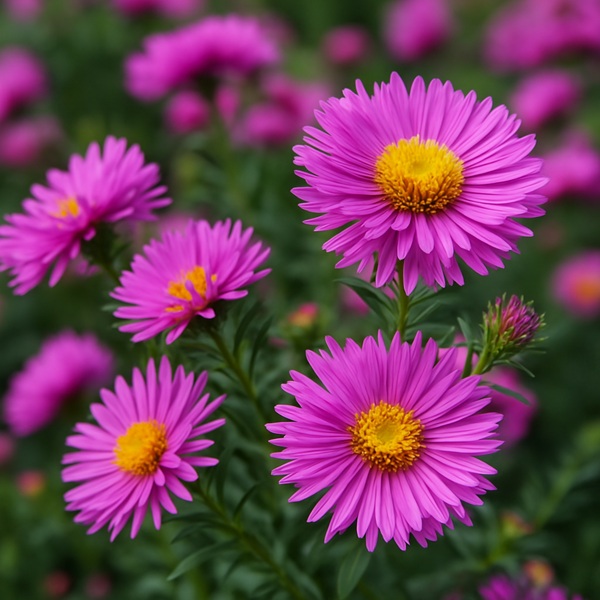
Aster is one of the most beloved and recognizable garden plants, widely grown in Ukraine thanks to its bright ornamental appeal, long flowering period, and relative ease of care. The Latin word aster means “star,” and indeed, aster blooms resemble little stars, ranging from miniature to large, double, and spherical forms. The genus Aster includes more than 200 species, but in ornamental gardening the most commonly used are China aster (Callistephus chinensis) and perennial species such as New Belgium aster, New England aster, Alpine aster, and others.
In Ukraine, asters thrive well thanks to the moderately continental climate, a sufficient number of sunny days, and varying moisture levels depending on the region. In the southern regions, such as Odesa and Kherson, asters may lack moisture, so regular watering is especially important there. In central and western Ukraine, including Kyiv, Cherkasy, and Lviv regions, conditions are more balanced, especially for perennial species. In the northern regions, such as Chernihiv and Zhytomyr, it is worth choosing frost-resistant varieties and providing winter cover.
The advantages of asters for Ukrainian gardeners include:
a wide range of flowering periods, from June until late autumn;
a broad color palette: white, pink, lilac, blue, purple, burgundy, and bicolored varieties;
suitability for borders, flower beds, mixed borders, and cut flowers;
decorative value even in single plantings;
simple care and easy access to seeds and seedlings.
So, aster is a versatile solution for landscaping both private gardens and public spaces. Thanks to its diversity of forms and colors, it can be easily integrated into any garden style, from classic to modern or country.
Before planting asters, it is important to choose the right variety. To do this, gardeners consider the plant’s height, bush shape, color, and intended purpose. For example, dwarf varieties (up to 30 cm) are suitable for the front of flower beds, while tall varieties (up to 1 m) are ideal for cutting or for planting toward the back of a bed. By flowering time, asters are divided into:
early — bloom in June, mostly perennials;
mid-season — flower from late July through September;
late — continue blooming until October and even November.
Popular varieties for Ukraine include:
Princess Mix — an early, double, compact variety;
Matador — rain-resistant and suitable for cutting;
Amethyst — a bush-type aster with spherical blooms;
Gala — late-flowering with bright coloration;
Ballada — ideal for alpine rock gardens and borders.
The choice of location depends on the plant’s needs. Asters prefer sunny, airy areas protected from strong winds. In shade, the plant becomes stretched, blooms less abundantly, and loses its ornamental quality. The soil should be:
light and well drained, without stagnant water;
slightly acidic or neutral (pH 6.0–7.0);
rich in organic matter, but without fresh manure;
loose in structure, with regular mulching and loosening.
It is not recommended to plant asters after gladiolus, tulips, carnations, and other plants prone to similar diseases. Good predecessors are marigolds, calendula, and cereals. It is best to allocate a new bed or flower border for asters where similar crops have not been grown for at least 2 years.
Asters can be grown both by the seedling method and by direct sowing. The seedling method is more reliable and makes it possible to achieve earlier and longer flowering, especially in regions with short summers. Seeds for seedlings are sown in February–March for early varieties or in April for mid-season and late varieties. The seeds are sown in boxes or containers filled with a light, disinfected substrate, to a depth of 0.5–1 cm. The soil is moistened and covered with film until the seedlings emerge.
Stages of growing seedlings:
preparing the substrate — a mixture of peat, humus, and sand (2:2:1);
disinfection — steaming or watering with a weak potassium permanganate solution;
sowing — to a depth of up to 1 cm, with 2–3 cm between seeds;
covering with film or glass — until germination;
pricking out — at the stage of 2 true leaves;
hardening off — 1–2 weeks before planting in the ground.
Seedlings are planted in open ground from mid-April in southern Ukraine or from early May, depending on the weather. The direct-sowing method is used less often, because flowering begins 2–3 weeks later in that case. Seeds are sown directly into the soil in April, when the soil has warmed to +12°C. If frost is possible, the planting is covered with agrofabric.
Planting distances:
for low-growing varieties — 15–20 cm between plants;
for medium-growing varieties — 25–30 cm;
for tall varieties — 35–40 cm.
During the first few days after planting, it is important to provide soft light or partial shading, regular watering, and protection from wind. Watering is essential, especially in dry weather, but without excess moisture. Asters do not tolerate waterlogging.
Caring for asters is not difficult, but it does require consistency. With proper cultivation practices, the plant can bloom abundantly and for a long time, maintaining its ornamental appearance until the first frost. The main needs of asters are sufficient light, moderate moisture, loose soil, and protection from disease. In Ukraine, where summers may be hot or rainy, care should be adapted to weather conditions.
Recommendations:
Watering — regular, especially during heat. Asters do not tolerate drying out, but stagnant water is also harmful. Water at the root without wetting the leaves or flower heads.
Loosening — the day after watering. It improves aeration, preserves moisture, and prevents the formation of a soil crust.
Mulching — stabilizes the microclimate around the root zone and suppresses weed growth. Mown grass, peat, or straw can be used.
Weeding — essential, especially during the early growth stages. Dense plantings are more likely to get sick.
Staking — necessary for tall varieties in windy or rainy weather.
Fertilizing:
2 weeks after planting — nitrogen fertilizers such as mullein solution or urea;
at the budding stage — complex NPK fertilizers with an emphasis on phosphorus and potassium;
during flowering — ash infusion or phosphorus-potassium fertilizers without nitrogen.
After flowering, the stems of annual asters are cut back. Perennial asters are cut almost down to ground level and then mulched before wintering. Pruning is best done in dry weather to avoid rotting.
The propagation method depends on the type of plant: annual asters are propagated by seed, while perennial asters are mainly propagated by dividing the bush, and less often by cuttings. Seeds of annual varieties can be collected independently: after flowering, the flower heads are left on the plant until completely dry, then removed, dried, and stored in paper bags in a dry place.
Sowing for the next season:
for seedlings — February to March;
in open ground — April, or before winter in October–November.
Perennial asters are rejuvenated every 3–4 years. Old bushes lose their decorative effect and bloom less abundantly. Division is an effective way to renew them:
in spring or autumn, the bush is dug up;
it is divided into parts with 2–3 growing points and roots;
the soil is renewed and compost is added;
the divisions are planted in a new place, keeping a spacing of 30–40 cm.
Cuttings are a less common but possible method. Top shoots 5–7 cm long are rooted in a greenhouse or under film. After a month, the plants are ready for transplanting.
Asters, especially when care rules are нарушено, can be affected by diseases. The most common diseases are fusarium, powdery mildew, and gray mold. The causes may include excessive moisture, overcrowding, poor drainage, and failure to follow crop rotation. Plants grown after carnations, tulips, and other similar crops are especially vulnerable. The best prevention is ventilation, proper spacing, and removal of diseased plants.
Typical diseases:
Fusarium — wilting and blackening of the leaves. The plant is destroyed, and the soil is treated with Fundazol.
Powdery mildew — a white coating on the leaves. Topaz, Skor, or garlic infusions are used.
Gray mold — brown spots on the stems. The affected parts are removed and fungicide treatment is applied.
Pests:
aphids and thrips — deform the flower heads;
spider mite — causes yellow spots and becomes active in hot weather;
slugs — damage young shoots after rain.
Protection:
spraying with infusions of wormwood or nettle;
using insecticides such as Actellik and Fitoverm;
hand-collecting slugs and setting traps.
Wintering:
annual asters are removed after flowering, and the soil is dug over;
perennial asters are cut back and mulched with peat, compost, or leaves;
in northern regions, they are additionally covered with spruce branches or agrofabric.
If these rules are followed, asters will delight the garden every year with lush flowering, adding color from summer until late autumn.