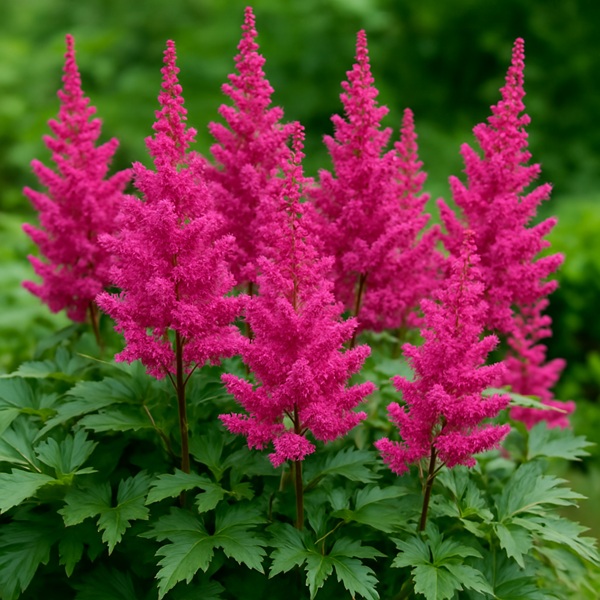
Astilbe is a perennial herbaceous plant with luxurious plume-like flower clusters and finely cut foliage, and it has become an essential part of shaded and partially shaded gardens. It belongs to the saxifrage family (Saxifragaceae) and includes more than 30 species and hundreds of varieties that differ in height, flower shape, color, and blooming time. In Ukraine, astilbe proves itself to be an undemanding, frost-resistant, and highly ornamental plant, especially valued for its ability to grow in low-light conditions — in shade, under trees, and near the north-facing walls of buildings.
Ukraine’s climate, with its moderately continental features, mild winters in the south, and cooler ones in the north, is fully suitable for growing astilbe. It performs especially well in regions with sufficient rainfall — in the west and central parts of the country. In the southern regions of Ukraine, such as Kherson, Odesa, and Mykolaiv, astilbe requires more attentive care and regular watering when moisture is lacking, especially during hot periods. In the northern regions, such as Chernihiv, Zhytomyr, and Volyn, young plants should preferably be covered for winter, although mature plantings usually tolerate the cold well without extra protection.
Astilbe prefers partial shade, but it can also grow in sunny locations provided the soil remains moist enough. In shade, flowering usually lasts longer but is less abundant, while in the sun it is brighter, though shorter. The best planting locations are:
under the canopies of deciduous trees, especially birch, linden, and apple trees;
along fences or walls facing east or northeast;
in mixed borders with shade-tolerant plants such as hostas, ferns, and brunnera;
near ponds, where air humidity is higher.
It is not advisable to plant astilbe in places with standing water or where the soil dries out quickly. In southern regions, mulching and protecting the root system from overheating are essential.
The wide range of astilbe varieties makes it possible to choose a plant for almost any garden condition. They are divided by height into:
dwarf — up to 30 cm, ideal for borders;
medium-growing — 40–60 cm, versatile for group plantings;
tall — 70–120 cm, excellent for the back of flower beds.
Varieties are also classified by blooming time:
early — late June;
mid-season — July;
late — August to mid-September.
By flower color, astilbes come in white, pink, crimson, lilac, red, and purple. Especially popular varieties include Amethyst, Fanal, Brautschleier, Gloria Purpurea, and Cattleya.
The soil for astilbe should be:
loose, moisture-retentive, and enriched with organic matter;
acidic or slightly acidic (pH 5.5–6.5);
well drained yet able to hold moisture;
dug over to a depth of at least 30 cm.
Before planting, the following should be added to the soil:
compost or well-rotted manure (5–7 kg per 1 m²);
peat, to improve structure;
ash or bone meal, as a source of potassium and phosphorus;
sand or fine gravel in heavy clay soils.
It is especially important to maintain high moisture without waterlogging — astilbe does not tolerate drying out, but it is also sensitive to stagnant water. The health and ornamental value of the plant depend greatly on soil quality.
The best time to plant astilbe in Ukraine is spring (April–May) or autumn (September–October). Spring planting is preferable because it gives the plant time to root well before the summer heat. In autumn, planting is advisable only if at least 4–6 weeks remain before the first frost. Planting is done on a cloudy day or in the evening to avoid stress from the sun.
Main steps:
Dig planting holes 25–30 cm deep and up to 30 cm wide.
Place drainage at the bottom (gravel, broken brick) and add a layer of fertile soil.
Position the rhizomes so that the renewal buds are buried 3–5 cm deep.
Firm the soil carefully and water the plant with warm water.
Be sure to mulch with peat, bark, straw, or decorative wood chips.
Planting spacing depends on the variety:
for dwarf varieties — 20 × 30 cm;
for medium-growing varieties — 30 × 40 cm;
for tall varieties — 40 × 50 cm.
After planting, it is important to monitor soil moisture. During the first two weeks, watering is done every 2–3 days, especially in warm weather. Overwatering should be avoided: the soil should stay moist, but not swampy. With spring planting, astilbe may bloom in the same season, though truly abundant flowering is usually expected from the second year onward.
Astilbe is a plant that establishes easily and is known for its hardiness, but with proper care it produces especially abundant and long-lasting blooms. One of the main factors in successful cultivation is moisture. In Ukraine, especially in the central and southern regions where summer droughts occur, regular watering is essential. During active growth and flowering, astilbe should be watered at least twice a week, and in hot weather every other day or even daily, especially if it grows in a sunny spot.
Feeding is also very important. In spring, after the first shoots appear, apply complex mineral fertilizers with an emphasis on nitrogen to build leaf mass. During budding and flowering, switch to potassium-phosphorus fertilizers, which stimulate active formation of flower clusters. In autumn, after flowering ends, add ash or compost to prepare the plant for winter. Excessive fertilization may cause lush leaf growth at the expense of flowering.
Pruning is done in two stages:
During the growing season, faded flower clusters may be removed if desired, which stimulates the formation of new shoots.
In late autumn (October–November), the entire above-ground part is cut back to the base, leaving stubs 5–10 cm high. This helps prevent rot and disease and supports healthy regrowth in spring.
Additional recommendations:
mulching is essential to preserve moisture and protect the root system from overheating;
weeding and loosening provide air access to the roots;
disease prevention includes infusions of wormwood, pine needles, and garlic;
staking tall varieties helps prevent flower stalks from breaking in wind or rain.
The most common and effective way to propagate astilbe is by dividing the clump, which is done in spring or autumn every 4–5 years. This not only provides new plants but also rejuvenates the old clump, increasing flowering intensity. Divisions should contain at least one renewal bud and a well-developed portion of rhizome.
Step by step:
Carefully dig up the clump and clean the roots from the soil.
Use a sharp knife to divide it into sections, then dust the cuts with ash or charcoal.
Plant according to the standard spacing, water, and mulch.
Cuttings are used less often, but they are also possible. Young shoots with a heel (part of the rhizome) are rooted in moist sand or a light substrate under film, with high humidity maintained. After 1–1.5 months, the cuttings take root and can be planted in open ground.
The seed method is the longest, but it is interesting for breeding purposes. Seeds are collected in September and sown in January–February:
sow on the surface without covering;
cover with glass or film and maintain a temperature of +18 to +22°C;
seedlings appear in 2–3 weeks;
prick out at the stage of 2 true leaves.
With this method, varietal traits may not be preserved, but sometimes interesting new forms appear.
Astilbe is quite resistant to pests and diseases, especially with proper care. But under unfavorable conditions — overwatering, deep shade, overcrowding — fungal infections may appear, including powdery mildew, rust, and leaf spot. For prevention, fungicides such as Fundazol and Topaz are used, along with spraying with organic infusions of wormwood, garlic, or pine needles. It is important to observe crop rotation and not plant astilbe after other moisture-loving crops.
Possible pests include:
nematodes — they deform the leaves and are difficult to control, so it is better to dig up and remove affected plants;
slugs — especially active in damp, shady weather; traps, ash, and metaldehyde are effective;
aphids and spider mites — active in drought; insecticides and spraying with water help control them.
Preparing for winter:
after pruning, apply a 5–10 cm mulch layer of peat, compost, or humus;
in regions with little snow, provide light cover with agrofiber or spruce branches;
in spring, remove the cover gradually to prevent the buds from rotting.
With proper care, astilbe can grow in one place for up to 10 years, delighting every year with airy, bright, and reliable flowering while keeping its beauty even in shade.