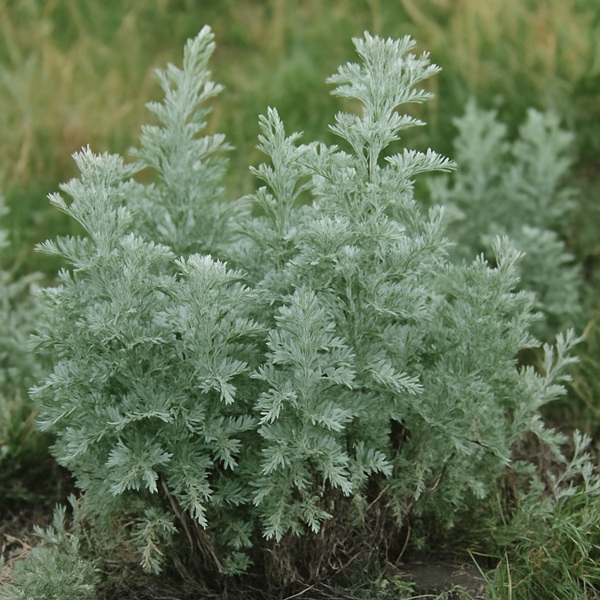
Wormwood (Artemisia) is a large genus of perennial herbaceous plants and subshrubs that includes more than 400 species. In Ukraine, wormwood is associated not only with fields and wild steppes, but also with ornamental gardening, folk medicine, and culture in general — its bitter aroma is mentioned in songs, poetry, and rituals. Many wormwood species have strong phytoncidal properties, repel pests, and improve the sanitary condition of a plot. Among the most common species suitable for cultivation in Ukraine are the following:
Bitter wormwood (Artemisia absinthium) — a classic medicinal herb with silvery-gray foliage and a pronounced aroma.
Steller’s wormwood (A. stelleriana) — an ornamental species with dense velvety foliage, ideal for borders and rock gardens.
Schmidt wormwood (A. schmidtiana) — a low-growing groundcover form with decorative silvery foliage, popular in alpine gardens.
Common mugwort (A. vulgaris) — a tall plant with airy foliage, used in folk medicine and aromatherapy.
Wormwood is especially valuable for the dry regions of Ukraine — the south, the center, and the steppe zones — thanks to its high drought tolerance and ability to grow in poor soils. It also tolerates pruning well, is resistant to disease, and requires almost no care. At the same time, its silvery-gray foliage contrasts harmoniously with bright flowering plants, creating refined compositions in flower beds. The main thing is to choose the right species and define its purpose: ornamental, medicinal, or practical.
Wormwood can be used as a hedge, a component of a mixed border, an aromatic element in the garden, or a natural protective agent. It pairs well with lavender, thyme, sage, and echinacea. All of these plants are equally resistant to drought and bright sun, which makes it possible to create durable compositions that do not require constant care. Wormwood looks especially striking against a background of gravel paths, stone, or wooden structures, emphasizing the natural style of the site.
Choosing the right place to plant wormwood is a key factor for success, especially under the variable Ukrainian climate. Wormwood prefers open, well-lit areas where it receives at least 6–8 hours of sunlight a day. In shade, the plant loses its ornamental appeal, becomes leggy, and may get sick. This is especially important for compact ornamental forms such as Schmidt wormwood: with insufficient light, their dense shape is lost.
Wormwood grows best in light, well-drained soils with a neutral or slightly alkaline reaction. It does not tolerate stagnant water, so lowlands or areas with a high groundwater level are not the best choice. Sandy or loamy soils with added sand are optimal. Preparing the planting hole includes:
digging the soil to a depth of 25–30 cm;
adding humus or compost, but not fresh manure;
adding wood ash to neutralize acidity;
providing drainage in heavy soils — crushed stone or expanded clay.
Planting can be done in either spring or autumn. Spring planting is better suited to the northern and eastern regions of Ukraine, as it gives the plant time to adapt before winter. In the southern and western regions, autumn planting is also possible up to the end of October. After planting, wormwood seedlings are watered well, and then watering is reduced to a minimum. In the first year, it is advisable to mulch the soil — this helps retain moisture and reduce the number of weeds.
Wormwood is a plant for those who value natural forms and do not have time for complicated cultivation techniques. It is remarkably undemanding, though basic care measures are still necessary. The main rule is not to overdo it. Wormwood does not tolerate excessive watering, heavy feeding, or shade. It needs space, sun, and infrequent but deep watering during prolonged drought.
Feeding is carried out only when needed. On poor soils, mineral fertilizers with a predominance of phosphorus and potassium should be applied in spring. Nitrogen is used very carefully — its excess causes vigorous leaf growth, which spoils the decorative shape. It is better to use organic infusions, such as nettle infusion or ash water, once or twice per season.
Pruning is important both for maintaining shape and for improving plant health. In spring, sanitary pruning is carried out — frozen, dry, or weak shoots are removed. In summer, the bush can be shaped by trimming overly elongated stems. In autumn, pruning should be done carefully so as not to weaken the plant before winter. In regions with a harsh climate, such as northern and eastern Ukraine, light covering is advisable — spruce branches, straw, or dry leaves — especially for delicate ornamental varieties.
Propagating wormwood is not difficult even for beginners. This plant divides easily, roots readily, and recovers quickly. In Ukrainian conditions, three main methods are used most often:
Division of the clump. In spring or early autumn, an adult plant is carefully dug up and divided into parts, each of which should have roots and above-ground growth. This method is especially suitable for compact varieties such as Schmidt wormwood and Steller’s wormwood. The divisions are planted in a new place and watered until they root. It is best to choose a cloudy, cool day.
Cuttings. In summer, shoots 10–15 cm long are cut, the lower leaves are removed, and the cuttings are inserted into moist peat mixed with sand or placed in water. Roots appear in 2–3 weeks. After that, the young plants are planted in the ground.
Growing from seed. A less commonly used but still possible method. Seeds are sown before winter or in early spring on the surface, without burying them, only lightly pressing them in. At a temperature of +18 to +20°C, seedlings appear in 10–14 days. After two true leaves form, the seedlings are pricked out and planted in open ground after the frosts have ended.
Many wild forms of wormwood are capable of self-seeding. However, in an ornamental garden this can disrupt compositions or lead to the loss of varietal characteristics. For that reason, it is recommended to remove flower stalks after flowering if seed collection is not planned.
Wormwood has a natural immunity to most diseases and is rarely affected by pests. Its essential oils act as a natural insecticide that repels aphids, whiteflies, caterpillars, and soil pests. Still, under unfavorable conditions or when the plant is weakened, the following problems may occur:
Powdery mildew. A white coating on the leaves under humid conditions. It is treated with colloidal sulfur or copper-based fungicides.
Root rot. Occurs when there is excess moisture. The solution is to improve drainage and replant the plant.
Aphids and spider mites. These are found mainly during dry periods. Garlic infusions, onion-skin infusions, or insecticides when necessary are effective.
To avoid disease, it is important not to overcrowd plantings — wormwood likes space and air. The best prevention is a well-lit location, light soil, moderate watering, and regular pruning. For natural protection, the plants can be sprayed periodically with infusions of wood ash or pine needles, or with biological products such as Trichoderma or Fitosporin.
It is also important to remove dead leaves promptly, not leave pruning debris behind, and at the end of the season it is advisable to treat the area with ash or superphosphate to balance the soil and reduce the risk of winter damage.
Wormwood is an exceptionally versatile plant. In Ukrainian tradition, it is valued not only for its ornamental appeal, but also for its medicinal, protective, and cultural properties. It can perform several functions at once:
Landscape design. The silvery foliage of wormwood contrasts beautifully with the bright colors of other plants. It is used in mixed borders, alpine gardens, and borders. Ideal companions include sage, lavender, echinacea, and carnation.
Plant protection. Wormwood decoctions are used for spraying vegetables and fruit trees — it helps reduce the number of pests. Dry branches are hung in basements or storage rooms — they repel moths, ants, and mites.
Folk medicine. Infusions and decoctions of wormwood are used for digestive problems, as an anti-parasitic remedy, and externally for skin diseases. It is important to remember that wormwood is toxic in large doses, so it is best to consult a doctor before using it.
Wormwood is also included in many herbal blends, ointments, and essential oils. It is used to make soap, aromatic sachets, and candles. In folklore, wormwood was used to protect homes and in rituals of cleansing and healing. Even today, it is added to festive wreaths, hung in houses, and used in ethnic decor.
So, wormwood is not just an undemanding plant for a flower bed. It is a full-fledged part of Ukrainian gardening and cultural tradition. It is easy to grow, decorates the site, improves the air, and offers practical benefits.