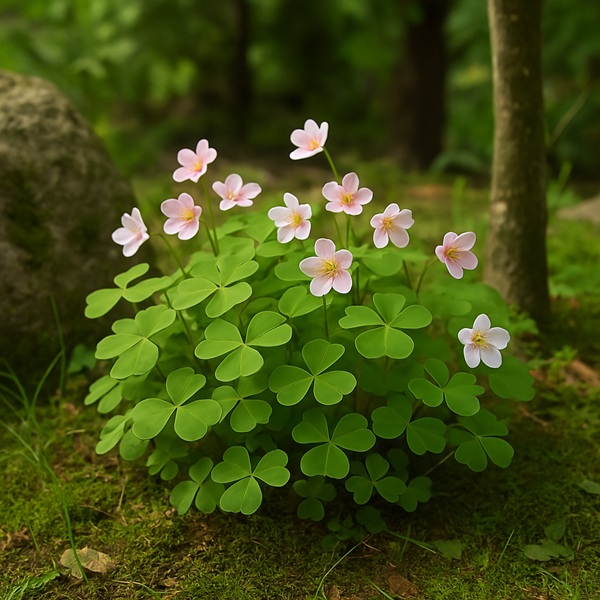
Oxalis is a perennial or annual plant from the Oxalidaceae family, distinguished by its elegant trifoliate leaves and delicate flowers, which make it attractive as an ornamental, ground-cover, and indoor plant. In its natural habitat, it is widespread across Europe, South America, Africa, and Asia, and in Ukraine it occurs both in the wild, for example common wood sorrel in the forests of Polissia, and in ornamental plantings. Thanks to its high shade tolerance, oxalis grows very well under trees, in partial shade, in forest clearings, flower beds, containers, rock gardens, and as a ground-cover plant in the garden.
The plant is highly valued for its versatility: it can be used in landscaping, as a houseplant, and also in cooking and folk medicine. Among the many oxalis species suitable for growing in Ukraine, the most popular are:
Common wood sorrel (Oxalis acetosella) — a wild form found in forests, with small white flowers;
Creeping wood sorrel (Oxalis corniculata) — a ground-cover form with purple leaves and yellow flowers;
Deppe’s oxalis — a perennial with clover-like leaves and bright pink or purple flowers;
Purple shamrock (Oxalis triangularis) — a striking indoor plant with purple leaves.
Ukraine’s climate makes it possible to grow various oxalis species both in open ground, especially in the south and central parts of the country, and in containers with indoor overwintering. The plant is undemanding, requires minimal care, and quickly spreads to form a dense green carpet that suppresses weeds. Its ability to fold its leaves in the dark and unfold them in the light gives the planting a lively dynamic quality. In addition, it is resistant to most pests, tolerates transplanting and pruning well, and does not require complex cultivation techniques, making it an ideal choice for beginners in gardening and landscaping.
Despite its hardiness, choosing the right planting site is important for oxalis to develop fully. In Ukrainian conditions, the plant prefers partial shade or diffused light. Direct sunlight, especially in summer in the southern regions of the country, can cause leaf scorch, while excessive shade reduces flowering intensity. The best places are under shrubs, trees, near fences, or on the eastern or northern side of buildings. Oxalis also grows excellently in containers: planters, hanging pots, and decorative boxes are easy to move, which makes it possible to regulate light exposure throughout the season.
The soil for planting should be loose, moderately fertile, and well-drained. Oxalis does not tolerate standing water, especially during the cold season, because its root system is prone to rotting. The ideal substrate is a mixture of leaf soil, peat, sand, and compost in equal parts. On heavy clay soils, coarse sand or perlite should обязательно be added. The plant responds well to organic matter, so before planting it is advisable to add humus or compost at 3–4 kg per square meter and thoroughly dig over the site. The optimal acidity is slightly acidic to neutral, with a pH of 5.5–6.5.
Planting in open ground is carried out in spring, once the risk of frost has passed, from mid-April to early May. In containers, oxalis can be planted throughout the entire warm season. It can be propagated in several ways: by dividing the clump, by tubers, by bulbs depending on the species, and also by seed. The simplest method is dividing a mature clump: the plant is carefully dug up, divided into parts with their own root system, and planted in a new place at a distance of 15–20 cm from one another. Seeds are sown superficially in May, lightly covering them with soil. Until seedlings emerge, the site is kept moist and protected from direct sunlight. The first leaves appear after 2–3 weeks, after which thinning is carried out.
Caring for oxalis is simple, but it does require consistency. The most important part is watering, especially in hot, dry weather. The plant likes moderately moist soil, does not tolerate prolonged drying out, but stagnant moisture is also unacceptable. In open ground, watering is done once or twice a week depending on the weather; in containers, more often, up to two or three times a week during summer heat. Settled water at room temperature is used. It is important not to water the leaves on a sunny day to avoid burns.
Feeding is carried out two or three times per season. In spring, nitrogen fertilizers are applied to stimulate green mass growth, and during flowering, phosphorus-potassium complexes are used. Among organic options, nettle infusion, ash, and vermicompost work well. Dosages should not be exceeded, since too much fertilizer stimulates leaf growth at the expense of flowering. For indoor plants, fertilizers for ornamental foliage plants are used at half strength every two or three weeks during the active growth period.
Pruning in the classic sense is not required, but sanitary care is necessary. Dried flowers and damaged leaves should be removed regularly, as this stimulates new flowering and maintains an attractive appearance. If the clump has become too overgrown, it can be thinned or divided. In containers, it is advisable to replant oxalis once a year into a fresh substrate, especially if the soil has become depleted. The plant may enter a dormant phase during which the leaves die back; this is normal. In that case, the bulbs remain in the pot and resume growth again in spring.
Oxalis is one of the easiest ornamental plants to propagate. In Ukraine, depending on the climate zone and cultivation method, it can be divided, transplanted, and rejuvenated during almost any warm period. The most effective method is dividing the clump. This is done in spring or early autumn. A mature plant is carefully dug up and divided into parts so that each has its own leaf rosette and roots. The divisions are then planted in a prepared site with a spacing of 15–20 cm between clumps. After transplanting, it is important to moisten the soil well and provide light shade for a few days, especially in sunny weather.
Some oxalis species form underground tubers or small bulbs, which can also be successfully used for propagation. They are dug up in spring or autumn and stored in a cool, dry place until planting. Before planting, it is advisable to soak the tubers in a weak potassium permanganate solution or treat them with a growth stimulant to improve sprouting. Indoors, the tubers are removed from the soil after the leaves wither, dried, and stored until spring. They are planted into fresh substrate in March or April, and new shoots appear within 2–3 weeks.
Seed propagation is used less often, mostly for breeding new varieties or when no other planting material is available. The seeds are very small and lose viability quickly, so they should be sown as soon as possible after collection. They are sown superficially, sprinkled with a thin layer of vermiculite or soil, covered to create a mini-greenhouse, and kept moist. The germination temperature is 20–23°C, and seedlings appear in 10–14 days. After 2–3 true leaves have formed, the seedlings are pricked out. This method is labor-intensive, but it makes it possible to obtain viable, well-hardened plants.
Oxalis is known for its resilience, but if cultivation practices are нарушed, especially through overwatering, excessive shade, or overly dense planting, it may be affected by fungal diseases. The most common problems are:
Gray mold — appears in conditions of high humidity and poor ventilation. A gray fluffy coating forms on the leaves.
Root rot — occurs when water stagnates. The plant wilts, and the leaves turn yellow or black near the base.
Powdery mildew — less common, but in damp weather it may cover the leaves with a white powdery coating.
To prevent disease, basic care rules should be followed: do not overwater the soil, do not overcrowd plantings, remove dry leaves in time, and ensure ventilation, especially indoors. At the first signs of infection, copper-based products such as Bordeaux mixture or copper oxychloride, as well as biofungicides like Fitosporin and Trichodermin, are used. Affected leaves should be removed, and the substrate should be partially or completely replaced in containers.
Among pests, the most dangerous are:
Aphids — small insects that gather on young leaves and buds;
Spider mites — typical in indoor growing conditions with dry air;
Thrips and whiteflies — most often found in greenhouses or on balconies.
Both folk remedies, such as wormwood, onion, or garlic infusions, and biological insecticides like Fitoverm and Bitoxybacillin can be used for control. Indoors, simply washing the leaves with warm water also works well. Regular inspection of plants makes it possible to detect problems early and prevent their spread.
Oxalis is not only decorative but also multifunctional. It is ideal for creating carpet plantings, filling shady areas, and decorating rock gardens and borders. Thanks to the wide range of leaf colors, including green, purple, and variegated shades, and its ability to spread on its own, the plant combines harmoniously with other shade-tolerant crops such as hostas, periwinkle, and ferns. Oxalis is planted in natural-style gardens, in “forest corner” compositions, on slopes, and under trees.
It is also popular as a houseplant. It is grown in pots, hanging planters, and decorative boxes. It tolerates dry air fairly well, but appreciates regular misting. Its feature of closing its leaves in the evening and opening them in the morning gives the plant a dynamic effect. Oxalis is suitable for children’s rooms, offices, and kitchens, does not release toxins, and is safe for pets, except in cases of excessive consumption.
In folk medicine, oxalis is used as a mild antiseptic, a fever-reducing remedy, and a source of vitamin C. Its leaves have a pleasant sour taste similar to sorrel and are used in salads, soups, and green sauces. However, because of its oxalic acid content, it should be consumed in moderation, especially by people with gastrointestinal or kidney problems. In cooking, this green is valued for its fresh spring flavor and its ability to pair well with traditional vegetables.