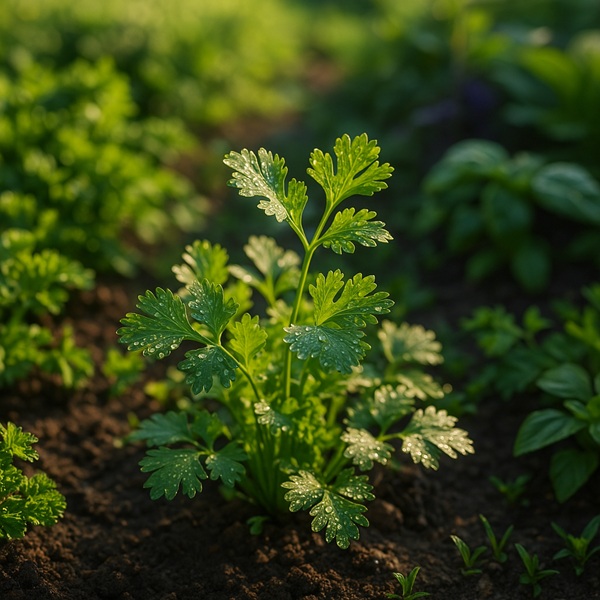
Cilantro, or coriander (Coriandrum sativum), is a popular aromatic crop valued not only for its fragrant greens but also for its seeds, which are widely used in cooking and folk medicine. In Ukraine, cilantro grows well across almost the entire country, from the southern regions to Polissia. It is an annual plant with a relatively short growing season that tolerates both spring and autumn frosts well and can produce several harvests in one season. At the same time, successful cultivation directly depends on choosing the right site, preparing the soil properly, and following sound agricultural practices.
Cilantro loves light and does not tolerate shade well, especially during the active growth stage. That is why well-lit areas should be chosen for sowing. With a lack of sunlight, the plants become stretched, the greens turn pale, and their taste and aroma weaken. Areas with standing water should also be avoided: although the seeds have good germination, coriander does not tolerate excess moisture, as the roots begin to suffer from a lack of oxygen and the risk of fungal diseases increases. The crop grows best on light and medium loams with a neutral or slightly alkaline soil reaction (pH 6.5–7.5).
Soil preparation is best started in autumn: carry out deep digging, remove the roots of perennial weeds, and apply organic fertilizers such as humus or compost at a rate of 4–5 kg per square meter. In spring, 2–3 weeks before sowing, the soil is loosened, wood ash is added at 150–200 g per square meter, and complex mineral fertilizers are also applied. For growing cilantro for greens, nitrogen plays the main role, since it stimulates vegetative growth. However, too much of it can worsen the taste of the greens, make them watery, and provoke premature bolting. Fertilizer rates should be calculated individually, with no more than 10–15 g of ammonium nitrate per square meter. It is also important to remember that cilantro should not be grown after other members of the carrot family such as dill, celery, or parsnip because of shared diseases and soil depletion.
In Ukraine, cilantro can be sown from mid-March onward, as soon as the soil warms up to +6 to +8 °C. The crop is not afraid of short-term frosts, and seedlings can withstand temperatures down to –5 °C. This makes it possible to sow cilantro quite early and get fresh greens already by early May. In addition, sowings can be repeated every 2–3 weeks until the end of July in order to have a continuous supply of greens. Cilantro is sown in open ground in rows: the distance between rows should be 20–30 cm, and the sowing depth should be 1.5–2 cm. Before sowing, it is advisable to soak the seeds in warm water for 12–24 hours, changing the water every 3–4 hours. This significantly improves germination and speeds up sprouting.
Cilantro seeds have a specific structure: they are not separate grains but two-seeded fruits. To improve germination efficiency, they can be carefully split in half by hand or lightly rolled with a rolling pin without damaging the embryos. This treatment is especially useful for early spring sowing, when the soil is still cold and dense. After sowing, the furrows are covered with loose soil or peat and lightly compacted. The first seedlings appear in 7–12 days, depending on temperature and moisture. At this stage, it is extremely important to maintain stable moisture in the topsoil, since drying out can lead to the death of the sprouts.
After seedlings appear, thinning is carried out, leaving 5–7 cm between plants to avoid overcrowding. If cilantro is grown for greens, this helps form a strong leaf rosette. If the main goal is seed production, the spacing can be increased to 10–12 cm. In the southern regions with high summer temperatures, it is advisable to sow cilantro in places with light midday shade, as this slows bolting. Some gardeners use mixed sowings, combining cilantro with radishes, lettuce, or spinach, which creates a favorable microclimate and reduces moisture evaporation.
Watering is one of the key elements of cilantro care. Despite a certain drought tolerance, coriander responds well to regular but moderate moisture. When water is lacking, the leaves become coarser, the content of essential oils decreases, and the taste worsens. Watering is especially important during the active growth stage, from emergence to budding. Plants are watered once or twice a week depending on weather conditions and soil type. Clay soils retain moisture longer, while sandy loams require more frequent watering. At the same time, standing water must not be allowed, so as not to provoke rot.
Regular loosening and weeding are also very important. After each rain or watering, the soil should be loosened so that no crust forms and oxygen can reach the roots. Weeding is best combined with mulching, for which rotted sawdust, compost, or cut grass are suitable. This helps retain moisture and suppress weed growth. During the first month after emergence, cilantro grows slowly, so it is especially important to remove weeds in time, as they may otherwise smother the crop.
Feeding is carried out depending on the cultivation goal. If the main harvest is greens, nitrogen fertilizers are applied at the stage of 2–3 true leaves. If cilantro is grown for seeds, phosphorus-potassium mixtures are used during budding. Organic fertilizers such as herbal infusions, mullein solution, or diluted poultry manure in a 1:10 ratio are applied only in diluted form, in the evening or during cloudy weather. Fresh manure is not used because it worsens taste and increases nitrate content. It is important to remember that excessive feeding leads to plant stretching and reduced aroma, which negatively affects product quality.
Cilantro is a crop that can be harvested at different stages of development, depending on which part of the plant is of interest: greens or seeds. If it is grown for fresh greens, the first harvest is possible already 30–40 days after sowing, when the plants reach 15–20 cm in height and have 5–6 true leaves. It is best to cut the greens in the morning or evening, when they are at their juiciest, leaving 2–3 cm above the ground. A repeated cutting is possible if the growing point is preserved, but the leaf quality will already be somewhat lower: it becomes tougher, less aromatic, and ages more quickly.
If the goal is seed production, the plants are left in the ground until the fruits fully ripen. This usually happens 90–120 days after sowing. The seeds ripen unevenly, first in the lower umbels and later in the upper ones. To avoid crop loss from shattering, the plants are cut at the wax-ripe stage, when the seeds are already fully formed but still held firmly. The cut plants are tied into bundles and dried in a well-ventilated room. After drying, threshing, cleaning, and storage in a dry place are carried out. The seeds are best stored in airtight jars or cloth bags.
Fresh cilantro greens can be stored in several ways:
In the refrigerator — for up to 5–7 days in containers or wrapped in a damp cloth;
Frozen — this preserves aroma and color well and is suitable for soups and sauces;
Dried — at temperatures up to +35 °C in the shade or in an electric dryer;
Salted or pickled — a traditional method for homemade preserves.
Dried greens lose part of their essential oils within 1–2 months, so it is better to prepare them in small quantities and renew supplies every season. Cilantro seeds store much longer, up to 4 years without significant loss of flavor or medicinal properties, provided they are properly dried to a moisture content of no more than 10% and stored in a dark, cool, dry place.
Although cilantro is fairly resilient, it is not immune to diseases and pests, especially under conditions of excessive moisture or crop rotation violations. The most common diseases are:
Powdery mildew — forms a white coating on the leaves, causing them to curl and dry out;
Septoria — causes brown spots with clear outlines and most often appears during periods of high humidity;
Phomosis and ascochyta blight — fungal lesions of stems and petioles that lead to rotting;
Root rots — occur on dense, waterlogged soils.
Prevention includes proper crop rotation, timely loosening and mulching, and avoiding overcrowded sowings. It is useful to treat the seeds before sowing with biofungicides such as Trichodermin or Planriz, and during the growing season, at the first signs of disease, to apply preparations based on copper or sulfur. After harvesting, plant residues must be removed from the plot, as this reduces the likelihood of pathogens overwintering.
Among the pests that may threaten cilantro, the most common are:
Carrot fly — its larvae damage the root system;
Aphids — suck sap from young leaves and spread viral diseases;
Leaf miners — tunnel through leaves, reducing their quality.
For control, biological products such as Fitoverm and Bitoxybacillin are used, as well as folk remedies such as wormwood infusions, garlic infusions, and soap solutions. Treatments are carried out in the evening to avoid leaf burn, especially when using concentrated extracts. Protection will be more effective if agrotechnical measures are combined with preventive treatments and the correct watering and feeding regime.
Cilantro is one of the best crops to include in crop rotation in Ukraine. It has a short growing period, does not exhaust the soil, and even improves its structure thanks to its well-developed root system. Tomatoes, cucumbers, cabbage, and legumes grow well after it. Cilantro itself performs best after crops such as onions, potatoes, and cereals. It is not recommended to grow it in the same place for several years in a row, especially after other carrot-family crops, in order to reduce the risk of diseases and pest damage.
Cilantro can be grown not only in open ground but also on a balcony, windowsill, or in a greenhouse. In container growing, it is important to provide enough soil depth, at least 15–20 cm, along with drainage and regular watering. Greens can be cut as early as 3–4 weeks after sowing. This is convenient for apartment dwellers who want fresh herbs in winter. In greenhouses, the temperature should be controlled, with the best range being +16 to +20 °C. At temperatures above +25 °C, cilantro quickly shifts to flowering.
Around the home, cilantro has many uses:
In cooking — as a seasoning for soups, meat dishes, and salads;
In medicine — to support digestion and as an antiseptic and calming remedy;
In cosmetology — coriander oil is used in skin and hair products;
In agriculture — as a green manure crop that helps improve soil health.
So, cilantro is not only easy to grow but also an extremely useful crop. It is perfectly suited both for large farms and for household plots, providing aromatic greens and seeds with almost no special expense.