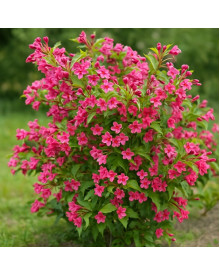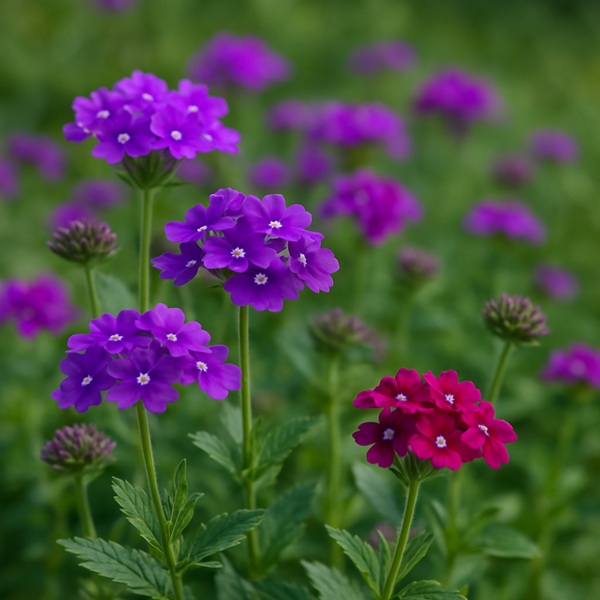
Weigela is one of the most striking and popular ornamental shrubs widely used in Ukrainian gardening and landscape design. It is a genus of deciduous shrubs in the honeysuckle family, comprising about 15 species and many cultivars. In Ukraine, the most common are flowering weigela (Weigela florida), early weigela (Weigela praecox), and hybrid weigela (Weigela hybrida), all of which are noted for their high ornamental value, frost resistance, and adaptability to different soil and climate conditions. The main feature of weigela is its long-lasting and abundant flowering, which begins in late spring and often repeats at the end of summer.
The shrub has a rounded or slightly spreading shape and reaches 1 to 3 meters in height depending on the species and growing conditions. The shoots are slender, sometimes slightly arching, which gives the shrub a picturesque lightness. The leaves are elongated, oval, and pointed at the tip, green or variegated depending on the cultivar. The flowers are funnel-shaped, solitary or clustered in inflorescences, and may be white, pink, red, burgundy, or yellow. Flowering is abundant and occurs in waves: the first wave comes in May–June, and the second, less intense one, in August. Thanks to this, weigela is a valuable element for creating flowering compositions throughout the entire warm season.
The ornamental appeal of weigela is preserved not only through flowering, but also through the interesting shape and color of its foliage, especially in variegated cultivars such as ‘Variegata,’ ‘Nana Variegata,’ and ‘Monet.’ Weigela pairs beautifully with other shrubs such as spirea, barberry, juniper, hydrangea, hosta, and roses. It looks excellent in solitary plantings, mixborders, hedges, and containers on terraces. The shrub is easy to shape and trim and suits a wide range of styles, from formal to naturalistic. In addition, weigela has ecological value: its flowers attract bees, butterflies, and other pollinators. In the climate of the forest-steppe and Polissia zones, it feels especially comfortable, and with proper cultivation practices it also grows well in the drier southern regions of Ukraine.
Before planting weigela, it is important to choose the right cultivar, since this affects not only the plant’s appearance, but also its winter hardiness, size, and growing requirements. In Ukraine, the most popular cultivars are those with high adaptability: ‘Alexandra’ (burgundy leaves, pink flowers), ‘Bristol Ruby’ (a tall shrub with ruby-red flowers), ‘Victoria’ (a compact form with dark foliage), and ‘Nana Purpurea’ (a dwarf form with purple leaves). These cultivars tolerate frosts down to –25 °C well, especially with light winter cover.
The best planting site is a sunny location or light partial shade, protected from the north wind. In full sun, the shrub develops dense foliage and blooms abundantly, while in shade its ornamental quality declines noticeably. Weigela prefers light, well-drained, slightly acidic or neutral soils (pH 5.5–7.0). In heavy, clayey, or waterlogged areas, root rot may occur, especially in autumn or early spring. To reduce acidity, dolomite flour or wood ash is added. In dense soils, sand and compost are incorporated, and drainage is arranged as well.
Preparing the planting site includes:
digging the area to a depth of 30–40 cm;
removing weeds and root remnants;
digging a hole measuring 50 × 50 × 50 cm;
filling it with a fertile mix of turf soil, humus, and sand in a 2:1:1 ratio;
adding mineral fertilizers (30–50 g of superphosphate and 200 g of ash).
The distance between shrubs depends on the cultivar: 1.2–1.5 m for low-growing forms and 2–2.5 m for taller ones. In mixed plantings with other shrubs, the future crown width should be taken into account to avoid overcrowding. In the southern regions, it is better to choose areas with light afternoon shade, while in the northern regions it is advisable to ensure that the shrubs can be covered for winter.
Weigela is planted in open ground in spring (April to early May) or autumn (late September to mid-October). Spring planting is preferable, especially in regions with changeable winters and possible snowless frosts. Autumn planting is possible only if at least 4 weeks remain before frost begins. Saplings with a closed root system can be planted from April to October, avoiding periods of heat and dry soil.
Planting steps:
Dig a hole of the required size.
Place a 10 cm drainage layer of expanded clay, gravel, or broken brick at the bottom.
Set the sapling vertically, carefully spreading the roots.
Fill with the planting mixture and firm it gently.
Water generously with 10–15 liters of water per shrub.
Mulch the trunk circle with peat, bark, or humus.
After planting, it is important to maintain a proper watering regime — the soil should remain consistently slightly moist, but without stagnation. The area around the trunk should be loosened regularly and weeds removed, especially during the first season. In hot regions, agrofabric or temporary shading can be used to reduce evaporation. In the first year, strong pruning should be avoided except for the removal of damaged shoots. Rooting stimulants such as “Kornevin” or “Heteroauxin” are useful for better establishment.
Mulching is essential. It preserves moisture and protects young roots from temperature fluctuations. Mulch is applied twice: in spring to retain warmth and stimulate growth, and in autumn as protection against freezing. This is especially important in regions where the soil freezes deeply. With proper care, weigela may bloom as early as the second year.
In the following years after planting, weigela requires simple but regular care, including watering, feeding, sanitary and formative pruning, soil loosening, mulching, and disease prevention. This shrub is quite undemanding, but with systematic care it can reveal its full ornamental potential.
Watering should be moderate, especially during hot periods from May to July. During bud formation and flowering, soil moisture should remain stable. Watering is carried out every 5–7 days, using 10–15 liters per shrub, in the morning or evening. After watering, it is advisable to loosen the soil and renew the mulch layer. In the southern regions, summer mulching protects not only from drying out but also from overheating of the roots. Excess moisture is equally dangerous, especially in heavy soils, since it may lead to rotting.
Feeding schedule:
Spring (April–May) — nitrogen fertilizers such as ammonium nitrate or urea for active growth;
Before flowering (May) — complex mineral fertilizers (NPK 10-10-10, 15-15-15) or organic feeding such as nettle infusion or diluted manure;
After flowering (July–August) — potassium-phosphorus fertilizers such as superphosphate, wood ash, or potassium magnesium sulfate to promote flower bud formation for the next season.
Pruning is divided into sanitary pruning (in spring), formative pruning (after flowering), and rejuvenating pruning (once every 4–5 years). In spring, damaged, dried, and frost-injured branches are removed. After flowering, the faded shoots are shortened to the first healthy bud — this stimulates a second wave of flowering and thickens the crown. Formative pruning is best combined with thinning, as this ensures air circulation and prevents fungal diseases.
Weigela is generally a resilient crop, but under excessive moisture, overcrowding, or sharp temperature changes it may be affected by certain diseases and pests. The most common problems are gray mold, leaf spot, powdery mildew, aphids, and spider mites.
Gray mold (botrytis) appears on flowers and leaves as brown spots followed by rotting. The main causes are excessive humidity and poor ventilation. Prevention includes thinning the crown, controlling watering, and treating with products such as “Fundazol” or “Topaz.” Powdery mildew appears as a white coating in warm, damp weather. Control measures include sulfur-containing products, ash infusions, or fungicides.
Main pests:
Aphids — settle on young shoots and buds, causing leaf curling and slowed growth;
Spider mites — become active in heat, form thin webbing, and cause yellowing of the leaves;
Leafroller caterpillars — feed on the leaves and may chew them completely.
For protection, both biological products (“Fitoverm,” “Bitoxybacillin”) and conventional insecticides (“Aktara,” “Confidor”) are used. It is important to alternate products to avoid pest resistance. In autumn, fallen leaves should always be collected and disposed of, especially if the plant was diseased, as this reduces the risk of pathogens overwintering.
Prevention includes:
spring spraying with 1% Bordeaux mixture;
regular thinning and pruning;
moisture control;
mulching of the trunk circle.
The winter hardiness of weigela in Ukraine depends on the cultivar and the region. In the central and western regions, the shrub winters well without cover, provided there is good drainage. In the northern and eastern regions, light winter protection is recommended: hilling up, mulching with peat to a depth of 10–15 cm, tying the shoots together, and covering with agrofabric or spruce branches. Special attention should be paid not so much to frost as to sudden thaws followed by renewed freezing, which can cause damping off.
Propagation methods:
Green cuttings — the most effective method. In June, 10–15 cm cuttings are taken and rooted in moist soil or sand under film;
Woody cuttings — prepared in autumn, stored until spring, and planted in a greenhouse;
Layering — lower shoots are bent to the ground, covered, and separated a year later;
Division of the shrub — carried out in spring or autumn and suitable for mature shrubs.
Seed propagation is practically not used, since ornamental cultivars do not retain their characteristics. Vegetative methods guarantee the preservation of varietal traits and good survival rates.
Weigela is a versatile plant for Ukrainian gardens. It is suitable for:
solitary and group plantings;
borders and hedges;
flowering mixborders;
container landscaping (compact cultivars);
combinations with roses, hostas, lavender, and spireas.
Thanks to its rich color palette, flexible form, and undemanding nature, weigela rightfully belongs among the best ornamental shrubs for Ukrainian gardens. Proper planting and care ensure lush flowering and longevity for many years.