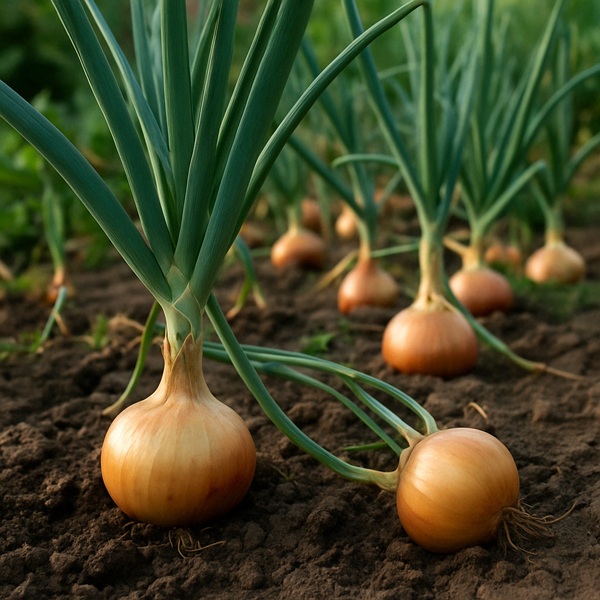
Onion (Allium cepa) is one of the oldest vegetable crops cultivated by people for thousands of years. In Ukraine, it holds a special place both in home gardens and in commercial agriculture thanks to its hardiness, versatility of use, and high nutritional value. Onion contains vitamins (C, B-group, PP), essential oils, flavonoids, and phytoncides, which make it not only tasty but also a health-promoting crop. It is widely used both in cooking and in folk medicine. It is an essential part of traditional Ukrainian dishes such as borshch, soups, salads, appetizers, and meat dishes.
There are many onion varieties that differ in shape, color, flavor, and ripening time. In Ukraine, the most common are yellow varieties (Stuttgarter Riesen, Zolotysta Semko, Danylivskyi), white ones (Bila Teplychna, White Crystal), and red ones (Red Baron, Carmen, Brunswick). In addition to the classic bulb onion, gardeners also actively grow shallots, Welsh onion, leek, and slime onion. Each has its own characteristics, flavor nuances, and growing season. For open-ground cultivation, growers usually choose varieties resistant to bolting and diseases, as well as those that store well through winter. When selecting a specific type, it is important to consider not only the climate of the region, but also the intended purpose — for greens, bulbs, storage, or seed production.
Onion is a biennial plant: in the first year it forms a bulb and green mass, and in the second it produces a flowering stalk and seeds. However, in practical vegetable growing it is more often cultivated as an annual crop from sets or seedlings. With proper care and correct planting dates, onion forms dense, juicy, large bulbs already in the first year. It requires good lighting, loose and fertile soil, and balanced watering. The crop is sensitive to soil acidity (the optimum is pH 6.0–7.0), excessive moisture, and overcrowded planting. For this reason, cultivation practices should be adapted to the specific conditions of the plot and the season.
One of the most important factors for success in growing onions in Ukraine is proper site preparation. The best predecessors are cabbage, tomatoes, cucumbers, potatoes, and legumes. It is not recommended to plant onions after garlic and other alliums in order to avoid the buildup of specific pests and diseases. The soil for onions is prepared in autumn: humus or compost is added (fresh manure must never be used), along with phosphorus-potassium fertilizers, followed by deep digging. In spring, before planting, the beds are loosened, leveled, and if necessary the acidity is neutralized with dolomite flour or ash.
Onions can be planted in three ways: by seed, by sets, and by seedlings. In the southern and central regions of Ukraine, winter sowing and early spring sowing of seeds (chernushka) directly into open ground are practiced successfully, making it possible to obtain marketable bulbs in a single season. However, the most popular method remains planting sets — small bulbs 1–2 cm in diameter that ensure a quick start and even emergence. Planting of sets begins in April, when the soil warms to +8 to +10°C. The spacing between rows should be 20–25 cm, between bulbs 8–10 cm, and the planting depth 3–5 cm depending on soil density.
The seedling method is suitable for the northern regions of Ukraine or when an early harvest is desired. Seeds are sown in February–March in boxes or trays, seedlings are grown for 50–60 days, and then planted into open ground in April–May. This method requires more effort, but it makes it possible to achieve stable results even in an unstable spring. For all methods, it is important to maintain the correct temperature for germination, provide even watering, and prevent the soil from drying out. It should be remembered that planting in heavy, compact soil without drainage leads to rotting and delayed plant development.
Onion is a crop that requires systematic care at all stages of vegetation. From the moment seedlings emerge until bulbs begin to form, the plant needs regular but moderate watering. Excess moisture is especially dangerous during ripening, since it encourages the development of rots. During the first half of growth, watering is carried out every 5–7 days depending on the weather, ensuring even soil moisture to a depth of up to 20 cm. Once bulb formation begins, usually around mid-June, watering is gradually reduced, and 2–3 weeks before harvest it is stopped completely. This helps the crop mature better and improves its storage quality.
Onions are fed three times during the season. The first feeding is given 2 weeks after planting with a solution of urea or ammonium nitrate (10–15 g per 10 liters of water). The second, during the active growth phase about 3–4 weeks later, uses organic-mineral fertilizers such as mullein infusion, poultry manure infusion, or humates. The third feeding is applied when the bulbs are forming: ash infusion or phosphorus-potassium mixtures are used, without nitrogen so as not to stimulate leaf growth. It is important to keep to the proper dosage and not overdo it, since excess fertilizer leads to abundant green mass at the expense of the bulb.
Weeding and loosening the soil are essential throughout the entire season. Onion does not tolerate overcrowding or competition from weeds, especially when young. The soil between the rows is loosened after every rain or watering, taking care not to damage the root system. In addition, onions are susceptible to a number of diseases and pests — onion fly, downy mildew, powdery mildew, and rots. Prevention includes crop rotation, disinfection of planting material, mulching, and the use of natural insecticides such as ash infusion, wormwood infusion, and tobacco infusion. When necessary, biofungicides and copper-based products are used in accordance with recommended guidelines.
When the crop is ready for harvest, onions give visible signs: the leaves begin to yellow, bend over, and dry out, the neck of the bulb becomes soft, and the outer scales become thin and dry. In Ukraine, harvesting bulb onions usually begins in July or early August, depending on planting time and the weather conditions of the season. It is important not to allow over-ripening, because onions that remain in the ground too long may start growing again and lose their keeping quality. They are dug up in dry, sunny weather, carefully lifted with a fork or spade to avoid damaging the bulbs.
After harvesting, the crop must be dried. For this, the onions are laid out in a single layer under a canopy, in an attic, or directly on the bed if the weather is stable. Drying lasts 10–14 days, during which excess moisture evaporates, the scales strengthen, and the neck closes completely. After drying, the leaves are trimmed, leaving a 3–5 cm “tail,” and the roots are removed. The harvest should be stored in a well-ventilated room at a temperature of +1 to +3°C and humidity no higher than 70%. Wooden boxes, mesh bags, woven baskets, or sacks that allow free air circulation are ideal.
Following all stages of harvesting and drying is the key to long-term storage. Under proper conditions, bulb onions can be stored until spring without losses. Varieties with a tight neck and dry outer scales keep especially well — this should be taken into account when choosing planting material. It is also important to inspect stored onions regularly and remove any damaged or rotten specimens. Excess green leaves can be frozen, dried, or preserved, while onion skins can be used as a natural dye or fertilizer. In this way, the onion harvest is useful not only in summer, but throughout the entire year.
Special attention should be given to growing onions for greens — that is, to obtain juicy leaves used in salads, soups, and main dishes. This is especially relevant in urban conditions, in greenhouses, or in spring, when fresh greens are most valuable. Both sets and perennial onions such as Welsh onion, slime onion, and shallots are suitable for this purpose. Onions for greens can be grown in open ground, in containers, on a windowsill, or even in hydroponic systems. The main thing is to create conditions for rapid growth: sufficient light, a temperature no lower than +15°C, and regular watering.
When growing for greens, the planting density is increased: the bulbs are placed almost touching one another, leaving only 1–2 cm between them. In this case, no bulb develops, but the leaves grow quickly and abundantly. The use of growth biostimulants such as Epin or Zircon speeds up the development of green mass. It is also important to cut the greens in time, without allowing them to age and become coarse. After 2–3 cuttings, the growth rate drops significantly, so the planting is renewed.
To obtain greens in winter, forcing is used — a method in which bulbs are planted in containers with a moist substrate or sawdust and placed in a warm, lit location. The first harvest of greens can be taken in as little as 2 weeks. This technology is used successfully even in small greenhouses. The leftover material after forcing can be added to compost, and the greens themselves serve as a valuable source of vitamins during the cold season. Onion greens are a fast, compact, and efficient way to obtain fresh produce in any season.
Onion is one of the most versatile and essential crops in Ukrainian home gardening. It adapts easily to different growing conditions, does not require complicated technology, and provides high yields with minimal expense. Thanks to the wide range of varieties and planting methods, it can be grown in practically any climatic region — from north to south, from a country plot to a windowsill. In addition, onion is a true treasury of health: it has antiseptic, immune-supporting, and strengthening properties, helps with colds and digestive problems, and even plays a role in the prevention of cardiovascular diseases.
For successful cultivation, it is enough to follow basic agronomic rules: proper crop rotation, good soil preparation, timely planting, moderate watering, regular feeding, and protection from pests. Even a beginner in gardening can count on a good result, because the crop is fairly forgiving of small mistakes. Onion is equally valuable both as bulbs and as greens, and it can be used not only in food, but also in home medicine, preserving, and even as a household remedy.
So, onion is not just a vegetable, but a strategically important and rewarding crop that deserves a place in every garden. Growing it does not require major expense, while the result is stable and long-lasting. Given Ukraine’s climate, modern seed production, and the availability of agricultural supplies, it can be said with confidence: onion has long been, and remains, a foundation of the home vegetable garden, a source of health, and a guarantee of a good harvest.