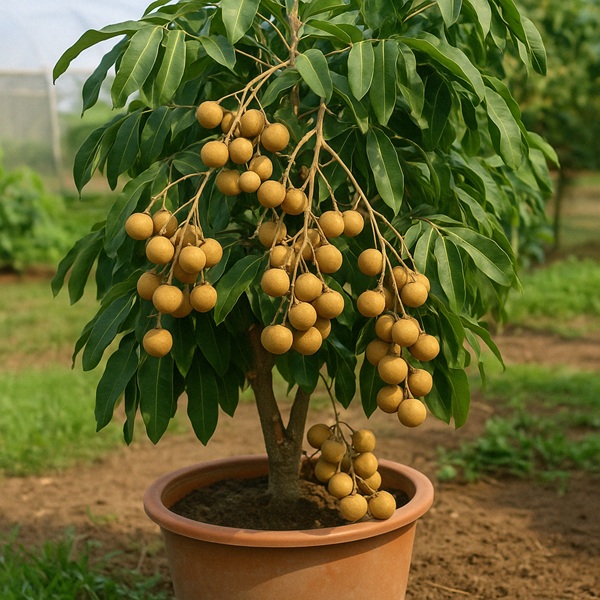
Longan (Dimocarpus longan), also known as “dragon’s eye,” is a tropical fruit tree native to Southeast Asia. It belongs to the soapberry family and is a close relative of lychee. Longan fruits are prized for their translucent, sweet, and aromatic flesh hidden beneath a thin yet fairly dense peel. Inside is a glossy black seed that resembles an eye, which gave rise to its poetic name. Although longan has traditionally been grown in Thailand, Vietnam, China, and India, recent decades have seen growing interest in cultivating it in cooler regions, including southern Ukraine, where microclimates and the use of protective coverings have made it possible to grow exotic plants.
Ukraine’s climate is not ideal for tropical crops, but in the southern regions — especially Zakarpattia, as well as Mykolaiv, Kherson, and Odesa regions — there are some opportunities to grow longan in protected cultivation. Longan is sensitive to frost and requires a warm, humid climate with temperatures no lower than +5°C. Even a brief drop to 0°C may partially damage the tree, especially if it has not been gradually adapted to such conditions. However, with the use of greenhouses, conservatories, protective covers, and proper care, the plant can establish itself successfully and even bear fruit. Success largely depends on the choice of variety, the growing conditions, and year-round care of the tree.
Understanding the biological characteristics of longan is the key to growing it successfully. It is an evergreen tree that reaches 10–15 meters in its natural habitat, but when grown in a garden it is often shaped into a compact plant no taller than 3–4 meters. Longan blooms in spring, and its fruits ripen in summer or early autumn. The plant needs moderate but consistent watering, good drainage, and fertile soil. In Ukraine, it is grown mainly in containers or in greenhouse conditions, with sufficient light and protection from drafts. An important part of longan care is controlling humidity levels and regularly misting the crown, especially during the heating season when indoor air becomes too dry.
Growing longan begins with choosing the right planting method. The tree is most often propagated by seed or cuttings, and more rarely by grafting. In Ukrainian conditions, at the initial stage it is more practical to use the seed method, since it allows the plant to adapt to the local climate from its earliest stages of growth. The seeds should be sown immediately after being removed from fresh fruits, because they lose viability quickly. For germination, a light and loose substrate is best — a mixture of peat, sand, and humus in equal proportions. The containers are covered with film or glass and placed in a warm location with a temperature of about +25–30°C. The first seedlings appear in 10–14 days.
After the true leaves appear, the young seedlings are transplanted into individual pots. It is important to remember that in the southern regions of Ukraine, longan can grow in open ground only if it is insulated and covered during winter. When grown in a container, the plant should be repotted every year, increasing the pot size and renewing the soil mix. The optimal soil composition for longan includes loamy or sandy-loam soils with a neutral or slightly acidic reaction (pH 6.0–6.5). Good drainage is essential to prevent root rot. Expanded clay or gravel is placed at the bottom of the container to avoid stagnant moisture.
Choosing the right place to keep the plant is one of the most important factors for success. Longan needs a lot of light, so it is best placed on south- or south-east-facing windows, in greenhouses, or in winter gardens with plenty of natural light. If light is insufficient, especially in winter, grow lights should be used to extend daylight to 10–12 hours. In open ground, it is best to choose sites protected from wind, with good lighting and the possibility of winter covering. In summer, containers can be taken outdoors — into the garden or onto a balcony — gradually acclimating the plant to outdoor conditions. But during sharp temperature fluctuations, longan should be returned to a warm room.
Longan requires balanced care, especially in a climate that is unusual for it. One important aspect is regular but moderate watering. Soil moisture should be kept at a stable level, without allowing it to dry out or become waterlogged. In summer, watering is more frequent, especially when the plant is grown in the sun or in a greenhouse. In winter, the frequency of watering is reduced, especially if the temperature drops to +10–15°C, in order to avoid root rot. In addition to watering, it is important to mist the leaves, especially during the heating season. Dry air may cause leaf edges to dry out and can lead to fruit drop.
For successful growth at home, longan needs regular feeding. During the active growth period, from April to September, complex fertilizers for tropical or citrus plants are applied. Feeding is done 1–2 times a month, alternating mineral and organic mixtures. Infusions of humus, compost, or vermicompost have shown good results. In winter, feeding is reduced or stopped completely, especially if the plant is in a dormant state. Excess fertilizer may burn the roots and worsen the condition of the leaves, so moderation is important.
Crown formation and sanitary pruning are also important for maintaining both decorative appeal and fruiting. Once the plant reaches a height of 50–70 cm, the top is pinched to encourage branching. In the following years, formative pruning is carried out, removing crowded, damaged, or weakened shoots. Pruning is best done in late winter or early spring before active growth begins. It is also important to monitor the appearance of pests and diseases. Longan may be affected by spider mites, aphids, and mealybugs. For prevention, bio-based products made from insect-pathogenic fungi or household remedies such as soapy water and garlic infusion can be used. In cases of severe infestation, systemic insecticides are applied, strictly following dosage recommendations.
Fruiting of longan in home or greenhouse conditions in Ukraine is a challenging task, but entirely possible if certain conditions are met. In its natural environment, the tree begins to bear fruit 4–6 years after planting. In container culture, this period may be somewhat longer, especially when the plant is grown from seed. Fruiting can be accelerated by using cuttings from already fruiting plants or by grafting onto mature rootstocks. Even then, however, it is necessary to create an optimal microclimate close to natural conditions: high humidity (60–80%), stable temperatures without sudden fluctuations, sufficient light, and regular feeding.
An interesting feature of longan is its need for a rest period that stimulates flowering. In subtropical and temperate climates, this can be created artificially by limiting watering and lowering the temperature for 1–2 months. After such a “wintering period” and a return to a warm and humid atmosphere, the plant enters an active growth phase and may begin to bloom. Flowering occurs at the tips of the shoots, where many small creamy-yellow flowers are formed in panicles. After pollination, which is done by hand in home conditions, the fruits begin to develop. They ripen within 3–4 months, depending on the variety and growing conditions.
To increase yield, methods of regulating growth and development may be used — pruning, thinning of the fruit set, and feeding with phosphorus-potassium fertilizers during budding. It is also important to remember that longan fruits develop unevenly: on the same tree, ripe berries and still unopened buds may appear at the same time. Harvesting is done gradually as the fruits ripen, when the peel becomes light brown and the flesh turns translucent and juicy. With proper care, one mature tree can produce up to 10 kg of fruit. After harvest, the plant is allowed to rest, watering is reduced, and it is prepared for the next fruiting cycle.
In Ukrainian conditions, the most practical way to grow longan is by using greenhouses and containers. A greenhouse makes it possible to maintain stable temperature and humidity, especially during winter. It is important to equip the greenhouse with ventilation, heating, and drip irrigation, as well as to provide shading in summer. Container culture is convenient because the plant can be moved: outdoors in summer and into the house or greenhouse in winter. This is especially relevant for the southern regions of Ukraine, where summers are hot and sunny, but winters are still too cold for a tropical crop.
Containers for longan should have a volume of at least 20–30 liters for a mature plant. The material can vary, but ceramic pots or thick-walled plastic containers with drainage holes are preferable. Repotting is done every 1–2 years depending on plant growth, trying not to injure the root system. It should be remembered that longan’s root system develops actively and needs plenty of space, so if the soil volume is insufficient, the plant may slow its growth or stop fruiting. In summer, the container with the tree can even be sunk into the garden soil for more natural lighting and better air circulation.
One drawback of container growing is the need for constant control over moisture and nutrient levels. Soil in a limited volume is depleted quickly, and without regular feeding, longan begins to lose leaves and weaken. It is also important to monitor the temperature regime — the plant does not like drafts or overheating. On hot days in the greenhouse, shading and ventilation should be arranged, while in winter heaters should be used or the pot should be wrapped with insulating material. Despite these difficulties, container growing makes it possible to create an individual microclimate and provide longan with conditions as close as possible to its natural habitat.
Longan is one of those exotic plants that, with the right approach, can become a true gem of a Ukrainian garden or greenhouse. Although the crop requires increased attention, the result — aromatic, sweet fruits and an evergreen crown with decorative foliage — justifies the effort. Longan is especially appealing to those who enjoy growing rare tropical plants and creating exotic corners on a balcony or in a winter garden. Thanks to increasingly accessible technologies and equipment for climate control, growing longan is becoming possible not only for professionals, but also for experienced enthusiasts.
Beginners should start by growing longan from the seed, using purchased fruits, and from the seedling stage onward experiment with lighting, feeding, and crown formation. In the early stages, the most important thing is to observe the plant and pay attention to its “signals”: yellowing leaves, stopped growth, or dropping buds all indicate that care conditions need to be adjusted. It is best to keep an observation journal recording watering, feeding, climate changes, and the plant’s response. This helps determine which conditions best suit a particular specimen, especially in Ukraine’s climate.
So, with patience and determination, longan can be successfully grown even in conditions that are unusual for it. It requires more effort than traditional fruit trees, but it also offers a truly unique result. It can be grown as an ornamental plant, yield delicious fruits, be used in cooking and cosmetology, or simply be enjoyed for its greenery all year round. In Ukraine, longan is still a rarity, but more and more gardeners are becoming interested in growing it. It is entirely possible that over time this plant will become a familiar feature of exotic corners in our gardens and greenhouses.