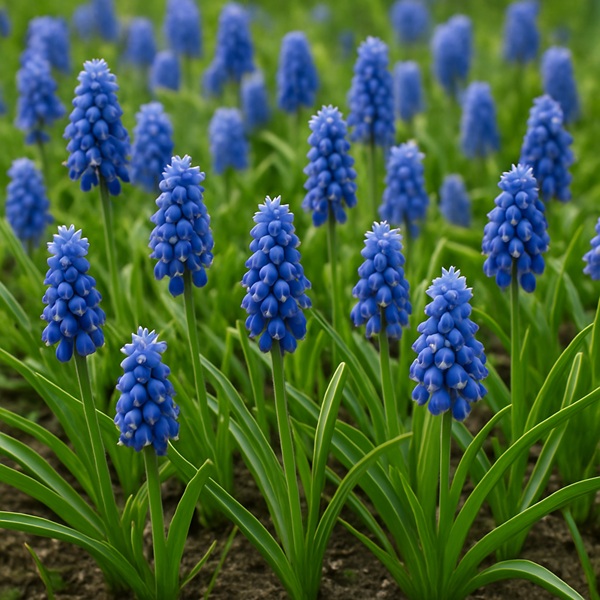
Muscari, also known as grape hyacinth, are miniature yet remarkably expressive spring bulb plants that are becoming more and more popular in Ukraine every year. These delicate flowers form dense bell- or urn-shaped inflorescences that bloom in April and May, decorating flower beds, borders, alpine slides, and spring mixborders. The most common species in Ukraine are Muscari armeniacum, Muscari botryoides, Muscari neglectum, as well as ornamental hybrids in white, blue, and violet shades. The main advantages of muscari are their low-maintenance nature, resistance to disease, drought, and frost, as well as their ability to spread quickly in one place without requiring annual transplanting.
Choosing the right planting site is the key to successful muscari cultivation. The plant prefers sunny areas or light partial shade, but in deep shade the number of flower stalks decreases and flowering becomes less abundant. South- or southwest-facing sites that warm up well in the spring sun are ideal. Muscari are often planted along garden paths, near shrubs, and beneath deciduous trees, which in spring do not yet cast deep shade. It is worth keeping in mind that after flowering, the leaves gradually die back and lose their ornamental appeal, so muscari are best combined with perennials that will later cover the bare spots.
Soil preparation also plays an important role. Muscari prefer light, loose, well-drained soils with a neutral or slightly alkaline reaction. In heavy, clayey, and overly wet sites, the plants often suffer from bulb rot. To improve soil structure, sand, compost, peat, or humus is added. It is also advisable to apply wood ash (100–150 g/m²) and superphosphate (30–40 g/m²). Given muscari’s frost resistance, in Ukrainian conditions they can be left to overwinter in open ground without cover. However, the site must be well drained, free from standing meltwater, and spacious enough for the plants to continue spreading.
Muscari are planted in autumn, from mid-September to late October, before stable frosts begin. This allows the bulbs to root before winter and ensures lush spring flowering. The ideal soil temperature for planting is around +10 to +12 °C. Spring planting is also possible, but in that case muscari will bloom only the following year, since they need time to adapt and form flower buds. Purchased bulbs should be carefully checked for damage, mold, or rot. Affected areas should be cut away and treated with ash or a fungicide.
The planting scheme depends on bulb size and decorative goals. On average, bulbs are planted at a depth of 6–8 cm, which is about three times the height of the bulb, with 5–10 cm between plants. For dense group plantings, the bulbs can be set closer together, making the spring display more striking. When creating borders, the distance between rows should be 10–15 cm. Before planting, the soil is moistened, holes or furrows are prepared, the bulbs are placed with the basal plate facing downward, then covered with soil and lightly firmed. The surface may be mulched with leaves or compost.
Muscari pair beautifully with other spring-flowering crops. They look harmonious alongside tulips, daffodils, crocuses, anemones, and primroses. When planting, it is worth considering blooming times: muscari are among the earliest to flower, while their foliage dies back by early summer. For that reason, when designing flower beds, it is practical to use layered compositions in which later plants cover the spaces left after the bulbs fade. This not only improves the overall decorative effect, but also ensures continuous flowering from early spring into autumn.
Muscari are an undemanding crop that adapts well to Ukraine’s climate. In spring, after the snow melts, narrow, elongated leaves appear first, followed by flower stalks with dense clusters of blooms. During the growing season, care consists of moderate watering, especially in a dry spring, loosening the soil, and removing weeds. Overwatering is unacceptable, as it can lead to bulb rot. Muscari respond well to feeding: in early spring, a balanced mineral fertilizer such as nitroammophoska is applied, and after flowering, phosphorus-potassium blends are used to help set flower buds for the following season.
After flowering ends, usually in May, faded flower stalks should be removed promptly so the plant does not waste energy on seed production. The leaves should be left until they turn completely yellow, since during this period photosynthesis continues and nutrients are stored in the bulb. Cutting or pulling the leaves too early is not recommended. In early summer, once the foliage has fully died back, the site is cleaned up, and if necessary, overcrowded clumps are thinned or bulbs are dug up for division and transplanting. However, muscari do not need to be dug up every year — they can grow in one spot for 4–5 years.
In containers, care is similar, but more attention must be paid to watering and drainage. Muscari are excellent for decorating balconies, terraces, front yards, and urban flower beds, creating a bright spring accent. After the foliage dies back, the containers can be moved to a less visible place until the next season, or the bulbs can be transplanted into open ground. The main thing is to follow their natural cycle: summer dormancy, autumn development, and spring flowering.
Muscari are propagated mainly vegetatively, through daughter bulbs, which form in large numbers around the mother bulb. Thanks to this, the plant spreads quickly, forming dense flowering carpets. After 3–4 years, the bulbs can be dug up, divided, and replanted elsewhere in the garden. The best time for this is June, after the foliage has completely died back and the bulbs have entered dormancy. Until replanting time, they should be stored in a dry, dark, well-ventilated room at a temperature of +17 to +20 °C.
To preserve varietal traits and ensure even flowering, overcrowded plantings should be thinned periodically. If muscari grow too long without division, the bulbs may become smaller, flowering may weaken, and some bulbs may begin to rot. When replanting, the bulbs are sorted by size: the largest are used for the main display, medium-sized bulbs are grown on, and the smallest are kept as future planting material. Before planting, the bulbs can be soaked for 30 minutes in a weak potassium permanganate solution or a fungicide to prevent disease.
Seed propagation is also possible, but it is used rarely, mainly for breeding or experimentation. After flowering, some flower heads can be left to ripen seed. In August, the seeds are collected and sown either in open ground or in boxes. Seedlings appear the following spring, and flowering begins only in the third or fourth year. Seedlings often do not retain the characteristics of the parent plant, especially in hybrids. This method is slow and labor-intensive, so for practical gardening, vegetative propagation is preferred.
Muscari are resistant to most diseases, but if growing conditions are poor, they may suffer from fungal or viral infections. The most common problems are gray mold, fusarium, penicillium rot, and mold on the bulbs. Signs include rotting, spotting on the leaves, and weak or uneven flowering. The main causes are overwatering, compacted soil, poor ventilation, and low-quality planting material. As a preventive measure, crop rotation should be followed, repeated planting in the same place after other bulb crops should be avoided, and bulbs should be treated before planting.
The most dangerous pests are wireworms, onion flies, aphids, and nematodes. Wireworms tunnel into the bulbs, which leads to rot. They can be controlled with traps, wood ash, and superphosphate. Onion flies lay eggs in the soil, and the larvae feed on young leaves and bulbs. Prevention includes regular loosening, mulching, and planting repellent plants such as marigolds, calendula, and onions nearby. Aphids suck sap from the leaves and flower stalks, causing curling and weakening. Effective remedies include folk treatments such as garlic, ash, and tobacco infusions, or biological products.
If signs of viral disease appear, such as mottling, twisted leaves, or discoloration, the affected plants should be removed and destroyed immediately. Viruses cannot be cured and are spread through sap or aphids. It is important to use clean tools, high-quality planting material, and monitor plant health regularly. With proper care, muscari remain healthy and decorative for many years without the need for chemical treatment.
Muscari are an ideal plant for creating vivid spring compositions. Thanks to their compact size, expressive flower color, and long-lasting bloom, they are perfect for flower beds, borders, rabatkas, alpine slides, and naturalistic spring plantings. Mass plantings are especially striking, forming solid carpets of blue, pale blue, or white. They are planted along paths, around trees and shrubs, to edge rose gardens, mixborders, or colorful “islands” in the lawn.
Muscari combine beautifully with other early-blooming plants such as anemones, scilla, chionodoxa, daffodils, and miniature tulips. Blue and yellow, or white and violet combinations create strong contrast and add depth to compositions. After blooming, muscari give way to summer perennials without disturbing the overall look of the flower bed. They can also be paired with ornamental grasses, ajuga, and sedums, which in summer hide the dying foliage.
Modern landscaping trends also favor using muscari in naturalistic plantings such as woodland corners, meadow-style areas, and low-maintenance gardens. They adapt easily, self-seed readily, and form dense flowering drifts by the second or third year. Muscari are also planted in pots and containers, creating movable arrangements that can be shifted around the garden. They are a versatile plant that can beautify any Ukrainian garden, from classic to contemporary.