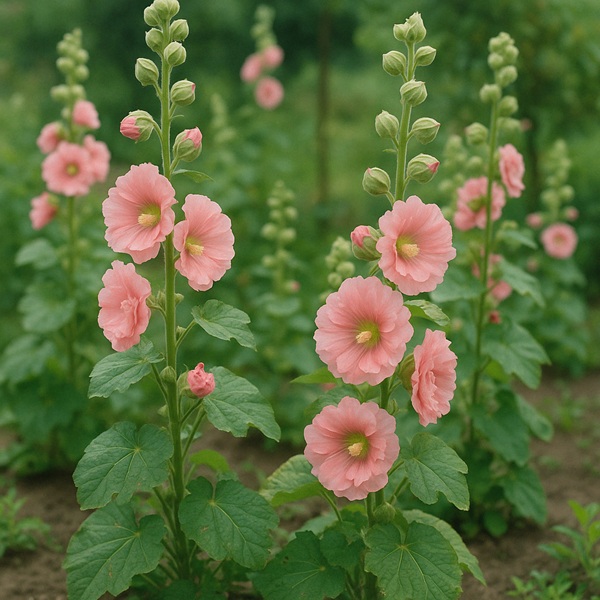
Hollyhocks, or stock roses as they are often called, are among the most striking yet at the same time undemanding garden plants that thrive very well in Ukrainian conditions. They can grow both in ornamental gardens and along fences, house walls, and country plots, creating a picturesque vertical accent. Despite their resistance to various weather conditions, the right choice of site and proper soil preparation significantly affect the plant’s decorative value and longevity.
For hollyhocks, it is best to choose well-lit, sunny areas. Although the plant can tolerate light partial shade, it flowers best in full sun. In Ukraine, especially in the southern and central regions, intense sunlight encourages the formation of large flowers in rich shades. However, areas with strong winds should be avoided, as the tall stems of hollyhocks may break. Ideally, the plant should be grown near a wall or fence, which will serve as both support and protection.
The soil for hollyhocks should be fertile, well-drained, and neutral to slightly alkaline. Heavy clay soils should be improved by adding sand and humus, while poor sandy soils should be enriched with compost. It is very important to avoid places where water stagnates, since the root system of hollyhocks is sensitive to overwatering. In autumn, before planting, the site is dug to the depth of a spade, humus is added at up to 5 kg per square meter, along with wood ash. In spring, a little complex mineral fertilizer with a predominance of phosphorus and potassium can be added to stimulate future flowering.
Preparing the planting holes also requires attention. The depth should be about 3–5 cm when sowing seeds, and up to 10 cm when planting seedlings or dividing a bush. The distance between plants depends on the variety — tall forms up to 2.5 m need at least 50–60 cm, while shorter ones need about 30 cm. This planting scheme ensures good ventilation, reduces the risk of fungal diseases, and allows the plants to develop fully.
Hollyhocks can be propagated in three ways: by seed, by seedlings, and by dividing the bush. The most common method remains sowing seeds — either directly into open ground or through seedlings. In Ukraine’s climate, the seedling method is more practical, especially in northern regions where spring can be cool and rainy.
Sowing seeds directly into open ground is usually done in May, after stable warm weather has set in. The seeds are sown into prepared furrows, watered, covered with about 1 cm of soil, and lightly firmed. The first seedlings appear in 10–14 days. To achieve flowering already in the first year, experienced gardeners recommend growing hollyhocks through seedlings. For this, the seeds are sown in containers in late February to early March. A light, nutritious mixture of peat, sand, and humus is used. The containers are placed in a warm, well-lit location. At a temperature of 20–22°C, seedlings appear within two weeks.
Pricking out is carried out after the first true leaf appears. Since hollyhocks do not tolerate transplanting well, it is better to sow the seeds immediately into separate pots or use peat tablets so that the seedlings can later be planted without damaging the root system. The seedlings need regular watering, but without water stagnation, as well as good lighting. Two weeks before planting into open ground, the plants are hardened off — first taken outside for 2–3 hours, gradually increasing the time until they can stay out for a full day.
Seedlings can be planted out from late April to mid-May, depending on the region. The southern and central regions of Ukraine allow earlier planting, while in the north it is better to wait for stable warmth. It is very important to keep the recommended spacing between plants and to make sure that when planting, the root collar stays at soil level — neither deeper nor higher — in order to avoid rotting or drying out.
Proper care of hollyhocks is the key to long-lasting and abundant flowering. Although this plant is considered undemanding, it still needs basic care: regular but moderate watering, protection from diseases, fertilization, and, when necessary, tying up and shaping the bush.
Watering should be moderate: hollyhocks do not like either drought or excess moisture. During dry periods, especially in the southern regions of Ukraine, it is worth watering once or twice a week, depending on the condition of the soil. It should not dry out completely, especially during budding and flowering. At the same time, excess moisture may cause root rot or the development of fungal diseases. The best time for watering is morning or evening, when moisture has time to soak in and does not evaporate too quickly.
Feeding plays an important role in the development of hollyhocks. The first fertilizer is applied 2–3 weeks after planting the seedlings or after seedlings emerge from seed. Complex mineral fertilizers with a low nitrogen content are used so as not to stimulate excessive leaf growth at the expense of flowering. Phosphorus-potassium mixtures or organic infusions work well, such as herbal infusion or mullein diluted with water at 1:10. During bud formation and flowering, another one or two feedings can be given at intervals of 3–4 weeks.
Shaping the bush is usually not necessary, since hollyhocks form an upright stem. However, when growing tall varieties, support must be provided. The plant should be tied carefully so as not to injure the stem. If the bush becomes too dense, extra side shoots can be removed — this improves ventilation and reduces the risk of fungal diseases. It is also important to remove faded flowers in time in order to stimulate the formation of new buds and prolong the plant’s decorative effect.
Although hollyhocks are considered fairly hardy plants, they are still prone to a number of diseases and may suffer from pests, especially in conditions of high humidity or overcrowded planting. The most common problem is rust — a fungal disease that appears as reddish-brown spots on the underside of the leaves. It can seriously weaken the plant, reduce its ornamental value, and even cause the leaves to fall completely.
To prevent rust, it is important to observe proper watering practices, avoid overwatering, and maintain enough space between plants for good air circulation. At the first signs of disease, affected leaves are removed and burned. The plant can also be treated with fungicides — copper-based preparations such as Bordeaux mixture or copper oxychloride are suitable. Treatment is carried out in calm weather, preferably in the evening, and repeated after 10–14 days if necessary.
In addition to rust, hollyhocks may suffer from powdery mildew, especially in damp and cool weather. The disease appears as a white coating on leaves and stems. Effective treatments include fungicides, as well as folk remedies such as garlic infusion or a soda solution with laundry soap. It is also important to watch for pests — slugs, aphids, and spider mites. Slugs become active in wet weather, especially in western and northern Ukraine, and hide in dense leaf mass. They are collected by hand or trapped using beer traps. Aphids and spider mites are destroyed with insecticides, and also by regular spraying with infusions of onion skins or tobacco.
Regular inspection of the plants, especially the lower leaves and stems, makes it possible to detect problems in time and prevent their spread. After flowering ends and at the close of the season, it is recommended to cut off all dried parts of the bushes and remove plant debris so as not to leave overwintering pests and sources of infection behind. Such measures are especially relevant in the southern and central regions of Ukraine, where a warm autumn can prolong the growing season and create conditions for repeated infection.
Although most gardeners grow hollyhocks as biennials or annuals, in Ukraine they can also be successfully cultivated as perennials, especially with proper preparation for winter. Most hollyhock varieties are fairly frost-resistant and can withstand temperatures down to –15°C, and in the southern regions even lower if there is snow cover. However, in snowless winters, especially with sharp temperature fluctuations, plants may die without protection.
To prepare hollyhocks for winter, at the end of the season the stems are cut back to a height of 10–15 cm above the soil surface. The bushes are then mulched using fallen leaves, peat, humus, or straw. The mulch layer should be at least 10 cm thick. Such protection not only preserves the root system from freezing, but also helps the plant begin growing more quickly in spring. In the northern regions of Ukraine, as well as in areas at risk of severe frost, it is advisable to additionally cover the bushes with agrofibre or spruce branches.
In spring, once stable warm weather is established, the cover is removed and the mulch is pulled back without interfering with the development of new shoots. Spring growth then requires standard care: loosening the soil, moderate watering, and the first feeding. If the plant has overwintered well, it begins active growth as early as April and may flower earlier than specimens sown or transplanted in spring. With proper cultivation practices, hollyhocks can therefore bloom for 3–4 years in a row, especially perennial varieties.
An additional advantage is the ability of hollyhocks to self-seed. If faded flower heads are not removed, the seeds fall to the ground and may sprout the following spring without any help from the gardener. At the same time, it is important to make sure the plantings do not become too dense, otherwise the risk of disease increases. Self-seeding can be used as a way of naturally renewing the planting, especially in rustic-style gardens or naturalistic compositions.
Hollyhocks stand out for their wide variety of cultivars and forms, which makes them versatile plants both for rustic country plots and for modern urban gardens. In Ukraine, both traditional tall stock rose varieties reaching 2–2.5 m in height and compact hybrids with double flowers that do not exceed 60–80 cm are available. The color range of hollyhocks varies from delicate pinks and whites to rich purples, crimson shades, and even almost black tones.
Tall varieties are especially striking as living walls along fences, outbuildings, or in the back of mixed borders. They pair well with plants such as delphinium, rudbeckia, echinacea, and musky mallows. Compact forms are often planted in borders, flower beds, and even containers. Thanks to their long flowering period — from June to September — they provide a bright accent in any corner of the garden.
Among the popular varieties for Ukraine are ‘Charter’s Double’ with double flowers, ‘Nigra’ with almost black petals, ‘Spring Celebrities’ — a compact hybrid in delicate shades — as well as ‘Pleniflora’ and ‘Parkallee.’ All these varieties are well adapted to local conditions and provide a reliable ornamental effect with minimal care. When choosing a variety, it is worth considering height, flowering time, disease resistance, and color preferences — this will help plan plantings more thoughtfully.
Hollyhocks can become the center of a seasonal composition or part of a mixed flower bed. They look wonderful in romantic gardens, suit country-style plantings, and can even serve as an accent in minimalist designs. In addition, hollyhocks are excellent honey plants that attract bees and butterflies, contributing to biodiversity in the garden.