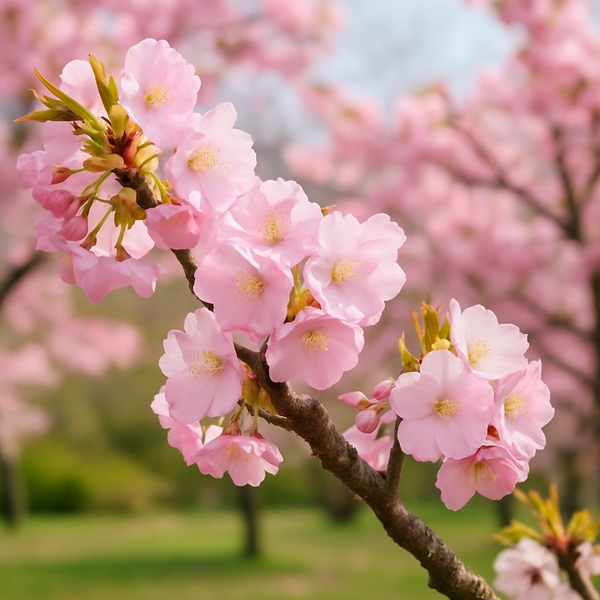
Japanese cherry is a symbol of spring, beauty, and the fleeting nature of life. Its blossom inspires poets, artists, and gardeners all over the world. Although Japanese cherry is associated with faraway Japan, it is appearing more and more often in Ukrainian landscapes as well — from botanical gardens to private plots. But how realistic is it to grow this tree in our climate?
First of all, it is important to understand that the name sakura usually refers to ornamental cherry varieties, most often Prunus serrulata, with single or double flowers in shades of pink, white, or cream. In the Japanese classification, there are dozens of varieties that differ not only in the color and shape of their flowers, but also in their climate tolerance. However, not all of them are suitable for growing in Ukrainian conditions. Some varieties cannot withstand temperatures below -15 °C and require covering or even container growing.
For the Ukrainian climate, it is best to choose frost-hardy species and varieties of Japanese cherry, including:
– Prunus serrulata ‘Kanzan’ — one of the most popular sakura varieties with double pink flowers, able to withstand frosts down to -20 °C with protection.
– Prunus subhirtella ‘Autumnalis’ — a variety that may bloom again in autumn.
– Prunus nipponica — compact, cold-tolerant, suitable for the central regions.
– Prunus sargentii (Sargent’s cherry) — a tall, frost-resistant tree, ideal for avenues.
– Prunus ‘Accolade’ — an early-flowering hybrid that blooms as early as April.
Choosing the right variety is half the battle. It is worth considering not only its decorative appeal, but also its resistance to wind, frost, and spring cold snaps. In the southern regions, the range of suitable varieties is broader; in the northern and central regions, it is especially important to pay attention to the planting site and microclimate.
Japanese cherry prefers sunny places protected from the wind. The best planting site is the southern or southeastern side of the plot, where the plant will receive at least 6–8 hours of light per day. At the same time, it is important to provide protection from drafts, especially in open areas. An ideal location would be near a house, hedge, or group of shrubs that create a favorable microclimate.
Japanese cherry is fairly demanding when it comes to soil. It needs fertile, light, well-drained soil with a neutral or slightly acidic reaction (pH 6.0–7.0). Heavy clay soil should be improved with sand and compost, and in areas with high groundwater it is recommended to plant on raised mounds or elevated spots. Stagnant water is absolutely unacceptable, as it quickly leads to root rot and the death of the plant.
Recommended site preparation:
Dig a hole measuring 60×60×60 cm.
Place drainage at the bottom — crushed stone, expanded clay, or coarse sand.
Fill it with a mixture of turf soil, compost, and sand (2:1:1).
Add 50–70 g of superphosphate and 1 cup of wood ash.
Water thoroughly and leave for 5–7 days before planting.
It is also important to consider the site’s natural features: Japanese cherry should not be planted in lowlands, near storm drains, or close to water runoff. Ideally, it should be placed on a slight slope or in the center of a lawn with sufficient light.
In the southern and central regions of Ukraine, Japanese cherry is planted in autumn, from late September to mid-October, so the plant has time to root before frost. In the northern and eastern regions, it is better to plant in spring, from late March to late April. The main thing is to avoid planting during sap flow or after the leaves have opened.
It is recommended to use seedlings with a closed root system, as they establish better and do not require root pruning. The planting process is as follows:
– Prepare the planting hole in advance.
– Place the seedling vertically, burying the root collar by 1–2 cm.
– Fill with the fertile mixture and lightly firm the soil.
– Water generously, using up to 15 liters of water.
– Mulch the area around the trunk with peat, pine needles, or decorative wood chips.
During the first month, moisture levels should be monitored carefully — both drying out and overwatering are equally harmful. Young trees are sensitive to temperature fluctuations, so in spring and autumn they can be temporarily covered with agrofabric. Light shading is also desirable during the first weeks, as it reduces transplant stress.
Japanese cherry is an ornamental tree that does not require excessive attention, but it responds sensitively to neglect of basic growing requirements. The gardener’s main task is to maintain a balance between moisture, nutrition, and crown shape. During the first 3–4 years after planting, the tree should be monitored especially carefully.
In spring, sanitary pruning should be carried out by removing frost-damaged, broken, and dry branches. This stimulates growth and improves air circulation in the crown. At this time, nitrogen fertilizers are also applied, such as nitrate, urea, or a compound NPK fertilizer with a higher nitrogen content; the soil is loosened and the mulch renewed. If the spring is dry, the tree should be watered regularly. Young seedlings may also need protection from night frosts, especially in April when buds are already beginning to form.
In summer, the main focus is watering. Japanese cherry does not tolerate drought, so in hot weather it should be watered once every 5–7 days, using 10–15 liters per tree. Potassium-phosphorus fertilizers are applied to support flowering and the formation of flower buds for the next year. Nitrogen is not recommended in mid-summer, to avoid producing shoots that will be vulnerable to cold. The area around the trunk must be kept clean, without weeds or excessive mulch.
In autumn, the tree is prepared for winter. After leaf fall, the soil under the tree is cleared of leaves and the remains of flower stalks, then mulched with a layer of peat or conifer litter. Phosphorus-potassium fertilizers such as superphosphate and ash are applied to strengthen the tissues. Young trees, up to 5 years old, are insulated: the area around the trunk is covered with straw, and the trunk is wrapped with burlap or agrofabric. In spring, this protection should be removed gradually to avoid bark scorch.
Japanese cherry needs regular shaping, especially during the first years after planting. With the right approach, its crown develops a decorative form, keeps harmonious proportions, and delights with flowering every year. Once mature, the tree tolerates only light sanitary pruning well, so it is important to form the scaffold branches early on.
Types of pruning:
– Sanitary — in spring, before sap flow begins. Diseased, frost-damaged, and damaged branches are removed.
– Formative — from March to May during the first 3–4 years. A vase-shaped or fan-shaped crown is formed.
– Rejuvenating — for trees older than 10 years. It is done gradually, removing no more than 25% of the crown in one season.
Diseases of Japanese cherry in Ukraine:
– Moniliosis (blossom blight) — wilting of flowers and young shoots.
– Shot hole disease — brown spots on leaves, followed by holes after the dead tissue falls out.
– Powdery mildew — a white coating on young leaves in shaded or overly humid conditions.
– Root rot — a result of stagnant water.
For disease prevention, copper-based products are used: Bordeaux mixture, Hom, and Kuproksat. Spraying is carried out in spring, before bud break, and in autumn, after leaf fall. If symptoms of disease appear, treatment is repeated at intervals of 10–14 days. Affected leaves and flowers must always be removed.
The flowering of Japanese cherry is a true spectacle in the garden. It lasts from 5 to 14 days depending on the variety and the weather, but during that time the tree completely transforms the surrounding space. Japanese cherry is not just an ornamental plant — it is an emotional focal point in garden design.
Ways to use it in the garden:
– as a specimen tree — a single plant on a lawn or as the central element of a composition;
– in group plantings with maples, barberry, and ornamental apple trees;
– in Japanese gardens — combined with stones, streams, gravel, and bamboo elements;
– in mixborders together with spring bulbs such as tulips, daffodils, and muscari;
– as the central accent of a landscape garden.
Japanese cherry looks wonderful in large parks as well as in small home gardens. Compact varieties are ideal for courtyards, patios, and flowerbeds near the house. The tree looks especially harmonious against a background of conifers such as thuja, junipers, and pines, since they remain decorative in winter and create a contrast with the pink spring blossom.
Japanese cherry is a choice for those who appreciate the seasonal change of mood, poetic beauty, and harmony with nature. If you give it attention and patience, it will reward you every year with inspiration and unforgettable moments.