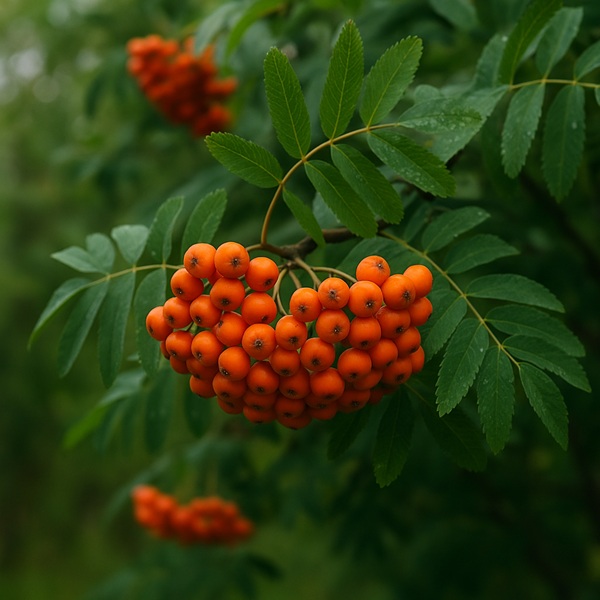
Rowan is a tree familiar to every Ukrainian. Its red berries against the backdrop of a yellow autumn crown are associated with warmth, homely comfort, and the generosity of nature. In gardening, rowan is not just an ornamental crop. It is valued for its healing fruits, hardiness, frost resistance, and longevity. It is both a decoration for the plot, a source of useful raw material, and an element of folk tradition.
There are many species and varieties of rowan, and they differ noticeably. The most widespread in Ukraine is common rowan (Sorbus aucuparia) — a medium-sized tree (up to 12 m) with an airy crown and bright red clusters of fruit. It can often be found in the wild — on forest edges, by roads, and in old gardens. In horticulture, both wild forms and ornamental varieties are used: ‘Morozivska,’ ‘Hranatna,’ ‘Rubin,’ as well as hybrids, including Michurin rowan, which is the result of crossing with aronia (black chokeberry).
When choosing a variety for your plot, it is worth focusing on the purpose of cultivation: for beauty — tall forms with a lush crown and bright fruit; for fruit production — hybrids with large sweet berries; for hedges — low-growing compact species. All of them are well adapted to the conditions of Ukraine, from the Carpathians to the Donbas. However, in the south, in especially hot years, growth may be suppressed without additional watering and shading during periods of extreme heat.
Rowan is quite a hardy plant, but the best results can be achieved by following the basic requirements for growing conditions. Above all, the tree is light-loving: it will grow in shade, but it flowers worse and produces small, more tart fruits. So the ideal place is an open sunny area or a site with light shade during the hottest hours.
It is important to protect the sapling from strong winds. Young trees are especially sensitive to gusts, particularly in spring when their rooting is still weak. It is best if there is natural or artificial protection on the northern side: a fence, a building, or a strip of shrubs. But complete isolation is not recommended — rowan needs ventilation to prevent fungal diseases.
The soil should preferably be light, fertile, with a neutral or slightly acidic reaction (pH 5.5–6.5). Loamy or sandy loam soils with good drainage and moderate moisture are best. Rowan should not be planted on clayey or waterlogged sites. Planting pit preparation scheme:
Size — 50×50×50 cm.
Drainage — a layer of gravel or broken brick at the bottom.
Substrate — a mixture of turf soil, humus, and sand (2:1:1).
Add half a liter of wood ash and 40–50 g of superphosphate.
Moisten and mulch the soil 1–2 weeks before planting.
Such an environment will promote rapid rooting and provide the plant with the starter nutrients needed for active growth.
Under Ukraine’s climatic conditions, rowan is planted in spring (March–April) or autumn (late September to mid-October). In the southern regions, it is better to plant in autumn — before the onset of frost, the tree has time to root. In the northern and central regions, spring planting is preferred in order to avoid frost damage to young trees.
Two-year-old saplings with a closed root system establish best. When buying, choose plants with well-developed roots, no mold, growths, or cracks in the bark, and several strong branches.
Planting technique:
Heap a small mound of prepared soil in the center of the pit.
Place the sapling and spread the roots over the surface of the mound.
Fill with soil, compacting it layer by layer so that no air pockets remain.
The root collar should be at ground level or slightly above.
Water with 10–15 liters of water.
Mulch with peat, bark, or straw.
During the first month after planting, it is necessary to monitor moisture, protecting the tree from drying out and overheating. With proper care, rowan establishes quickly, begins to grow actively, and flowers as early as the third or fourth year.
After planting, rowan requires moderate but regular care. It is especially important to provide support during the first 3–4 years, until the tree is fully established. After that, care mainly comes down to observation, timely watering, feeding, and pruning. If everything is done on time, rowan will stay healthy, flower abundantly, and bear generously.
In spring, as soon as the snow melts and the soil warms up, sanitary pruning is carried out — damaged, weak, and frostbitten branches are removed. The first feeding is applied — nitrogen or complex mineral fertilizers such as nitrate or nitroammophoska. The soil around the trunk is loosened, watered, and mulched with sawdust, cut grass, or peat. Mulch helps retain moisture and suppress weeds.
In summer, the tree needs additional watering during hot periods — once every 10–14 days, using 15–20 liters of water for a mature tree. Phosphorus-potassium fertilizers or an ash infusion are applied to stimulate flowering and fruiting. In June and July, the leaves and shoots should be inspected — the appearance of spots, curling, or clusters of insects indicates a possible threat. Preventive spraying is recommended, either with biological products such as Fitosporin and Planriz, or with a weak soap solution.
In autumn, after harvest and leaf fall, all debris is cleared from under the tree, phosphorus-potassium fertilizers are applied (ash, superphosphate), and the trunk zone is loosened and mulched. In the northern regions, young trees are insulated — wrapped with agrofabric, while the soil around the trunk is covered with dry leaves or straw. This prevents root freezing and frost cracks in the bark.
Although rowan is quite a resilient crop, with improper care or under unfavorable conditions it may suffer from diseases or pests. This is especially true for cultivated varieties and hybrids. Inspecting the tree is the best prevention, helping detect threats in time.
Common diseases:
– Scab — brown spots on leaves and fruits. Most often appears in wet weather.
What to do: prune affected parts and spray with Bordeaux mixture or “Hom.”
– Rust — orange dots on the underside of the leaf. Often transferred from juniper or other conifers.
Solution: remove weeds and treat with fungicides.
– White leaf spot — gray spots on leaves.
Control: use sulfur-based products or biofungicides.
Typical pests:
– Rowan moth — caterpillars eat the berries from the inside.
– Jewel beetle — a beetle that damages the bark and weakens young trees.
– Aphids — appear on the tips of shoots and cause leaf deformation.
– Apple blossom weevil — damages the buds.
To protect plants, insecticides such as Confidor and Actellic or biological products such as Fitoverm and Bikol are used. Treatment should be carried out on a calm day early in the morning or in the evening, avoiding contact with flowers so as not to harm bees. After rain, the treatment is repeated after 5–7 days.
Harvesting is not only a practical but also an aesthetic process. Rowan berries are collected in September–October, when they have developed their characteristic color and ripened fully. Some of the fruit can be left on the tree — this will decorate the garden and serve as food for birds in winter.
Uses of the berries:
– for making preserves, jams, and compotes;
– for drying — as an addition to teas and herbal infusions;
– as an ingredient for tinctures and syrups;
– in folk medicine — to strengthen immunity, improve digestion, and support vascular health.
Rowan is pruned every year. During the first 3–5 years, the crown is shaped — most often into a spherical or free form. Later, old non-fruiting branches and branches growing inward are removed. The cut surfaces are treated with garden varnish. Crown renewal every 8–10 years helps maintain fruiting and tree health.
In landscape design, rowan serves several functions:
– as a specimen tree — a standalone tree on a lawn;
– in hedges;
– as a backdrop for flowerbeds with chrysanthemums, astilbes, and ornamental grasses;
– in a natural-style garden together with other fruit crops.
Rowan is a bridge between beauty, usefulness, and tradition. It is undemanding, resilient, long-lived, and multifunctional. By planting it once, you get not just a tree, but a true symbol of the Ukrainian garden.