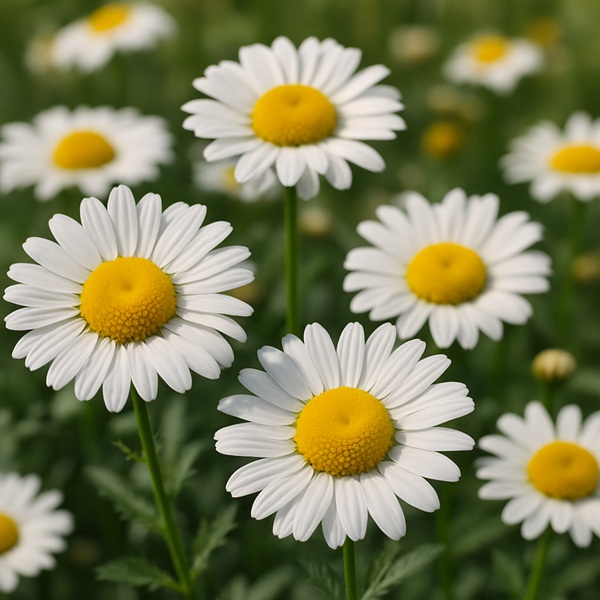
Chamomile is one of the most recognizable and beloved plants, both in the wild and in the garden. This name is often used for different kinds of flowers: from true medicinal chamomile (Matricaria chamomilla), which is used in medicine and cosmetology, to the large-flowered garden chamomile — oxeye daisy (Leucanthemum vulgare), also known as marguerite daisy. Sometimes feverfew and tansy are mistakenly grouped with chamomile as well. So before you start growing it, it is important to determine clearly which kind of chamomile you actually plan to plant.
If your goal is to obtain medicinal raw material, it is best to choose German chamomile, which has characteristic small flowers with a convex yellow center and a delicate aroma. For ornamental landscaping, especially in landscape design, garden chamomile (oxeye daisy) is more suitable — with large white petals and strong hardiness. Perennial species also grow well in Ukraine, including Leucanthemum maximum, Leucanthemum superbum, and their hybrids such as ‘Alaska,’ ‘Becky,’ and ‘Crazy Daisy.’
The difference between these types lies not only in their appearance, but also in their growing requirements. German chamomile is an annual, easy to sow in spring and harvest by August. Garden chamomile, on the other hand, is a perennial that can grow in one place for up to 5 years without needing annual renewal. It is also important to consider the climate: in southern Ukraine, chamomile blooms longer, while in the north it may freeze without winter protection. Once you have chosen the type, you can move on to selecting the site and preparing the soil.
Chamomile is a sun-loving plant. Even light shade can cause the stems to stretch, the flowers to become pale, and flowering to weaken. That is why the best place for planting is an open, well-lit area. South- or southwest-facing slopes without stagnant air or water are especially suitable. In regions with high humidity, it is particularly important to avoid damp areas, since excess moisture around the roots encourages rot and fungal diseases.
The soil should be loose, well-drained, and neutral to slightly alkaline (pH 6.5–7.5). Acidic and heavy clay soils should be improved in advance by adding sand, compost, and wood ash. The ideal structure is light loam or sandy loam enriched with humus. Chamomile does not like marshy ground, but it tolerates drought well, which makes it ideal for southern regions of Ukraine or for gardens with limited watering.
How to prepare the site:
– In autumn, dig deeply (25–30 cm) and remove the roots of perennial weeds.
– In spring, add compost (3–5 kg/m²) and a small amount of mineral fertilizer containing phosphorus and potassium.
– Do not apply fresh manure — it encourages leaf growth but suppresses flowering.
– Before sowing or planting, loosen and level the soil, then water it with a weak potassium permanganate solution.
Important: perennial chamomile does not like transplanting. It is best to choose a permanent place right away, where it can grow freely for 4–5 seasons. With proper soil preparation, it spreads quickly and produces abundant flowering as early as the following year.
The sowing time depends on the type of chamomile. German chamomile is sown in spring (March–April) or before winter (October–November). The seeds are small and are sown on the surface without being buried, under a thin layer of mulch. The first seedlings appear in 7–10 days at a temperature of +10 to +15 °C. Spring sowing produces flowering by July, while winter sowing gives blooms 2–3 weeks earlier.
Perennial garden chamomile can be propagated in several ways:
By sowing seedlings (February–March). The seeds are sown in containers, covered with a thin layer of sand, and kept at +18 to +22 °C. After 2 leaves appear, the seedlings are pricked out. They are planted in open ground in May.
By direct sowing in the ground — from late April to June. The seedlings are later thinned, leaving 20–30 cm between plants.
By dividing the clump — in early spring or in August. This method is best for rejuvenating or propagating mature plants.
The planting scheme depends on the variety: compact types are spaced 20 cm apart, while tall varieties need 40–50 cm. After planting, the soil is mulched to retain moisture, suppress weeds, and protect the roots from temperature fluctuations. Watering should be moderate, and especially careful in the first weeks to avoid rot. Seedlings should also be temporarily shaded during sunny hours.
Keep in mind: when grown from seed, you should not expect mass flowering in the first year. Chamomile reveals its full ornamental potential from the second season onward, but in return it is long-lived, undemanding, and exceptionally attractive.
Chamomile is considered undemanding, but for lush and long-lasting flowering it still needs minimal yet consistent care. This mainly means proper watering, moderate feeding, removing faded flower heads, and thinning overcrowded plantings. This combination helps keep the flower bed neat right through autumn.
Watering should be moderate, especially on light soils. After seedlings emerge or transplants are planted out, the soil should be kept evenly moist without becoming waterlogged. Mature perennial plants are watered once every 5–7 days in hot weather, and less often on cloudy days. Stagnant water around the roots is the main cause of disease.
Feeding is done two or three times per season. In spring, it is advisable to use a balanced mineral fertilizer with phosphorus and potassium. During bud formation, feed with potassium-phosphorus blends or a wood ash infusion. On poor soils, diluted organic fertilizer such as compost tea may be applied, but excess nitrogen is harmful — it encourages leaf growth at the expense of flowers.
Removing faded flowers is a simple but effective way to prolong blooming. It also prevents self-seeding, which is especially relevant for German chamomile, and helps maintain the decorative appearance of the bed. If the flowers are grown for cutting or for sale, regular harvesting of the blooms also encourages better branching and renewed flowering.
Although chamomile is generally quite resistant, improper growing conditions may lead to diseases or pest problems. Issues most often arise in shaded, waterlogged, or overcrowded plantings. Still, most of them can be prevented with basic preventive care.
Common diseases:
– Gray mold (Botrytis) — brown spots on the leaves and a gray fuzzy coating. It often develops in rainy weather.
What to do: remove affected parts, treat with Topaz or Ridomil, reduce watering, and improve ventilation.
– Powdery mildew — a white coating on the leaves.
Prevention: thin the planting, and use sulfur-based products or biofungicides such as Trichoderma or Planriz.
– Root rot — especially dangerous for young plants.
Solution: improve drainage, transplant to a raised spot, and water carefully.
Pests:
– Aphids — settle on buds and young leaves and suck out sap.
– Thrips — tiny insects that leave silvery spots.
– Spider mites — cause yellowing of the leaves and appear in hot weather.
To protect plants, gardeners use insecticides such as Fitoverm and Actellic, or folk remedies such as garlic infusion, laundry soap, and ash. Spraying should be done on both sides of the leaves. It is important to rotate treatments to prevent resistance in pathogens and pests. The key point is prevention and careful observation.
Chamomile is easy to propagate and can grow in one place for 4–5 years without losing its ornamental value. The most reliable methods are:
– Dividing the clump — in early spring or autumn. The divisions establish quickly and bloom the following year.
– Sowing seeds — both spring and winter sowing. This is especially relevant for German chamomile and hybrid chamomile.
– Green cuttings — less common, but they make it possible to preserve varietal traits.
Chamomile usually winters well in Ukrainian conditions. Perennial varieties can withstand frosts down to -25 °C, especially with snow cover. In northern regions or in winters with little snow, light covering is recommended: mulch, dry leaves, or spunbond. German chamomile is resown every year.
Uses in design:
– In mixborders — it pairs beautifully with lavender, sage, and catmint.
– In meadow-style compositions — with cornflowers, poppies, and bellflowers.
– In borders and along paths.
– In naturalistic gardens — as part of a floral carpet.
Chamomile brings lightness, natural charm, and a sense of home comfort to a flower bed. It is simple and refined at the same time, and its white bloom is a universal element in almost any garden style. In addition, it can be cut for bouquets, dried, and used for cosmetic or medicinal purposes.