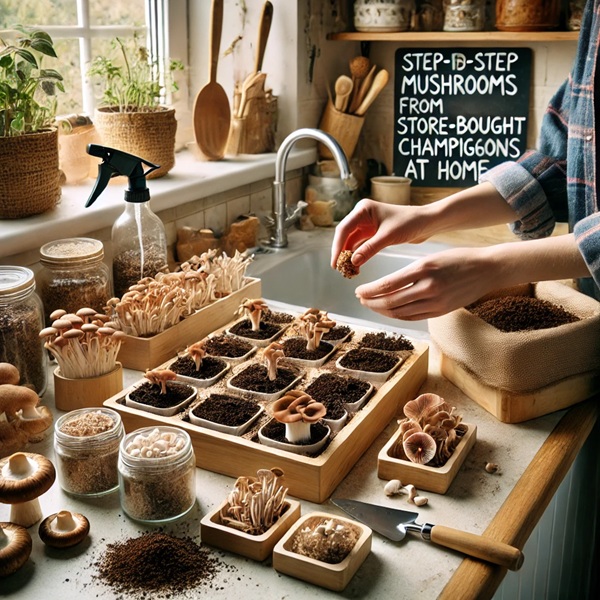
Champignons are among the most popular mushrooms in the world thanks to their delicate flavor, versatility in cooking, and rich vitamin content. Growing champignons at home from store-bought mushrooms is not only a way to provide yourself with fresh, environmentally friendly produce, but also an exciting process that can become a new hobby.
Many people believe that growing champignons requires special conditions and complicated technology. In fact, with the right approach and the creation of a suitable environment, these mushrooms can be successfully grown right at home using ordinary store-bought mushrooms. It is an accessible and effective way to get a harvest without major expense.
Champignons belong to saprotrophic fungi that grow on organic matter such as compost or manure. They do not require sunlight, so they can be grown in a basement, pantry, or enclosed balcony. In this detailed guide from Marta Flowers, you will learn how to grow champignons from store-bought mushrooms step by step — from preparing the material to harvesting.
To grow champignons from store-bought mushrooms, you need to obtain mycelium — the fungal network from which new mushrooms will grow. Store-bought champignons can become a source of spores if you choose fresh, high-quality specimens.
How to choose mushrooms for growing:
Choose fresh mushrooms: they should be firm, with no signs of mold or rot.
Cap integrity: it is better to choose mushrooms with closed caps, as this means they are not yet fully mature and contain more spores.
Healthy white color: champignons should be white or cream-colored, without dark spots or discoloration.
After selecting the mushrooms, you can begin preparing the mycelium. To do this, cut off the stem together with part of the base, where the greatest concentration of spores is found. This part of the mushroom will become the source of the future fungal network.
Methods of preparing mycelium from store-bought mushrooms:
Cut the stems into small pieces 1–2 cm long.
Soak the cut pieces in warm water for 24 hours. This helps activate the spores and prepare them for germination.
After soaking, remove the stems from the water and dry them on a paper towel. They are then ready to be planted in the prepared substrate.
Growing champignons requires a special substrate that provides the mycelium with the nutrients it needs. In natural conditions, champignons grow on organic remains, so for cultivation you need to create a similar environment.
Materials suitable for the substrate:
2 parts compost based on horse manure or straw
1 part humus
1 part peat
1 part gypsum or chalk to maintain a neutral pH level
If it is not possible to prepare this mixture yourself, you can buy a ready-made mushroom substrate with the required nutrients from gardening stores.
How to prepare the substrate:
Mix all the ingredients into a uniform mass.
Make sure the substrate is moist but not wet. Water should not drip out when you squeeze it in your hand, but it should still hold its structure.
Place the substrate in boxes, containers, or other vessels with drainage holes. The layer should be at least 10–15 cm deep.
Choosing a place to grow mushrooms:
Champignons do not like bright light or high temperatures. The best conditions are:
Temperature: 20–25°C during mycelium growth, 12–18°C during fruiting.
Humidity: 70–90%. The air around the mushrooms should be sprayed regularly to maintain moisture.
No drafts and no bright light.
A basement, pantry, or a dark corner of a room is ideal. It is important to maintain a stable microclimate and monitor the humidity level with a humidifier or regular misting.
After preparing the substrate and the mycelium, you can begin planting. This process does not require special skills, but it does require care and attention.
How to plant the mycelium correctly:
Make small holes in the prepared substrate about 2–3 cm deep.
Place a prepared piece of mushroom stem into each hole.
Cover the holes with substrate and lightly firm the surface.
Moisten the soil with warm water using a spray bottle.
After planting, the containers should be covered with film or cloth to maintain optimal humidity and temperature. The mycelium usually takes 2–4 weeks to colonize the substrate. During this period, maintain a temperature of 20–25°C and keep the substrate regularly moist.
Signs of successful mycelium growth:
A white coating appears on the surface of the substrate.
A light mushroom smell typical of fresh champignons develops.
Caring for the fungal network during fruiting:
Once the mycelium has spread through the substrate, the next stage begins — fruiting. At this point, the temperature should be lowered to 12–18°C and the covering removed. Humidity should remain at 70–90%, with regular spraying of the air around the mushrooms.
To stimulate fruiting, you can gently loosen the top layer of the substrate. This improves oxygen access and speeds up the appearance of the first fruiting bodies.
Harvesting is one of the most enjoyable stages of the process. If all conditions are met, the first mushrooms will appear 2–3 weeks after fruiting begins.
How to harvest properly:
The mushrooms should be carefully twisted out of the substrate together with the stem so as not to damage the mycelium.
The place where a mushroom was removed should be covered with fresh substrate and lightly moistened.
Harvesting can be done every 3–5 days. One mycelium can continue fruiting for 2–3 months.
How many mushrooms can be harvested:
From one square meter of substrate, you can get up to 6–10 kg of champignons over the full growing cycle. However, this depends on the quality of the mycelium, the growing conditions, and how consistently the fungal network is cared for.
Care after harvesting:
Moisten the substrate 1–2 times a week.
Refresh the top layer of the substrate after each harvest.
Maintain the required temperature and humidity.
The mycelium can be used several times. After each fruiting cycle, the substrate should be refreshed or fully replaced. This helps ensure longer fruiting and higher yields.
Growing champignons at home requires attention to detail and following all the recommendations. Even experienced growers may run into problems.
Main mistakes:
Temperature imbalance
Problem: If the temperature is too high, it may destroy the mycelium or stop its development.
Solution: Monitor the temperature at each stage with a thermometer.
Low air humidity
Problem: Mushrooms cannot develop properly if the humidity is too low.
Solution: Spray the air around the container regularly or use a humidifier.
Mold on the substrate
Problem: Mold may appear due to excessive moisture or lack of ventilation.
Solution: Watch the humidity level and ventilate the room regularly. If mold appears, remove the affected areas and treat the substrate with a weak potassium permanganate solution.
Poor mycelium growth
Problem: This may be caused by too few nutrients or poor-quality mycelium.
Solution: Use only fresh mushrooms and prepare a high-quality, nutrient-rich substrate.
No fruiting
Problem: Incorrect care or insufficient ventilation may stop mushroom formation.
Solution: Loosen the top layer of the substrate regularly and keep humidity at the proper level.
Growing champignons from store-bought mushrooms is an interesting and practical activity that allows you to get an environmentally friendly product right at home. With the right approach, this process does not require major costs or special knowledge, and the result can keep rewarding you for several months.
Main steps for successful champignon cultivation:
Choose fresh mushrooms with firm, healthy stems.
Prepare a nutrient-rich substrate and create the right conditions for mycelium growth.
Water regularly and monitor air humidity.
Harvest properly and care for the mycelium after fruiting.