Ginger is a unique plant that combines ornamental, culinary, and medicinal value. Its spicy root is widely used in cooking, folk medicine, and cosmetology. Although ginger is traditionally grown in the tropics, it can also be cultivated successfully at home or in the garden. The key is to create the right conditions and follow proper growing techniques. In this article, we will look at every stage, from choosing planting material to harvesting and storing the crop.
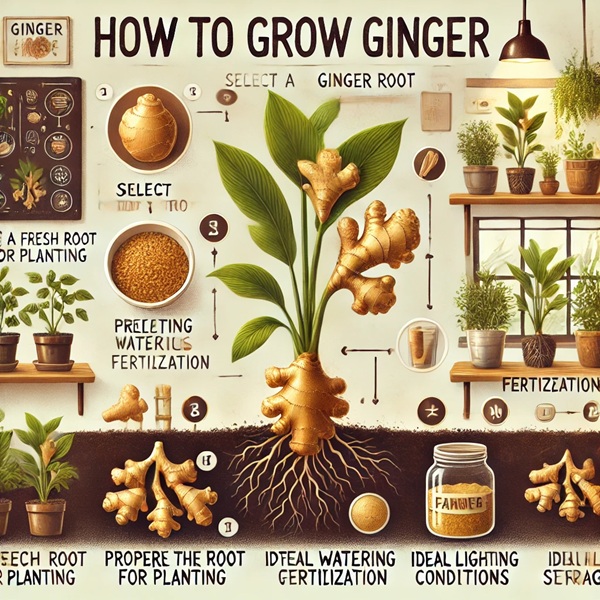
The first and most important step is choosing high-quality planting material. A suitable ginger root should be fresh and firm, without signs of wilting, mold, or dry patches. The skin should be smooth — the younger the root, the faster it will sprout. It is important that the “eyes” (buds), from which the shoots will later emerge, are clearly visible.
It is best to use rhizomes purchased from specialized stores or trusted sellers. Ordinary ginger from a supermarket may be treated with chemicals that slow down sprouting.
To speed up the appearance of shoots, the planting material should be prepared properly. First, the root is soaked in warm water for 12–24 hours to awaken the buds and remove possible chemical residues. Then large rhizomes are cut into pieces so that each part has at least one live bud. The cut surfaces are treated with wood ash or a weak potassium permanganate solution to prevent rotting. After that, they are left to dry for 24 hours at room temperature.
Next, the ginger can either be planted directly in the soil or pre-sprouted. For sprouting, the root is placed in a container with moist moss or peat, while maintaining a temperature of 22–25°C. The first shoots will appear in 10–14 days.
The pot should be wide and at least 30 cm in diameter, since ginger roots spread sideways. It is important to provide good drainage — a layer of expanded clay or pebbles is placed at the bottom of the container.
The optimal soil mix consists of 50% garden soil, 25% humus or compost, and 25% sand or coconut substrate. The rhizome is placed horizontally, lightly buried in the soil to a depth of 2–3 cm, then moistened without overwatering. The first shoots will appear in 2–3 weeks.
Ginger grows best in warm regions where the temperature does not fall below 15°C. In colder areas, it is grown in greenhouses.
The best location is partial shade or an area with diffused light, protected from the wind. The soil should be light and well-drained. Ginger is planted at a depth of 5–7 cm, with 20–30 cm between plants.
Ginger is a fairly undemanding plant, but it still needs certain conditions for active growth and development.
The optimal temperature is 22–28°C. When the temperature drops below 15°C, growth slows down. Ginger does not like direct sunlight, so it is better placed in partial shade.
Watering should be moderate — the soil should remain moist, but without stagnant water. The water should be warm and settled. To maintain humidity indoors, the leaves can be misted.
During the active growth period, from April to August, compost and organic fertilizers are used. For rhizome formation, phosphorus-potassium fertilizers are applied. In autumn, feeding is reduced.
Ginger is propagated by dividing the rhizomes. This can be done during repotting — simply cut the root into pieces with buds and plant them in new pots.
When grown in containers, ginger is repotted once a year into fresh soil. This helps prevent soil exhaustion and ensures a good harvest.
Ginger matures 8–10 months after planting. The main sign that it is ready is yellowing and drying of the leaves.
To harvest, the soil should be loosened carefully and the rhizomes dug up. They are then cleaned of soil, washed with warm water, and left to dry for 1–2 days in a warm place.
Fresh ginger can be stored in the refrigerator for up to 3–4 weeks, in the freezer for up to 6 months, and in dried form for up to a year.
Leaves turn yellow and dry out — lack of moisture or nutrients.
Solution: increase watering or apply fertilizer.
Roots are rotting — overwatering or stagnant water.
Solution: improve drainage and reduce watering.
Growth slows down — lack of warmth or light.
Solution: move the plant to a warmer place.
No new shoots appear — the rhizome may be too old.
Solution: use younger pieces of root for planting.
Growing ginger is an interesting and rewarding process. With proper care, it can become not only a source of fresh root, but also an attractive ornamental plant. By following the recommendations for planting, watering, feeding, and temperature control, it is possible to achieve a generous harvest even at home.