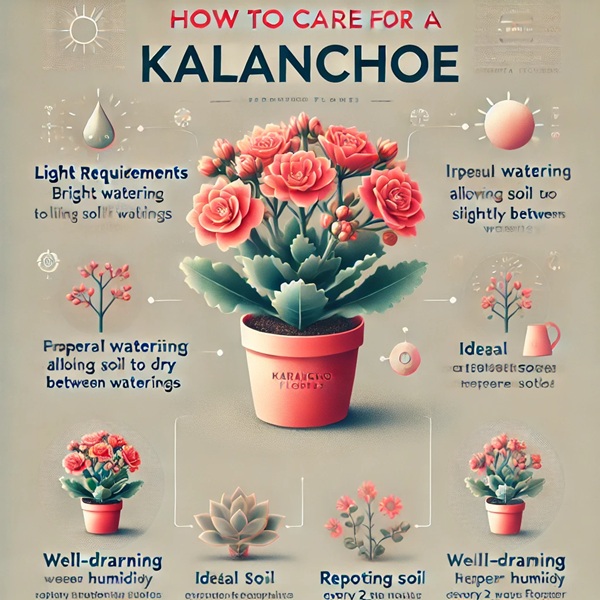
Kalanchoe is one of the most popular houseplants, valued for its decorative appeal, medicinal properties, and low-maintenance nature. It can delight you for a long time with its bright flowers and succulent green leaves, but to achieve this, it is important to follow the basic rules of care. Although kalanchoe belongs to succulents and is able to store moisture, it still needs proper watering, suitable lighting, timely feeding, and repotting. In this article, we will take a detailed look at how to care for kalanchoe correctly so that it stays healthy and blooms regularly.
Kalanchoe is a light-loving plant, and proper lighting has a major effect on its growth and flowering.
The best place is on south-, southeast-, or southwest-facing windows, where there is enough sunlight.
If the plant stands on a north-facing window, it may lack light, which will lead to stretched stems and weaker flowering.
In winter, when natural light is reduced, kalanchoe may need additional lighting with grow lamps.
Kalanchoe tolerates bright sun well, but in the summer heat, especially at midday, it should be shaded to prevent leaf burns.
In spring and summer, the comfortable temperature for kalanchoe is +20 to +26°C.
In autumn and winter, the temperature should be +12 to +16°C — this helps the plant set buds for future flowering.
Sudden temperature changes and drafts are harmful to kalanchoe, especially during the cold season.
If the plant gets enough light and the temperature regime is maintained properly, it will grow actively and bloom regularly.
Like all succulents, kalanchoe does not need frequent watering, since its leaves can store moisture. However, letting the soil dry out completely can weaken the plant.
In spring and summer, watering is done once every 7–10 days, allowing the soil to dry out completely between waterings.
In autumn and winter, watering is reduced to once every 2–3 weeks, especially if the plant is kept in cool conditions.
It is important to water only at the root, avoiding water on the leaves and stems.
Soft, settled water at room temperature.
Hard water with lime deposits can cause the leaves to turn yellow.
Kalanchoe does not require high air humidity, so it does not need misting. However, if the air in the room is very dry, you can wipe the leaves with a damp cloth to remove dust.
If you follow a moderate watering routine, kalanchoe will remain strong, healthy, and resistant to disease.
Kalanchoe needs a loose, well-drained substrate that does not retain excess moisture.
Leaf and turf soil — 50%.
Sand or perlite — 30% to provide drainage and air permeability.
Peat — 20% to help retain nutrients.
You can also use ready-made soil for succulents, adding a little sand or perlite to improve the structure.
Young plants are repotted once a year, since they grow quickly.
Mature plants are repotted once every 2–3 years, when the roots become crowded.
Choose a pot with drainage holes, 2–3 cm larger than the previous one.
Place a drainage layer at the bottom, such as expanded clay, pebbles, or pieces of charcoal.
Carefully remove the plant, shake off the old soil, and remove any damaged roots.
Plant the kalanchoe in the new pot, fill it with fresh soil, and lightly firm it.
Water it 3–4 days after repotting so the roots have time to adapt.
After repotting, it is especially important to control watering, since newly transplanted plants are particularly sensitive to excess moisture.
Kalanchoe needs regular fertilizing, especially during the period of active growth and flowering.
In spring and summer, fertilizers are applied once every 2 weeks.
In autumn, feeding is reduced as the plant is prepared for its dormant period.
In winter, fertilizers are not used, since the plant is resting.
For flowering kalanchoe, fertilizers with phosphorus and potassium are used to stimulate blooming.
For decorative foliage varieties, fertilizers with nitrogen are suitable, as they promote green growth.
Maintain a regime of 12–14 hours of darkness for a month before flowering.
Provide a dry and cool dormant period in winter.
Remove faded flower clusters so the plant can direct its energy toward new buds.
Kalanchoe is a wonderful and undemanding plant that, with proper care, can bloom several times a year. Sufficient lighting, moderate watering, timely feeding, and repotting will help create ideal conditions for its growth. If you follow the basic recommendations, kalanchoe will become a beautiful part of your home, delighting you with bright flowers and succulent leaves for many years.