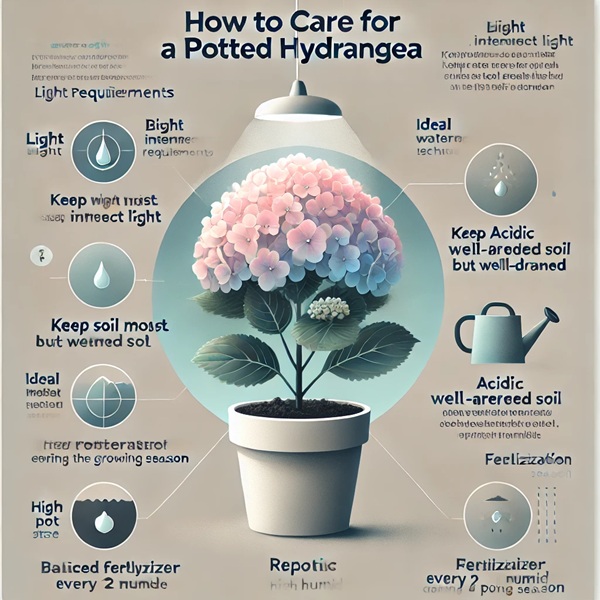
Hydrangea is a wonderful flowering plant that can be grown successfully not only in the garden, but also in a pot. Its lush flower heads and rich green leaves make it a true decoration for any interior or balcony. However, for potted hydrangea to delight you with its blooms for many years, certain care conditions must be followed. This plant needs proper watering, optimal lighting, suitable soil, and timely feeding. In this article, we will look at all the nuances of growing hydrangea in a pot so that it remains healthy and blooms for a long time.
Hydrangea is a light-loving plant, but direct sunlight can damage its delicate petals and leaves. The best place for indoor growing is a bright windowsill with diffused light. An east-facing or west-facing side is ideal, where the plant receives enough light while remaining protected from the scorching midday sun.
If the pot with hydrangea is placed on a south-facing window, it is recommended to shade it with light curtains or blinds. In winter, when natural light becomes weaker, grow lights can be used to extend the daylight period.
Temperature also plays an important role. The optimal temperature for hydrangea’s growth and flowering is +18 to +22°C. In summer, the plant can be taken out onto a balcony or terrace, but it is important to avoid sudden temperature changes and drafts.
In winter, during the dormant period, the temperature should be lower, around +5 to +10°C. This is necessary so that the hydrangea can set flower buds for the next season. If the plant spends the winter indoors with central heating, it should be kept as cool as possible by placing it in the coolest part of the room.
Hydrangea is a moisture-loving plant, and regular watering is the key to its healthy development. However, excessive moisture can cause root rot, so it is important to maintain the right balance.
In spring and summer, hydrangea is watered 2–3 times a week, depending on the condition of the soil.
In autumn, watering is reduced to once a week to prepare the plant for dormancy.
In winter, if the plant is kept in a cool room, it is watered no more than once every 10–14 days.
It is important to use soft, settled water at room temperature. Hard water with a high lime content can change the soil’s acidity, which negatively affects the condition of the hydrangea.
In addition to watering, high air humidity should be maintained, since dry air can lead to yellowing and drying of the leaves. To do this, you can:
Mist the leaves with soft water, avoiding the flowers.
Place containers of water nearby to humidify the air.
Use a humidifier in the room.
If the air is too dry, especially during the heating season, the leaf edges may begin to dry out, and blooming will become shorter.
Hydrangea prefers acidic soil with good air permeability. Ordinary garden soil is not suitable, since it can retain moisture and lose acidity.
High-moor peat — 40% to provide the necessary acidity.
Leaf soil — 30% to enrich the substrate with nutrients.
Perlite or sand — 20% to improve drainage and prevent water stagnation.
Pine litter — 10% to add natural acidity.
Hydrangea is repotted once every 2–3 years, since over time the substrate becomes depleted and loses its beneficial properties.
Choose a pot 2–3 cm larger in diameter than the previous one.
Place drainage at the bottom, such as expanded clay, pebbles, or pieces of brick.
Carefully remove the plant, trying not to damage the roots.
Transfer the hydrangea into the new pot, adding fresh substrate.
Water moderately so the soil can settle.
After repotting, it is important to monitor watering carefully, since newly repotted plants are especially sensitive to moisture levels.
Hydrangea needs regular fertilizing, especially during the period of active growth. Feeding helps the plant form lush flower heads and maintain the rich color of its leaves.
In spring and summer, fertilizers are applied once every 10–14 days.
In autumn, feeding is reduced as the plant is prepared for winter.
In winter, fertilizers are not used, since the plant is dormant.
To prolong blooming, organic fertilizers such as humus infusion can be used, but it is important not to overfeed the plant.
Even with proper care, hydrangea may face various problems.
Leaves begin to turn yellow — possible causes: iron deficiency, overwatered soil, or lack of oxygen around the roots.
Solution: apply iron chelate, reduce watering, and loosen the top layer of soil.
Hydrangea does not bloom — possible causes: improper overwintering, phosphorus deficiency, or a pot that is too large.
Solution: provide cool winter conditions, use phosphorus-rich fertilizers, and move the plant into a smaller pot.
Leaf edges dry out — a sign of low air humidity.
Solution: mist the plant regularly and use a humidifier.
White coating on the leaves — may indicate powdery mildew.
Solution: treat with a fungicide and remove the affected leaves.
Growing hydrangea in a pot requires attention and proper care. Following the watering schedule, maintaining air humidity, feeding on time, and choosing the right soil will help create ideal conditions for its growth. If you follow all these recommendations, hydrangea will bloom abundantly and for a long time, becoming a true decoration of your home or balcony.