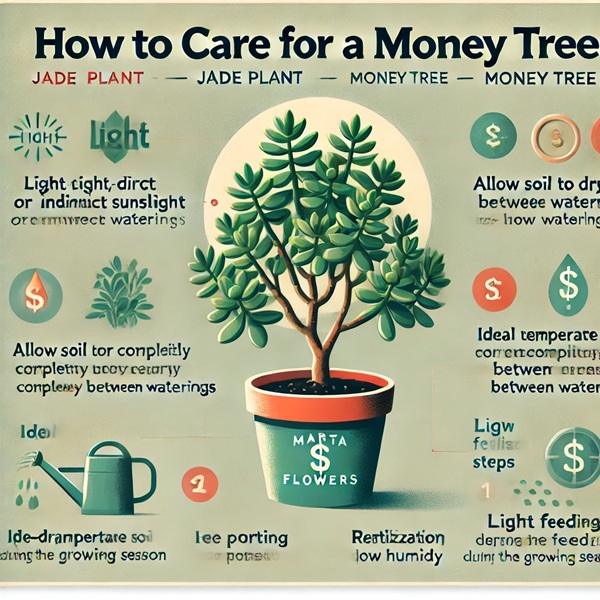
The money tree, or Crassula, is one of the most popular houseplants. It attracts attention with its decorative appearance, low-maintenance nature, and ability to store moisture in its thick leaves. According to folk beliefs, this plant brings financial well-being into the home if it is cared for properly. However, despite its hardiness, the money tree still needs certain conditions to stay healthy and grow actively. In this article, we will look at all aspects of caring for crassula so that it can delight you with its lush appearance and long life.
The money tree comes from South Africa, so its natural environment is dry and sunny regions. This means the plant loves bright light and tolerates direct sunlight well.
In summer, a pot with crassula can be placed on south-facing, southeast-facing, or southwest-facing windows, where there is plenty of light.
If the plant stands on the north side, it may not get enough light, which will lead to stretched stems and weakened leaves. In that case, grow lights can be used.
In winter, the money tree needs at least 6–8 hours of bright light a day. If natural light is not enough, it is worth arranging additional artificial lighting.
Temperature conditions also play an important role in the development of crassula.
In spring and summer, the optimal temperature is 20 to 27°C.
In autumn and winter, it is 10 to 15°C.
In winter, the money tree enters a dormant period, and if the room temperature rises above 18°C, this can weaken the plant. For that reason, during the cold season it is recommended to keep it in a cooler place, for example on a glazed balcony.
It is important to avoid sudden temperature changes and drafts, since they can cause the leaves to drop.
The money tree is a succulent, which means it can store moisture in its leaves and does not need frequent watering. The most common mistake many growers make is overwatering, which can lead to root rot.
In summer, it is watered once every 7–10 days, making sure the soil dries out completely between waterings.
In autumn and spring, watering is reduced to once every 2 weeks.
In winter, when the plant is dormant, once every 3–4 weeks is enough.
For watering, it is better to use soft, settled water at room temperature. It is important not to overwater the plant — if the soil stays moist for more than three days, the watering is too frequent.
Crassula does not require high air humidity, so it does not need misting. However, you can occasionally wipe the leaves with a damp cloth to remove dust and improve the plant’s breathing.
If the air in the room is too dry, for example during the heating season, you can place a container of water near the plant to increase humidity.
For the money tree, light and well-drained soil is essential, since stagnant moisture can cause the roots to rot.
Leaf and turf soil — 50%.
Sand or perlite — 30%.
Peat or charcoal — 20%.
You can also use ready-made soil for succulents and cacti, adding a little sand to improve air permeability.
The money tree is repotted:
Young plants — once every 1–2 years, since they grow actively.
Mature plants — once every 3–4 years, when the roots become cramped in the pot.
Choose a wide, shallow pot with good drainage holes.
Place a drainage layer at the bottom, such as expanded clay, pebbles, or broken brick.
Carefully remove the plant, trying not to damage the roots.
Transfer the crassula into the new pot and fill it with fresh soil.
Water it 3–4 days after repotting to give the roots time to adapt.
After repotting, the plant may need some time to adjust to the new conditions. During this period, it is important to avoid overwatering and keep it in a warm place.
The money tree does not require frequent feeding, but fertilizers are still necessary for active growth and a beautiful crown.
Apply fertilizer once a month from March to September.
Use special fertilizers for cacti and succulents.
In autumn and winter, feeding is stopped because the plant enters its resting phase.
To form a beautiful and lush crown, the tops of young shoots should be pinched. This stimulates the growth of side branches and makes the crown denser.
When the plant reaches a height of 10–15 cm, pinch off the top bud.
If long, weak shoots appear, they can be trimmed carefully.
Remove old and dried leaves to improve air circulation.
Regular pruning helps create a beautiful rounded crown shape and prevents the plant from becoming leggy.
Despite its hardiness, the money tree can face various problems:
Leaves are falling off — possible causes: drafts, sudden temperature changes, excess moisture.
Solution: normalize watering and avoid cold air currents.
Leaves become soft and wrinkled — lack of moisture.
Solution: check the condition of the soil and increase watering.
The money tree is stretching upward — lack of light.
Solution: move the plant to a brighter place or use a grow light.
The roots begin to rot — a sign of overwatering.
Solution: repot the plant into dry soil and reduce watering.
If problems are addressed in time, crassula will grow healthy and continue to delight with its decorative appearance.
The money tree is an undemanding and beautiful plant that is easy to grow even for beginners. With proper care, it will delight you for many years. Follow the basic rules of lighting, watering, repotting, and crown formation, and your crassula will become a true decoration of your home, bringing comfort and well-being.