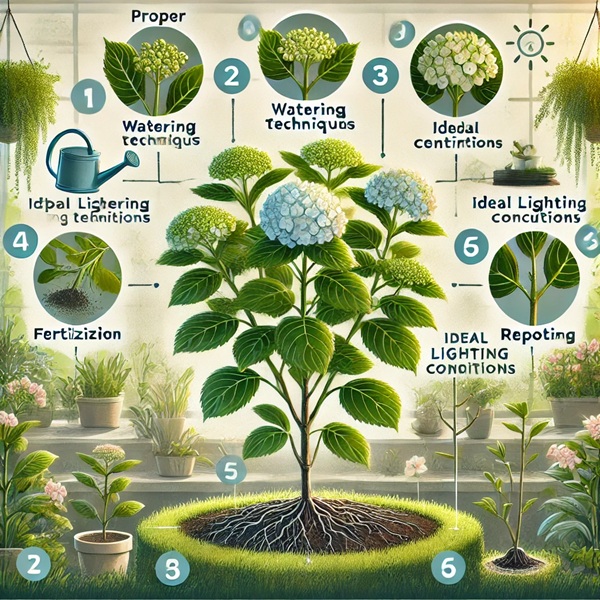
Hydrangea is one of the most spectacular ornamental plants, admired for its lush and long-lasting blooms. Its large flower clusters, presented in a wide range of shades, can become the main украшение of any garden or home. However, for hydrangea to stay healthy and delight the grower with its flowering for many years, it is important to care for it properly. In this article, we will look at the main aspects of hydrangea care, from choosing the right location and planting to watering, feeding, pruning, propagation, and preparing it for winter.
Before planting hydrangea, it is necessary to choose a suitable variety, since different types have their own growing characteristics. The main varieties of hydrangea are:
Bigleaf hydrangea — the most popular and striking type, with bright flowers whose color depends on the acidity of the soil.
Panicle hydrangea — cold-hardy and distinguished by its elongated flower clusters.
Tree hydrangea — a large shrub with white or cream-colored flower clusters that tolerates pruning well.
Climbing hydrangea — a vine-like plant used for vertical landscaping.
The place for planting hydrangea should be bright but protected from direct sunlight. Shrubs feel best in partial shade, especially in regions with hot summers. Direct sun can cause leaf scorch, while deep shade can reduce the intensity of flowering.
The soil should be fertile, moist, and acidic or slightly acidic, with a pH of 5.5–6.5. Alkaline soils are not suitable for hydrangeas, since in such conditions the plants cannot absorb iron properly, which leads to chlorosis. To acidify the soil, peat, pine litter, or special additives can be used.
Hydrangea is planted in spring or autumn. A hole measuring 50 × 50 cm is dug, a drainage layer of crushed stone or expanded clay is placed at the bottom, and then it is filled with a mixture of humus, peat, and garden soil. After planting, the shrub is watered generously and mulched with bark or sawdust to retain moisture.
Hydrangea is a moisture-loving plant, and regular watering is essential for lush blooming. A lack of moisture can lead to wilting leaves and smaller flower clusters. Shrubs should be watered once or twice a week, depending on weather conditions. During dry periods, watering is increased, while in rainy weather it is reduced.
It is best to use soft, settled water. In regions with hard water, it can be acidified by adding citric acid or vinegar, using 1 teaspoon per 10 liters of water. Watering should be done at the root, avoiding water on the leaves and flowers in order to prevent fungal diseases.
Feeding encourages active growth and abundant flowering. The following fertilizing schedule is used:
In spring — nitrogen fertilizers such as urea or ammonium nitrate to stimulate growth.
During bud formation — compound fertilizers with phosphorus and potassium.
In mid-summer — potassium fertilizers to support flowering.
In autumn — phosphorus fertilizers to strengthen the root system before winter.
Organic fertilizers such as humus and compost are applied once a season in the form of mulch, which improves soil structure and helps keep it acidic.
Pruning hydrangea depends on the type. Bigleaf hydrangea is pruned only lightly, since it forms flower buds on last year’s shoots. In autumn, only faded flower clusters and weak branches are removed, while in spring damaged or frostbitten shoots are cut away.
Panicle and tree hydrangeas can be pruned more heavily, since they bloom on the current year’s shoots. In spring, the shrubs are shortened, leaving 3–5 buds on each shoot, which stimulates the growth of strong new branches and the formation of large flower clusters.
Climbing hydrangea is hardly pruned at all, with only dry and damaged branches removed.
During the season, sanitary pruning is carried out by removing weak and diseased shoots, as well as old branches that interfere with the growth of younger ones.
Hydrangea can be propagated in several ways: by cuttings, layering, dividing the shrub, and by seed.
Cuttings are the simplest and most popular method. In summer, young shoots 10–15 cm long are cut, the lower leaves are removed, and they are rooted in a moist peat-based substrate. After 3–4 weeks, the cuttings develop roots and can then be transplanted into open ground.
Propagation by layering is done in spring or summer by bending a lower branch to the ground, fixing it in place, and covering it with soil. After a few months, roots form at the contact point, and the young shrub can be separated from the parent plant.
Dividing the shrub is done when transplanting old plants. The shrub is dug up and divided into several parts, making sure that each part has roots and buds, and then planted in prepared holes.
Growing from seed is the slowest method, since seedlings bloom only after several years. It is used mainly for rare species.
Hydrangea requires proper preparation for winter, especially in regions with a cold climate. In autumn, feeding is stopped, watering is reduced, and the base of the shrub is mulched with peat or humus.
Bigleaf hydrangea is covered with agrofabric or spruce branches, and in colder regions it is additionally covered with fallen leaves. Tree and panicle hydrangeas usually overwinter well without cover, but young shrubs are better protected from frost.
Hydrangea is an amazing plant that, with proper care, can delight you with its lush blooming for many years. Following recommendations for watering, feeding, pruning, and winter protection will help you grow healthy and strong shrubs that will become a true decoration of your garden or home.