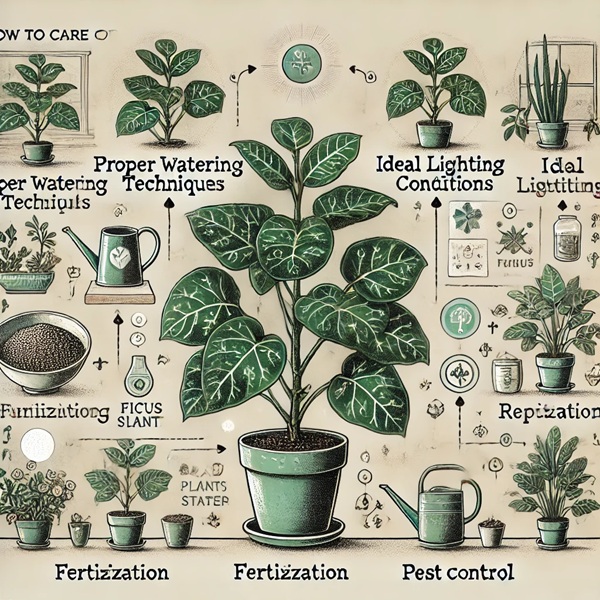
Ficus is one of the most popular houseplants, valued for its декоративність, low-maintenance nature, and ability to purify the air. The variety of species and forms makes it possible to choose a plant that suits any interior, from small bushy varieties to majestic tree-like forms. Despite its hardiness, ficus still requires proper care, including choosing the right location, timely watering, feeding, pruning, and repotting. In this article, we will look at all the nuances of ficus care so it can delight you with a healthy appearance and lush greenery for many years.
Ficus is a light-loving plant, but its needs depend on the specific type. For example, Ficus benjamina feels best in bright, diffused light, while the rubber plant can grow even in partial shade. Variegated varieties need more sunlight; otherwise, their leaves may lose their decorative coloring.
The best place for a ficus is an east-facing or west-facing window, where it gets enough light but is protected from direct sun, which can cause leaf burns. If the ficus is placed on a south-facing windowsill, it should be shaded during the hottest hours. In winter, when natural light decreases, grow lights can be used to make up for the shortage.
The plant does not tolerate sudden relocation well. Once you have found a good spot for it, it is better not to move it unnecessarily, since this can cause leaf drop and slower growth. Ficus is also sensitive to drafts, so it should not be placed near an open window or an air conditioner.
The temperature should remain stable. The optimal temperature for ficus is 20 to 26°C in the warm season and not below 16°C in winter. Sudden drops in temperature may cause the plant to shed its leaves, while prolonged chilling can damage the root system.
Watering is an important part of ficus care, but overwatering can lead to root rot. The ideal schedule depends on the season and growing conditions. In summer, ficus is watered once or twice a week, while in winter it is watered once every 10–14 days. It is important to pay attention not only to the schedule but also to the condition of the soil: the top layer should dry out well before the next watering.
For watering, it is best to use soft, settled water at room temperature. Cold or overly hard water can cause yellowing and leaf drop. The plant should be watered carefully, without allowing water to stagnate in the saucer. If water remains there 20–30 minutes after watering, it should be poured off.
Ficuses like increased air humidity, especially tropical species such as the fiddle-leaf fig or Ficus benjamina. During the heating season, when the air becomes dry, it is recommended to mist the leaves with warm water 2–3 times a week. It is also helpful to wipe the leaves with a damp cloth to remove dust and improve photosynthesis.
To maintain proper humidity, you can place a container of water near the plant or use a humidifier. This is especially useful in winter, when indoor heating dries out the air.
Ficuses need regular feeding, especially during the active growth period, from spring to autumn. A lack of nutrients can lead to slower growth, weaker leaves, and loss of decorative appeal.
For feeding ficus, use compound mineral fertilizers with a high content of nitrogen, phosphorus, and potassium. Nitrogen promotes active leaf growth, phosphorus strengthens the root system, and potassium improves the plant’s resistance to stress.
From March to September, fertilizers are applied once every 2–3 weeks.
In autumn, feeding is reduced to once a month.
In winter, fertilizers are not applied if the plant is in a dormant state.
You can use liquid fertilizers diluted in water according to the instructions, or granular fertilizers that dissolve gradually in the soil. Organic fertilizers such as wood ash infusion or humus are also suitable, but they should be used carefully so as not to oversaturate the soil.
Ficus needs repotting as the root system expands. Young plants are repotted every year, while mature ones are repotted once every 2–3 years. If roots begin to emerge through the drainage holes or the plant slows its growth, this means the pot has become too small and it is time to repot.
For repotting, choose a pot 2–3 cm larger than the previous one. Containers that are too large are not suitable, since the soil in them stays moist for longer, which can lead to root rot.
The best substrate for ficus is light and loose, with good air and water permeability. You can use a ready-made potting mix for ficus or prepare your own by mixing leaf soil, peat, sand, and humus in equal proportions.
Pruning helps maintain the plant’s decorative shape and stimulates the growth of new shoots. In spring, the tops of young plants can be pinched to encourage branching. Old and damaged leaves are removed as needed.
Ficus can be propagated in several ways: cuttings, air layering, and seeds.
Cuttings are the simplest and fastest method. In spring or summer, a top cutting 10–15 cm long is cut, the lower leaves are removed, and it is placed in water or moist soil until roots form.
Air layering is used for propagating mature plants. A small cut is made in the trunk, wrapped in moist moss, and covered with film. After a few weeks, roots appear, and the layered section can then be separated and planted in a pot.
Ficus is a versatile plant that, with proper care, will delight you with its greenery for many years. By following the basic rules of care, you can grow a healthy and strong plant that will become a beautiful addition to any interior.