Cyclamen is an elegant houseplant that draws attention with its delicate flowers and decorative foliage. Its unique ability to bloom during the cold season makes it especially valued among flower growers. Despite its demanding nature, with proper care cyclamen will reward you with lush blooms year after year. In this article, we will take a detailed look at all the nuances of cyclamen care, from planting and watering to propagation and dealing with possible problems.
Before buying a cyclamen, it is important to decide which type suits you best. In indoor floriculture, two types are most commonly grown: Persian cyclamen and European cyclamen.
Persian cyclamen is the most widespread and is distinguished by its large flowers in a variety of shades. It blooms in autumn and winter, then enters a dormant stage in spring. European cyclamen (Alpine violet) has smaller flowers, but it is known for its long flowering period and the absence of a strongly pronounced dormancy period.
Choosing the right pot for cyclamen plays an important role in its health. The best option is a ceramic or plastic pot with drainage holes. The size of the container should allow about 2 cm of space between the tuber and the sides of the pot. In a pot that is too large, the plant will direct its energy into root growth rather than flowering, while in one that is too tight, it will quickly become exhausted.
The soil for cyclamen should be light, loose, and breathable. You can use a ready-made substrate for violets or prepare a mix yourself by combining leaf soil, peat, sand, and perlite in equal proportions. Good drainage is essential, so a layer of expanded clay or fine gravel is placed at the bottom of the pot.
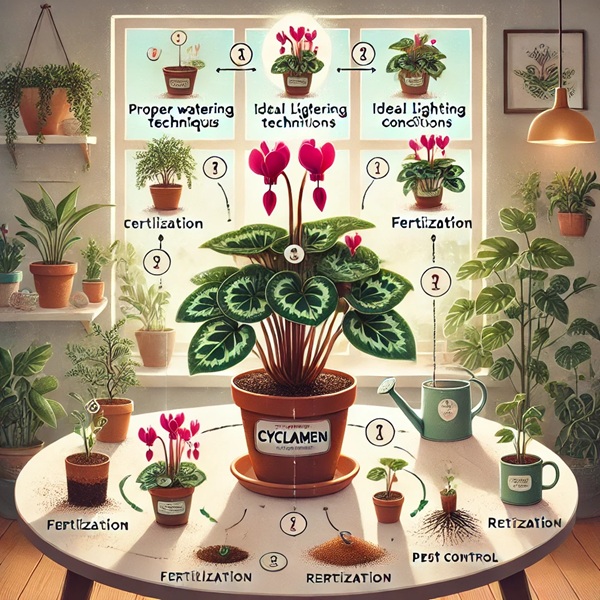
Cyclamen needs bright but diffused light. The best place for it is a windowsill on an east-facing or west-facing window. If the plant stands on a south-facing window, it should be shaded to avoid leaf scorch. Insufficient lighting leads to stretched flower stalks and a weakened plant.
Temperature is one of the key factors in successfully growing cyclamen. This plant prefers cool conditions. The optimal temperature for flowering is 15–18°C. If the temperature rises above 20°C, the plant may stop growing and enter dormancy too early.
In summer, when the air temperature becomes high, cyclamen is best kept in a cool place, for example on a glazed balcony or in a cool room. During the heating season, it is important to make sure that hot air from radiators does not dry the plant out. You can place the pot on a tray with moist pebbles or use a humidifier.
Watering cyclamen requires special attention, since excess moisture can lead to tuber rot, while lack of water causes the leaves to wilt. The best watering method is bottom watering, when water is poured into the saucer and any excess is drained off after 15–20 minutes. This method helps prevent moisture from getting onto the tuber and leaves, reducing the risk of fungal diseases.
Watering is done with soft, settled water at room temperature. During the period of active growth and flowering, cyclamen should be watered regularly, keeping the soil moderately moist. After flowering ends, watering is reduced, and during the dormant period it is kept to a minimum, without allowing the soil to dry out completely.
Cyclamen likes high air humidity. To maintain the right level, you can place a tray with moist moss or expanded clay near the plant. Spraying the leaves is not recommended, since water droplets may cause spotting. Instead, you can humidify the air around the plant with a spray bottle.
Feeding is necessary to support cyclamen’s health and abundant flowering. During active growth and flowering, the plant is fed once every two weeks with liquid fertilizer for flowering plants that contains phosphorus and potassium. Nitrogen fertilizers should be used carefully, since too much nitrogen encourages leaf growth at the expense of flowering.
After flowering ends, feeding is reduced, and during the dormant period it is stopped completely. In spring, when the plant wakes up, fertilizers with minimal nitrogen content can be introduced, gradually increasing their concentration.
Repotting is carried out once every 1–2 years before the start of active growth. During repotting, it is important not to bury the tuber completely — its upper third should remain above the soil surface. After repotting, watering should be done carefully, gradually increasing its frequency.
Cyclamen can be propagated by seed and by dividing the tuber.
Propagation by seed is a lengthy process, but with proper care it is possible to obtain strong plants. The seeds are sown in light soil, lightly covered with earth, and covered with film to maintain humidity. The first seedlings appear in 1–2 months, after which they are pricked out and gradually accustomed to open air.
Division of the tuber is used less often, since this method is more traumatic for the plant. For propagation, a healthy tuber is chosen and cut into parts so that each one has a growing point, then the cut surfaces are dusted with charcoal. The pieces are then planted in separate pots and cared for like mature plants.
Cyclamen may suffer from certain diseases, most often caused by improper care. Tuber rot occurs because of excessive watering and stagnant moisture in the soil. The affected areas are removed, the cuts are treated with a fungicide, and the plant is transplanted into fresh substrate.
Among pests, cyclamen is most often affected by spider mites and thrips. These insects cause leaf curling and slowed growth. To control them, insecticides are used, and the air humidity is increased, which makes it harder for the pests to reproduce.
Cyclamen is a plant that requires careful attention, but if all recommendations are followed, it will reward you with refined blooms even in the coldest months of the year. By following the basic rules of lighting, watering, feeding, and temperature control, you can grow a healthy and strong plant that will decorate your home for many years.