Dracaena is one of the most popular houseplants, valued for its low-maintenance nature and decorative appearance. Its long, narrow leaves and elegant trunk add sophistication to an interior, while its ability to purify the air makes it an excellent choice for homes and offices. However, despite its resilience, dracaena still requires proper care, including correct watering, suitable lighting, regular feeding, and timely repotting. In this article, we will take a detailed look at all the nuances of caring for this wonderful plant so that it stays healthy and brings you joy for many years.
Dracaena is a plant of tropical and subtropical climates, so its natural environment involves moderate light and a stable temperature. It is important to choose the right place for it in the home to avoid growth problems.
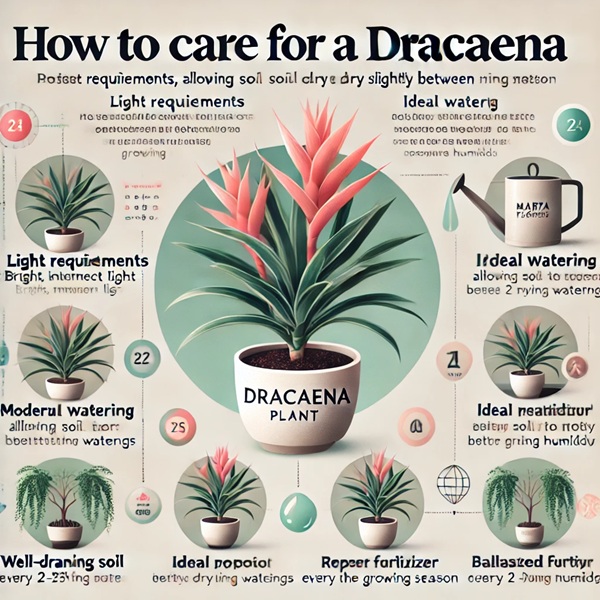
Dracaena likes bright but diffused light. Direct sunlight can cause leaf burns, so it is best placed on east-facing or west-facing windows.
If dracaena stands on a south-facing window, it should be shaded with curtains or placed a little farther from the glass.
In winter, daylight hours become shorter, and if natural light is not enough, grow lights can be used for additional illumination.
With insufficient light, dracaena may slow its growth, and its leaves may begin to lose their rich color.
In spring and summer, dracaena prefers temperatures of +20 to +25°C.
In autumn and winter, the temperature should not fall below +15°C, since cold can cause the roots to rot.
It is important to avoid sudden temperature changes and drafts, as they negatively affect the plant’s condition.
If you create optimal lighting and temperature conditions for dracaena, it will grow actively and look healthy.
Proper watering is one of the most important aspects of dracaena care. It does not like either excessive moisture or overly dry soil.
In summer, dracaena needs watering 2–3 times a week, especially on hot days.
In autumn and spring, watering is reduced to once every 7–10 days.
In winter, the plant should be watered once every 2 weeks to avoid root rot.
Before watering, it is important to check the soil: if the top 2–3 cm have dried out, it is time to moisten the plant.
It is best to use settled or filtered water at room temperature.
Hard water containing chlorine can cause yellowing of the leaves, so it should be purified beforehand.
Dracaena feels comfortable at a humidity level of 50–60%.
During the heating season, indoor air becomes dry, so the plant can be misted 2–3 times a week.
It is also helpful to wipe the leaves periodically with a damp cloth to remove dust and improve the plant’s breathing.
By following the correct watering and humidity routine, dracaena will remain healthy and continue to grow actively.
Dracaena needs a light, well-drained substrate that gives the roots access to oxygen and prevents water from stagnating.
The optimal soil composition is:
Turf and leaf soil — 50%
Peat — 30%
Perlite or sand — 20%
You can also use ready-made soil for palms or dracaenas, adding a small amount of sand to improve drainage.
Young plants are repotted once every 2 years, since their root system develops actively.
Mature plants are repotted once every 3–4 years, if the roots have filled the whole pot.
The new pot should be 2–3 cm larger in diameter than the previous one, but not too spacious, to avoid water stagnation.
Carefully remove the plant from the old pot, trying not to damage the roots.
Clean the root system of old soil, removing any dry or rotten roots.
Add a drainage layer of expanded clay, pebbles, or pieces of charcoal.
Plant the dracaena in the new substrate, lightly firming the soil around the roots.
Water the plant 2–3 days after repotting so the roots have time to adapt.
With proper repotting, dracaena will establish quickly and continue to grow actively.
Dracaena needs regular feeding, especially during the active growing period from spring to autumn.
Feed the plant once every 2 weeks from March to September.
Use liquid fertilizers for decorative foliage plants.
It is important to choose formulas containing nitrogen, phosphorus, potassium, and trace elements such as iron and magnesium.
In winter, feeding is stopped because the plant enters a resting phase.
If dracaena has become too stretched out, the top can be cut off to stimulate the growth of side shoots.
Pruning is done in spring or summer using a sharp, sterile knife.
After pruning, dracaena will begin producing new shoots and become fuller.
Sometimes problems arise while caring for dracaena.
Leaves turn yellow and dry out — causes: dry air, lack of moisture, or lack of nutrients.
Solution: increase humidity, adjust watering, and apply fertilizer.
Leaves are falling off — causes: drafts, cold air, or overly frequent watering.
Solution: protect the plant from drafts and reduce watering.
Roots are rotting — causes: overwatering and lack of drainage.
Solution: repot the plant into fresh substrate and reduce watering frequency.
Dracaena is a beautiful and undemanding plant that, with proper care, becomes a true decoration of the home. Sufficient light, moderate watering, timely feeding, and repotting will help the plant stay healthy and strong. By following the basic recommendations, you will be able to enjoy its beauty for many years.