Aloe is one of the most popular houseplants, valued not only for its low-maintenance nature but also for its beneficial properties. It is well known for its healing qualities and is widely used in cosmetology, medicine, and home skin care. However, despite its resilience, aloe still needs certain conditions for proper growth and development. If the basic rules of care are not followed, the plant may slow its growth, lose its decorative appeal, or even die. In this article, we will look at all the key aspects of aloe care, including lighting, watering, temperature conditions, repotting, feeding, and solving possible problems.
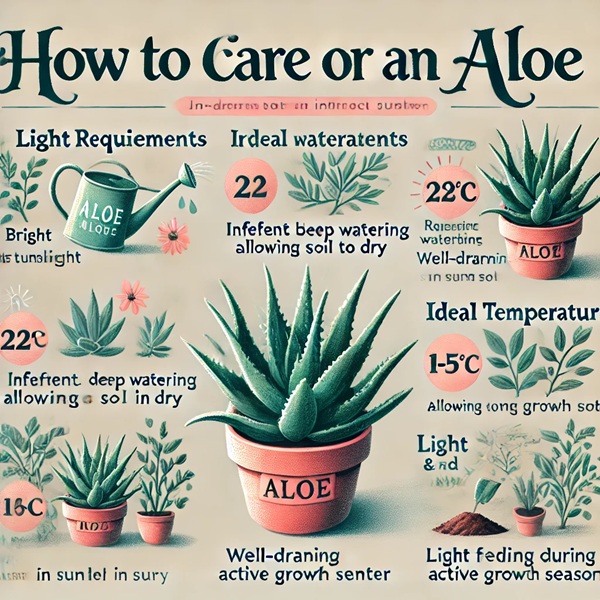
Aloe is a light-loving plant that naturally grows in dry regions, in open areas with intense sunlight. That is why, when grown indoors, it is important to provide it with as much light as possible.
Aloe does best on south-facing, southeast-facing, or southwest-facing windows. If it is not possible to place the plant in such a spot, additional lighting with grow lamps can be used. This is especially important in winter, when daylight hours are shorter. A lack of light leads to stem stretching and weakened leaves.
Temperature conditions also play an important role. In summer, aloe is comfortable at 22–28°C, and in winter at 10–15°C. During its dormant period, which usually begins in winter, it is best to keep the plant cooler by moving it to a less heated room. However, the temperature should not fall below 5°C, since cold can damage the root system.
It is worth avoiding sudden temperature changes and drafts, since they can weaken the plant and make it more vulnerable to disease. In summer, aloe can be moved to a balcony or garden, but care should be taken to protect it from cold wind and heavy rain.
Aloe is a succulent that can store moisture in its leaves, so it does not need frequent watering. One of the most common mistakes in caring for this plant is overwatering the soil, which can lead to root rot.
In summer, aloe is watered once every 7–10 days, depending on the air temperature and humidity in the room.
In winter, watering is reduced to once every 3–4 weeks, since the plant enters a dormant state.
Water only when the top layer of soil has dried out completely. This can be checked by inserting a finger about 3–4 cm into the soil. If the soil is dry, it is time to water.
Watering should be moderate. It is best to use soft, settled, or filtered water at room temperature. At the same time, stagnant water must not be allowed to remain in the saucer — any excess should be drained after watering.
Air humidity is not a critical factor for aloe. It tolerates dry air very well, so additional humidification is not necessary. However, if the air in the room is very dry, the leaves can occasionally be misted with warm water, but this should be done rarely and only in hot weather.
Aloe needs a light, loose, and well-drained substrate that allows water to drain quickly and does not retain moisture around the roots. Ordinary garden soil is not suitable, since it is too heavy and poorly aerated.
Leaf soil and turf soil in equal parts.
River sand, about 30% of the total volume.
Peat, to improve air permeability.
Charcoal or crushed brick, to protect against root rot.
You can also use ready-made soil for succulents and cacti sold in flower shops.
Repotting is done once every 2–3 years, depending on the condition of the plant. Young specimens are repotted more often — every 1–2 years — since they grow actively and quickly fill the entire pot.
The pot for aloe should be wide but shallow, with mandatory drainage holes. It is important not to bury the growing point, so as to avoid rotting.
Aloe does not require frequent fertilizing, but during the active growth period, from spring to autumn, it can be fed once a month.
For this, specialized fertilizers for succulents and cacti are used, containing a minimal amount of nitrogen, since too much nitrogen can cause root rot.
Fertilizer is applied only after watering, so the roots are not burned. In winter, fertilizers are not used because the plant is dormant.
If aloe has not produced new leaves for a long time, its growth can be stimulated by repotting it into fresh substrate and providing brighter light.
Even with proper care, the plant may sometimes encounter different problems.
Leaves become soft and limp — possible cause: overwatering.
Reduce watering and repot the plant into fresh substrate if the roots have started to rot.
Leaves stretch out and lose firmness — this is the result of insufficient light.
Move the aloe to a brighter place or use a grow lamp.
Yellow spots on the leaves — possible cause: sunburn.
Move the plant to a place with diffused light.
Aloe is not growing — the soil may be depleted or the lighting insufficient.
In this case, repotting and regular feeding will help.
Stem or root rot — a sign of overwatering.
Urgent repotting into new, dry substrate and reduced watering are required.
Following all these recommendations will help avoid most problems and keep the plant healthy.
Aloe is an undemanding plant, but for полноценний growth it is necessary to follow the basic rules of care. Sufficient lighting, moderate watering, proper soil, and timely repotting will help you grow a strong and healthy plant. If you follow these recommendations, aloe will not only decorate your home, but also become a reliable helper in home medicine and skin care.