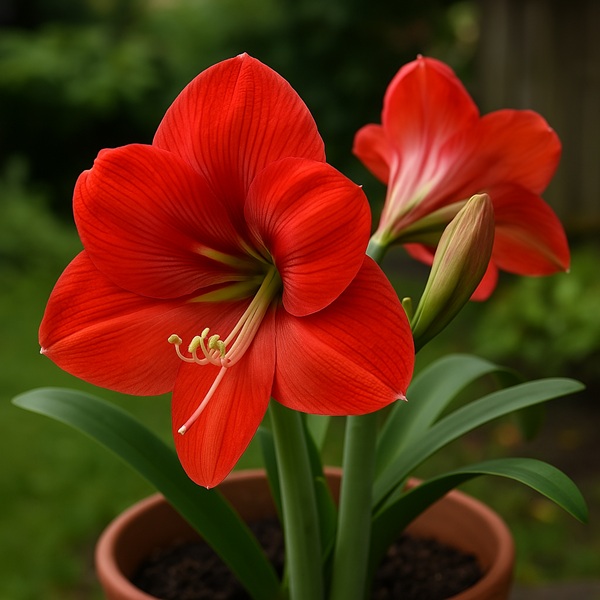
Hippeastrum (Hippeastrum) is a perennial bulbous plant from the amaryllis family, native to the tropical regions of South America. In Ukraine, hippeastrum is usually grown as an indoor plant, although in summer it also does very well outdoors — on balconies, terraces, and sometimes even in the garden. The plant has become especially popular because of its large, striking flowers up to 20 cm in diameter, borne on strong, leafless flower stalks up to 60 cm tall. Its color range is impressive: from white and soft pink to bright red, burgundy, peach, green, and multicolored combinations.
It is important to clearly distinguish hippeastrum from amaryllis — two plants that look similar but are completely different in origin. Amaryllis (native to Africa) blooms in autumn, has fragrant flowers and narrow leaves, and also has a smaller bulb. Hippeastrum, by contrast, usually blooms in winter or spring, has almost no scent, has broader leaves that appear later, and flower stalks that are hollow inside. In Ukraine, the varieties most commonly sold are hybrid hippeastrums specially bred for indoor growing. Popular variety groups include Butterfly, Galaxy, Diamond, and Double.
Choosing planting material is extremely important. The bulb should be firm, dry, and free of signs of rot or mechanical damage. It should feel resilient, with living roots. The ideal diameter is at least 6 cm, and for abundant flowering, 8–10 cm. It is also worth paying attention to the presence of a flower stalk — if it is already sprouting, this means the plant is ready for active growth and will bloom in 4–6 weeks. Hippeastrum can also be grown from offsets — small bulbs that form next to the mother bulb — but they flower only after 2–3 years. Planting material should be bought from reliable sellers, especially if you plan to force it for holidays such as New Year or March 8.
Tip: if you bought a bulb in summer or autumn, do not rush to plant it — let it rest for 1–2 months in a cool, dry place. This improves flowering quality.
Planting hippeastrum is a crucial stage that determines not only rooting success but also when flowering begins. In Ukraine, the plant is most often planted indoors from September to March in order to get flowers in winter or spring. Sometimes so-called forcing is carried out — planting timed to achieve flowering by a specific date. In summer, hippeastrum can be planted outdoors so that the bulb gains mass and forms flower buds for the following season.
Pot requirements:
The pot should be only 2–3 cm wider than the bulb so that the plant does not waste energy on growth but focuses on flowering. The height should be at least 20 cm, since the hippeastrum root system grows vertically downward. A drainage layer of expanded clay or pebbles 3–5 cm thick is essential. Drainage holes are mandatory: stagnant moisture leads to rot.
Soil:
Hippeastrum needs a loose, airy, and nutritious substrate. Ready-made soil for bulbous plants is suitable, or a mix of the following components:
2 parts leaf soil;
1 part humus;
1 part coarse sand or vermiculite.
Planting depth:
The bulb must not be buried completely — at least one-third or even half of its height should remain above the surface. This helps prevent rotting and makes it easier to monitor its condition. After planting, the soil is lightly firmed and watered with warm water. During the first 7–10 days, watering is limited until active flower stalk growth begins. Then the amount of moisture is gradually increased.
Important: do not confuse the flower stalk with a leaf. The flower stalk is thick and rounded, while the leaves are flat and appear later. To speed up growth, keep the pot at +22 to +25 °C in a bright place without direct sunlight.
After planting, the active growing phase begins, during which hippeastrum needs highly balanced care. During this period, the plant not only forms a flower stalk but also stores resources for the future. In Ukraine’s climate, especially in winter and spring, it is extremely important to compensate for the lack of light and maintain the proper temperature.
Lighting:
Hippeastrum likes bright but diffused light. The best location is an east-facing or southwest-facing window. In winter, supplemental lighting with phytolamps is essential. If there is not enough light, the flower stalk becomes stretched and the flowers become smaller. If placed on a south-facing window, the glass should be shaded with tulle at midday.
Watering:
After the flower stalk appears, watering is gradually increased. Water along the edge of the pot, avoiding moisture on the bulb. The water should be settled and at room temperature. During flowering, hippeastrum needs regular moisture, but without overwatering. After flowering ends, the volume of watering is gradually reduced.
Feeding:
Fertilizing begins when buds appear and continues until the end of summer, provided active growth continues. Fertilizers:
before flowering — with a higher phosphorus content;
after flowering — complex fertilizers with an emphasis on potassium and nitrogen.
The interval is every 14 days. After flowering is over, feeding continues for another 1–2 months so the bulb can strengthen. Then, in August–September, fertilizing is stopped so the plant can prepare for its dormant period.
Reminder: never fertilize hippeastrum in dry soil — this can cause root burn. Fertilizers should be applied only after watering.
When hippeastrum finishes flowering, an equally important stage begins — the accumulation of nutrients in the bulb. Many people mistakenly stop watering at once and put the plant away for storage. This is risky: without proper transitional care, the bulb will not store enough resources and may fail to bloom the next season. In Ukraine, where lack of light often persists for a long time after winter, post-flowering care is especially important.
What should be done after flowering:
Immediately after the flowers fade, cut the flower stalk as close to the base as possible. Do not pull it out, so as not to damage the bulb.
Continue keeping the pot in a well-lit place, watering moderately. The leaves continue photosynthesis, which helps store nutrients.
Continue feeding for another 6–8 weeks — first phosphorus-potassium fertilizers, then with less nitrogen.
When the leaves begin to yellow, gradually reduce watering, without cutting the leaves until they have dried completely.
When dormancy begins: under Ukrainian conditions, this is usually August–September. Hippeastrum needs a rest period of at least 2 months. It is during this time that flower buds are formed. Without a полноценный dormant period, the next flowering cycle may either not begin at all or produce weak buds.
Tip: if the leaves do not dry out on their own, stimulate dormancy by limiting watering and moving the pot to a shaded place. In 1–2 weeks, the green mass will gradually dry off.
After the leaves have completely dried, the pot with the plant is moved to a cool, dry, dark place. Ideal storage conditions are +12 to +15 °C, low humidity, and complete darkness. In a private house, this may be a veranda, hallway, or pantry. In an apartment, it may be a wardrobe or the lower shelf of a kitchen cabinet, as far as possible from heating.
The dormant period is not just a pause but a vital phase of development. This is when the plant forms flower buds and prepares for a new season. The duration of dormancy is 8–12 weeks. In Ukraine, it is best provided in autumn — from August to November — so that a new cycle can begin in December–January. Skipping this phase or shortening it often leads to failure to bloom.
What to do during dormancy:
Do not water the plant at all.
Keep it in a dark, cool place.
Check the bulb every few weeks for signs of rot or mold.
Do not apply fertilizers or disturb the roots.
After the dormant period ends, usually in November–December, the pot is brought back into the light and given its first careful watering. Within 7–10 days, a flower stalk appears — a round, dense shoot. If a leaf appears instead, this indicates that the plant did not rest enough or did not accumulate enough nutrients. In that case, it is worth giving it more time or returning it to dormancy.
Signs the plant is ready to bloom:
the bulb looks healthy and feels firm;
a thick flower stalk emerges from the center;
there are no signs of rot or damage.
Tip: to keep the flowers decorative for longer, once the buds open, keep hippeastrum in a cool place at +18 to +20 °C. At higher temperatures, the flowers fade faster.
It is possible to stimulate flowering twice a year, but this weakens the bulb. It is better to follow one full cycle: growth period, flowering, post-flowering period, dormancy. In this regime, hippeastrum will bloom abundantly every year without problems.
Hippeastrum can be propagated at home in several ways: by offsets, seeds, or scales. Ukrainian conditions also allow bulbs to be planted outdoors in summer and then returned to pots in autumn. The easiest and most common method is propagation by offsets.
Propagation by offsets:
During repotting, in spring or autumn, separate the side bulbs from the mother bulb.
Each offset should have at least minimal root beginnings.
Plant them in small pots with light soil similar to the main substrate.
Such plants bloom in 2–3 years.
Seed propagation is mainly relevant for breeding. It requires hand pollination of the flowers, collecting the seeds, and sowing them in a loose substrate. Seedlings appear at a temperature of +23 to +25 °C. Such plants flower only after 3–4 years.
Problems growers often face:
no flowering — caused by the wrong pot, excess nitrogen, lack of light, or a missed dormant period;
bulb rot — caused by overwatering, watering directly on the bulb, or lack of drainage;
yellow or limp leaves — lack of light, micronutrient deficiency, or natural aging;
pests — scale insects, thrips, and spider mites. Treatment: “Fitoverm,” “Actellic,” and washing with a soap solution.
Reminder: if you plan to get flowers by a certain date, for example by March 8, start forcing 6–8 weeks beforehand, taking into account the variety and bulb size.